


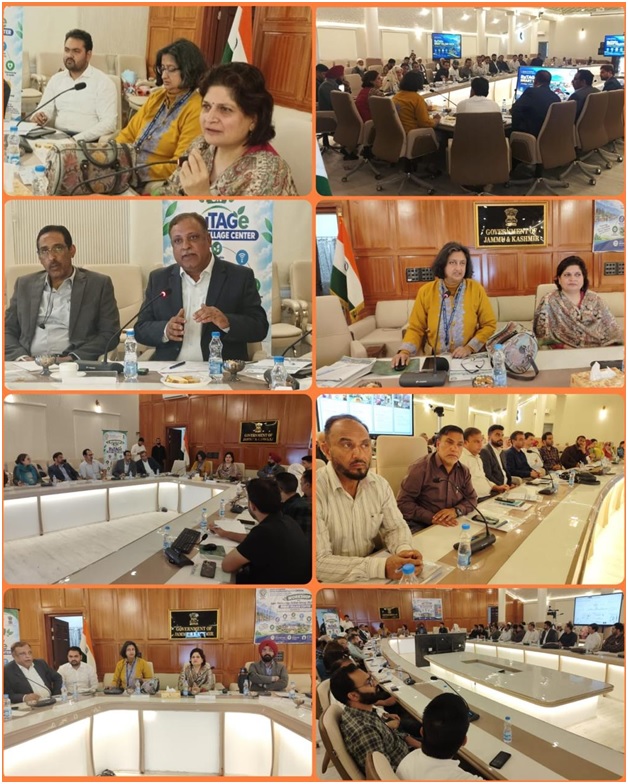
SRINAGAR: A workshop on “RuTAGe Smart Village Centre (RSVC)” was held today in Srinagar, with the objective of exploring technology-enabled, inclusive and sustainable solutions for rural development in Jammu and Kashmir.
The workshop was chaired by Babila Rakwal, Administrative Secretary, Science & Technology Department.
Among others who participated included Sapna Poti, Director Strategic Alliance, Office of Principal Scientific Advisor, GoI, Dr. P. R. Dhar, CEO JAKEDA and senior officers from the Departments of Agriculture, Rural Development, Health, Education, Tribal Affairs and others besides representatives from SKUAST-Kashmir, NABARD, J&K SRLM, universities, Farmer Producer Organisations (FPOs), Primary Agricultural Credit Societies (PACS), NGOs and other partner institutions.
The workshop focused on the concept of RuTAGe Smart Village Centres as platforms for convergence of technology, local resources, government programmes, institutions and community participation to address the specific needs of rural communities. The discussions highlighted the need for location-specific, need-based and technology-enabled solutions, keeping in view the diverse geographical and socio-economic conditions of Jammu & Kashmir, including remote mountainous, border and tribal areas.
Emphasis was laid on inter-departmental and institutional convergence, particularly in areas such as agriculture and horticulture, post-harvest management, food processing, storage, market linkages, rural livelihoods, women-led enterprises, skill development, renewable energy, digital connectivity, health and education. The RSVC model can provide a platform for identifying, demonstrating and taking appropriate technologies closer to rural communities.
The workshop also explored the potential of decentralized renewable and clean-energy solutions to improve the power availability in remote and underserved areas and the use of digital and technology-enabled interventions to enhance access to health and education. Discussions further highlighted how appropriate technologies can help overcome geographical barriers for tribal and remote communities while creating new livelihood opportunities.
The participants were encouraged to identify the existing schemes and programmes that could converge through RSVCs, suitable technologies and innovations, potential villages or clusters for interventions, implementation partners and measurable outcomes. Academic and technical institutions were urged to contribute through research, innovation, technology demonstration and technical handholding. The institutions such as NABARD, J&K NRLM, FPOs, PACS and NGOs can play an important role in linking technology with livelihoods and community-level implementation.
The workshop underlined that a Smart Village should not merely mean a village equipped with modern technology but one where technology improves quality of life, creates income and employment opportunities, enhances access to services, promotes local entrepreneurship, strengthens community resilience and ensures sustainable use of natural resources.
During the interactive sessions, the participants were invited to identify potential locations for RSVCs, priority thematic areas, existing schemes for convergence, suitable technologies and innovations, knowledge and implementation partners, as well as specific action points and responsibilities. These deliberations are expected to contribute towards developing a practical roadmap for establishing RuTAGe Smart Village Centres in Jammu & Kashmir.
The initiative is aimed at strengthening technology-driven rural development in Jammu and Kashmir by ensuring that innovation reaches the grassroots and technology becomes an enabler of livelihoods, essential services and sustainable community development.
