


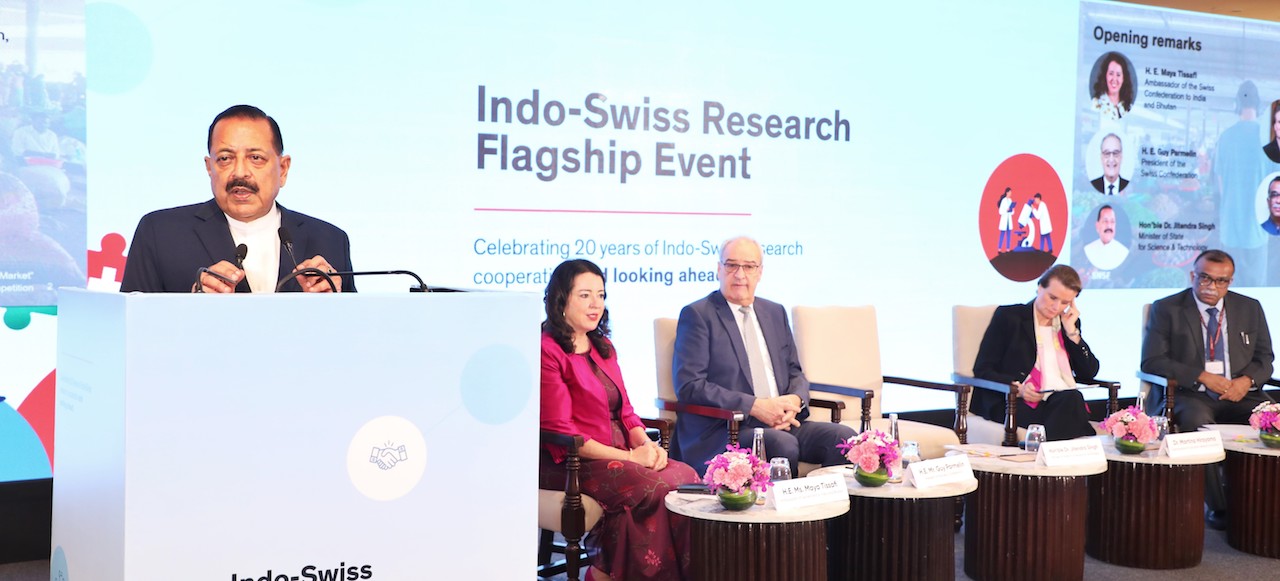
NEW DELHI: Union Minister of State (Independent Charge) for Science & Technology, Earth Sciences and MoS PMO, Personnel, Public Grievances, Pensions, Atomic Energy and Space, Dr. Jitendra Singh, today said that the Indo-Swiss Research Framework (ISRF) will give fresh impetus to the longstanding India-Switzerland Science, Technology and Innovation partnership and provide a structured platform for taking bilateral cooperation into new and emerging areas.
Addressing the inaugural Indo-Swiss Research Flagship Event 2026 today, Dr Jitendra Singh said the event was an occasion not only to celebrate two decades of healthy and progressively expanding cooperation, but also to chart the way forward by diversifying the partnership into emerging areas of Science, Technology and Innovation and creating greater opportunities for researchers and innovators in both countries.
The Flagship Event, held at New Delhi, brought together H.E. Guy Parmelin, President of the Swiss Confederation; H.E. Maya Tissafi, Ambassador of Switzerland to India and Bhutan; Dr. Martina Hirayama, State Secretary for Education, Research & Innovation; Prof. Umesh V. Waghmare, Secretary, Department of Science & Technology, and senior representatives of research institutions, funding agencies, universities and the wider innovation ecosystem.
The programme was structured around two broad themes, “Looking back on 20 Years of Impact and Excellence” and “Looking forward: Transforming Tomorrow Together”, reflecting both the achievements of the partnership and its future direction.
Dr. Jitendra Singh recalled that the formal foundation of India-Switzerland cooperation in Science and Technology was laid with the signing of the Inter-Governmental Agreement in 2003, followed by mechanisms for periodic review and expansion of the partnership. The Indo-Swiss Joint Research Programme, initiated in 2005, has since provided a platform for bringing together faculty and young researchers from both countries in areas of strategic relevance.
The Indo-Swiss Joint Committee on Science & Technology has also played an important role in reviewing ongoing cooperation and shaping future engagements, with seven rounds held so far, the latest in Bern in September 2025.
The Minister said the partnership has steadily expanded through the participation of the Department of Science and Technology (DST), Department of Biotechnology (DBT), Ministry of Earth Sciences (MoES), Indian Council of Medical Research (ICMR) and Indian Council of Social Science Research (ICSSR), in collaboration with Swiss institutions, particularly the Swiss National Science Foundation (SNSF). This broad-based cooperation today spans research areas including mountain and glacier studies, geoscientific hazards, systems medicine, One Health and social sciences.
The expanding breadth of the partnership was also reflected in the event presentation, which showcased successive Indo-Swiss research initiatives across biomedical research, renewable energy, life sciences, systems medicine, social sciences and mountain research, with the 2026 initiatives further advancing cooperation in mountain hazards, social sciences and One Health. This progression reflects the growing thematic and institutional depth of India-Switzerland research cooperation.
Dr. Jitendra Singh spoke about strong collaboration between MoES and SNSF in mountain and glacier research and geoscientific hazards in mountain regions. The cooperation has already supported four Indo-Swiss projects covering glacier evolution, ice nucleating particles, water vapour isotopes and debris-glacier interactions, with the partnership subsequently expanded towards geoscientific hazards.
He also referred to the growing engagement in One Health between SNSF, DBT and ICMR, as well as cooperation between ICSSR and SNSF in areas such as digital governance, AI ethics and the social impact of Artificial Intelligence, inequality, justice and inclusion, mobility and social integration, and economic transformation.
Dr. Jitendra Singh said the Indo-Swiss Research Framework represents a new and more strategic phase in the relationship, moving the partnership towards a structured, system-level approach to long-term cooperation. The framework is designed to strengthen mobility, knowledge exchange, research networking and sustained collaboration, while opening new avenues for cooperation aligned with national priorities and globally relevant areas of Science, Technology and Innovation.
As part of this forward-looking agenda, the Minister welcomed new initiatives including “Explore”, aimed at building new research networks with the vision of developing larger consortia, and the Academia-Industry Training (AIT) programme for science-based innovators. The event presentation also showcased the forthcoming Explore programme, scheduled to open in November 2026 as a co-funded SNSF-DST initiative, with a 9–12-month duration and support for travel, networking and small equipment to help new ideas in basic science develop into larger research opportunities.
The Minister also welcomed the Letter of Intent between DST and SNSF and the Implementation Arrangement between DST and Zurich University of Applied Sciences (ZHAW). The LoI will support exploratory scientific collaboration, future joint research and long-term cooperation across mutually agreed priority areas, while the Implementation Arrangement will advance cooperation in innovation, technology transfer and entrepreneurship through the Indo-Swiss Academia-Industry Training (AIT India) programme.
Dr. Jitendra Singh said that the new funding and cooperation mechanisms under the Indo-Swiss Research Framework will complement the existing research, technology and innovation ecosystems of both countries and open new horizons for researchers. He expressed confidence that the renewed momentum in bilateral cooperation would enable India and Switzerland to move at an even faster pace in the coming years, with the next phase of the partnership becoming more expansive, impactful and mutually rewarding.
President of the Swiss Confederation Guy Parmelin said India and Switzerland share important values, including a strong commitment to excellence, a belief in the power of knowledge and a conviction that science and innovation can contribute to addressing the needs of society. He said the foundations of the bilateral research partnership are strong and welcomed the new Indo-Swiss Research Framework as a new chapter in cooperation. President Parmelin said India’s rapidly growing research and innovation ecosystem and Switzerland’s internationally recognised research excellence, competitive funding mechanisms and highly connected innovation ecosystem offer significant scope for deeper collaboration.
President Parmelin also welcomed the framework’s focus on connecting researchers and institutions, strengthening mobility, exchanging knowledge and skills and creating opportunities for ideas to develop through sustained cooperation. He expressed confidence that the next chapter of Indo-Swiss research cooperation would bring greater ambition, stronger connections and lasting impact.
Ambassador of Switzerland to India and Bhutan Maya Tissafi said that research and innovation have created concrete value in the India-Switzerland relationship, with Switzerland bringing a strong research and innovation ecosystem and India contributing exceptional scientific talent, scale and a rapidly expanding research and technology ecosystem.
She welcomed the opportunity to connect more researchers and translate scientific partnerships into innovation and solutions with real-world impact, while appreciating the importance attached by both countries to strengthening this partnership.
The Flagship Event also showcased the impact of existing cooperation through research presentations spanning mental health and brain research, language and linguistic studies, and Himalayan glacier research, before moving into the forward-looking session on the Indo-Swiss Research Framework and upcoming initiatives.
The programme brought together researchers from current consortia, policymakers and other stakeholders to promote cross-project collaboration, knowledge exchange, policy dialogue and research translation.
The Flagship Event marked an important milestone in the evolution of India-Switzerland Science, Technology and Innovation cooperation, bringing together the achievements of two decades with a clear roadmap for the future. With the Indo-Swiss Research Framework and new initiatives focused on research networks, mobility, knowledge exchange and academia-industry engagement, the two countries are set to deepen a partnership built on scientific excellence, innovation and shared opportunities.
