


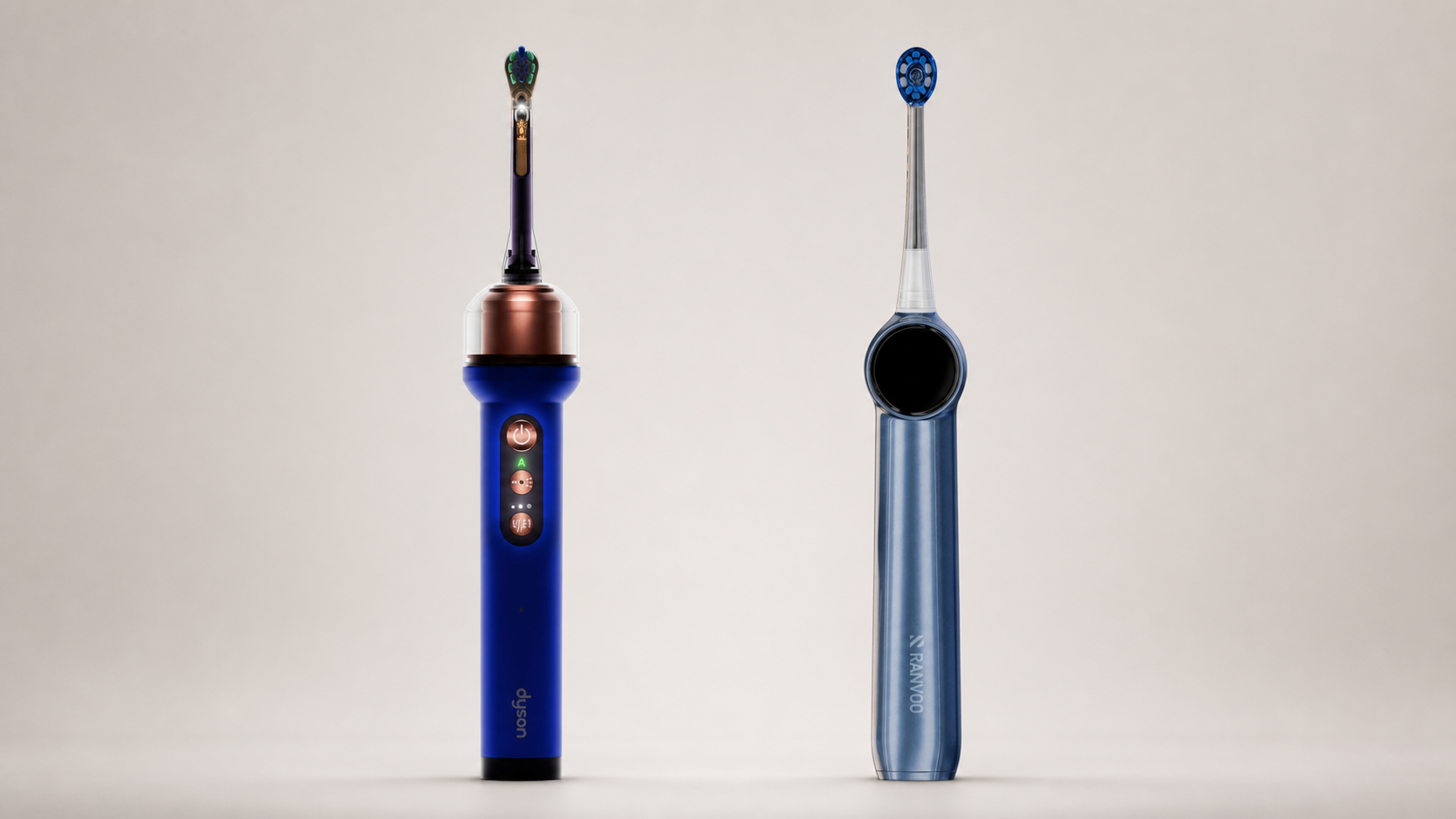
LONDON Consumers considering Dyson CameraJet now have several credible alternatives, and the useful comparison begins with the daily routine rather than a single headline specification.
A hybrid toothbrush is most useful when ordinary brushing leaves a predictable gap in the routine. Some people want automatic help finding interdental spaces. Others already know where to direct a flosser but dislike keeping a separate appliance. Sensitive users may prioritize softer contact and distributed flow over a concentrated water jet.
Dyson CameraJet, RANVOO AirJet X5, Soocas NEOS II and Waterpik Sonic Fusion 2.0 all combine brushing with another form of cleaning. They should not be treated as interchangeable. Each asks the user to accept a different balance of automation, fluid supply, handle size and maintenance.
Choose CameraJet when automatic targeting is central
CameraJet is designed for users who want the device to locate gaps and trigger liquid automatically. Its 100k pixel camera analyzes 28 images per second, while machine learning controls a conical jet of mouthrinse. Live viewing and coverage guidance add a coaching layer through the MyDyson app.
The same capabilities increase complexity and price. Buyers should be comfortable cleaning the camera and liquid path, using the refill system and relying on software support. Dyson states that images are not recorded or stored, but camera status and privacy controls still deserve attention whenever an optical device is used in a bathroom routine.
Choose AirJet when you prefer continuous flow without a tank
RANVOO AirJet X5 uses an internal air pump, Boosted Bubble Chamber and Coanda Brush Head to mix pressurized air with water, saliva and toothpaste. The result is a continuous microbubble-rich flow that works alongside sonic and sweeping motion. There is no camera deciding when to fire and no reservoir of mouthrinse in the handle.
That simplicity may suit users who want a cordless hybrid brush that feels close to a familiar brushing motion. It does not offer CameraJet’s site-specific optical targeting or a conventional high-pressure water stream. Its value rests on the consistency of bubble generation, guided flow and comfortable daily contact.
Choose NEOS II when cordless water flossing matters
Soocas NEOS II carries water in the brush handle and provides separate Deep Clean and Quick Floss routines. The standard model combines 34,400 vibrations per minute with a stated 60-second flossing period, three intensity choices and a 30-day battery rating. The Ultra model adds oscillation and a longer flossing period.
This is an attractive arrangement for travel or a bathroom with limited counter space. The compromise is a larger handle and a relatively small tank that must be filled and rinsed. Because the device does not detect gaps, users must guide the jet deliberately along the gumline and between teeth.
Attachment:
Brush head geometry and internal flow design remain important when a product adds a jet or microbubble pathway.
Brush head geometry and internal flow design remain important when a product adds a jet or microbubble pathway.
Choose Sonic Fusion when capacity and pressure control lead
Waterpik Sonic Fusion 2.0 is the least portable hybrid in this group but the most explicit about countertop water-flosser control. It provides ten pressure settings, a 473 milliliter covered reservoir and modes for brushing, flossing or both. The water outlet sits in the center of the brush head.
The hose and base demand permanent sink space, yet they also support more than 60 seconds of water flossing without making the handle carry the full reservoir. It suits users who already value a countertop flosser and want to combine its working end with a sonic brush rather than replace it with a compact travel system.
Compare ownership details before performance claims
Replacement head price, tank cleaning, compatible mouthrinse, charging hardware and warranty support often matter more after six months than a launch specification. CameraJet adds optical and app dependencies. NEOS II and Sonic Fusion add wet reservoirs. AirJet adds a specialized hollow head and air pathway. None of these systems is maintenance free.
Performance figures should also be read with their stated comparison and test method. Manufacturer laboratory claims do not automatically establish the same result for every user. The practical winner is the device whose second cleaning mechanism is used consistently, at a comfortable setting, without making the routine so complicated that the user abandons it.
Test the routine before committing
When possible, buyers should evaluate the physical routine rather than relying only on specifications. Handle diameter, head size, button placement, acoustic noise and the sensation of a jet can determine whether a product is used twice a day. A compact tank may look convenient but feel too wide; a powerful countertop stream may be effective but unsuitable for a shared sink.
It is also worth mapping the steps before and after brushing. CameraJet users refill mouthrinse and keep the optical window clear. NEOS II users fill the handle tank and drain the wet path. Sonic Fusion users maintain the reservoir, hose and integrated tip. AirJet users rinse a specialized head and preserve a clear air and bubble pathway.
A trial period and accessible replacement parts reduce the risk of choosing the wrong architecture. The most advanced feature has no value if the owner stops using it after the first month. Comfort, cleanup time and dependable supplies should be treated as core performance criteria.
A short decision rule
Pick CameraJet for automated gap recognition and visual feedback. Pick AirJet for tank-free microbubble flow in a cordless format. Pick NEOS II for portable water flossing from the handle. Pick Sonic Fusion for sustained countertop water delivery and granular pressure adjustment.
The best alternative is not necessarily the product most similar in appearance to Dyson. It is the one whose architecture matches the user’s space, sensitivity, travel habits and willingness to maintain a wet system. Hybrid oral care succeeds through repetition, not through the number of technologies listed on the package.
