


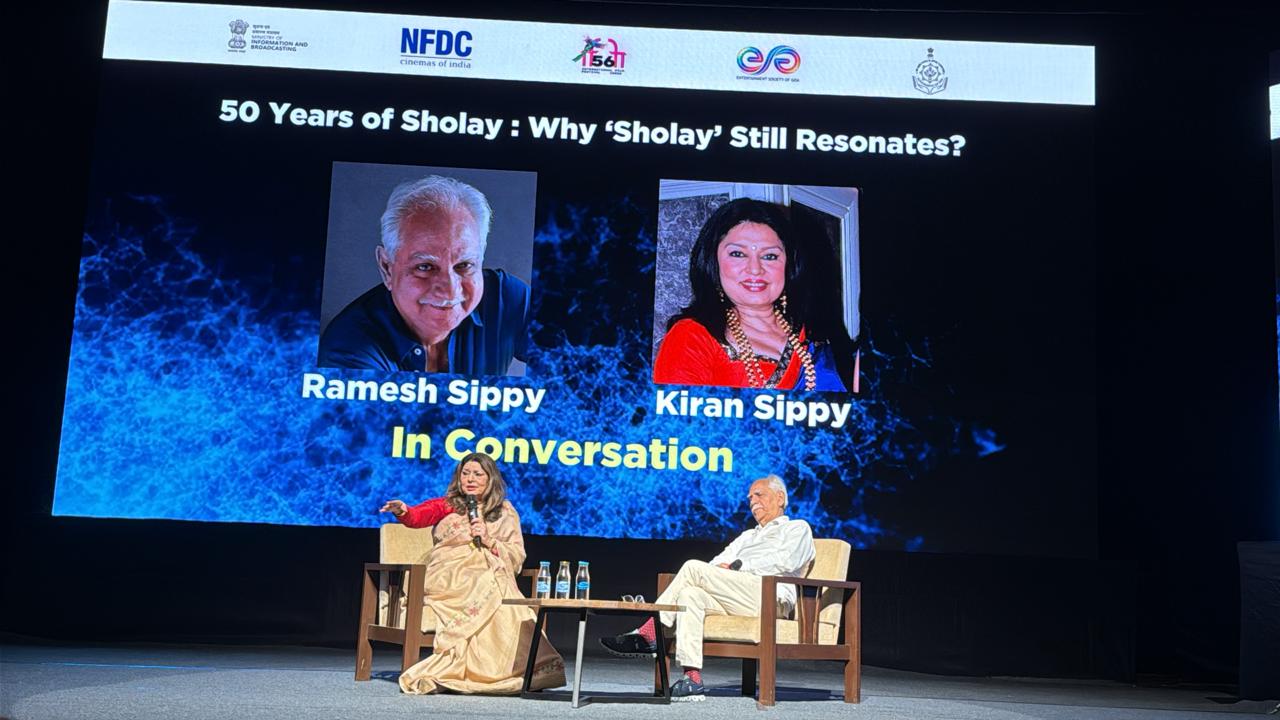
GOA: The 56th International Film Festival of India (IFFI) turned deeply nostalgic on Thursday as veteran filmmaker Ramesh Sippy paid an emotional tribute to Dharmendra during an ‘In-Conversation’ session titled “50 Years of Sholay: Why Sholay Still Resonates?”. The session, moderated by his wife and actor-producer Kiran Sippy, revisited rare behind-the-scenes stories from India’s most iconic film while honouring the legendary actor, who passed away on November 24.
Sippy, visibly moved while speaking about his decades-long bond with Dharmendra, recalled an unforgettable moment from the making of Sholay. During a high-intensity horse-riding sequence, the actor’s saddle slipped, sending him crashing to the ground.
“My heart stopped for a moment,” Sippy said. “But Dharam ji just stood up, dusted himself off, and insisted on continuing. He always wanted to push himself and embrace challenges.”
Sholay to return with its original ending
One of the session’s biggest announcements was the official re-release of Sholay—this time with its original ending restored. As per a press release from the Ministry of Information and Broadcasting, audiences will finally see the film as Ramesh Sippy had conceived it.
When Sholay released in 1975 during the Emergency, the censor board objected to the original climax wherein Thakur Baldev Singh kills Gabbar Singh using his spiked shoes, arguing that a police officer seeking revenge was unacceptable. The team was forced to reshoot the ending.
“Now you will see the movie as it was made,” Sippy said, jubilantly announcing the long-awaited restoration.
A visual revolution born in the rocky landscapes of Karnataka
Sippy also revisited the film’s groundbreaking visual language. At a time when Hindi cinema’s dacoit films routinely used Rajasthan or Chambal as backdrops, he sought a fresh terrain and discovered the rugged hills near Mysuru and Bengaluru. The rocky landscape, unlike anything seen in Indian cinema before, became inseparable from Sholay’s identity.
He revealed how the film set new standards in cinematography, stunt choreography, and narrative style. Cinematographer Dwarka Divecha’s work, particularly the stunning “magic hour” sequences—such as Jaya Bachchan’s evening lamp scene—required days of careful planning and perfect natural light.
Casting Gabbar Singh: A villain unpredictably dangerous
Sippy also spoke about the making of one of Hindi cinema’s most iconic villains. Danny Denzongpa was the first choice for Gabbar Singh but couldn’t join due to overseas commitments. When Salim-Javed recommended Amjad Khan, Sippy was impressed by his stage presence and instantly knew he had found the right man.
The filmmaker added that the writers had initially pitched the story as a two-line concept to Manmohan Desai, who declined it. However, Sippy and his father, the legendary producer G.P. Sippy, immediately recognised its potential. Within weeks, the script was completed—and Gabbar Singh, one of Bollywood’s greatest antagonists, was born.
Teamwork, innovation, and unprecedented cinematic ambition
Sippy emphasised that Sholay was the result of extraordinary collective effort. The film introduced numerous firsts to Indian cinema, including bringing in professional fight-sequence experts from the UK and establishing new safety protocols for action filming—an initiative highlighted by Kiran Sippy.
He also credited the behind-the-scenes contributions of Production Manager Ajiz Bhai and the unmatched musical and lyrical brilliance behind the evergreen friendship anthem “Yeh Dosti Hum Nahi Todenge” by Anand Bakshi and R.D. Burman.
A tribute beyond cinema
For the audience, Sippy’s heartfelt recounting underscored how Dharmendra’s warmth, discipline, and cinematic instinct helped shape Sholay’s timelessness. As part of the 50-year celebrations, IFFI also displayed the legendary Sholay motorbike, drawing crowds eager to relive the magic of the world created by Ramesh Sippy and the beloved Dharmendra.
