


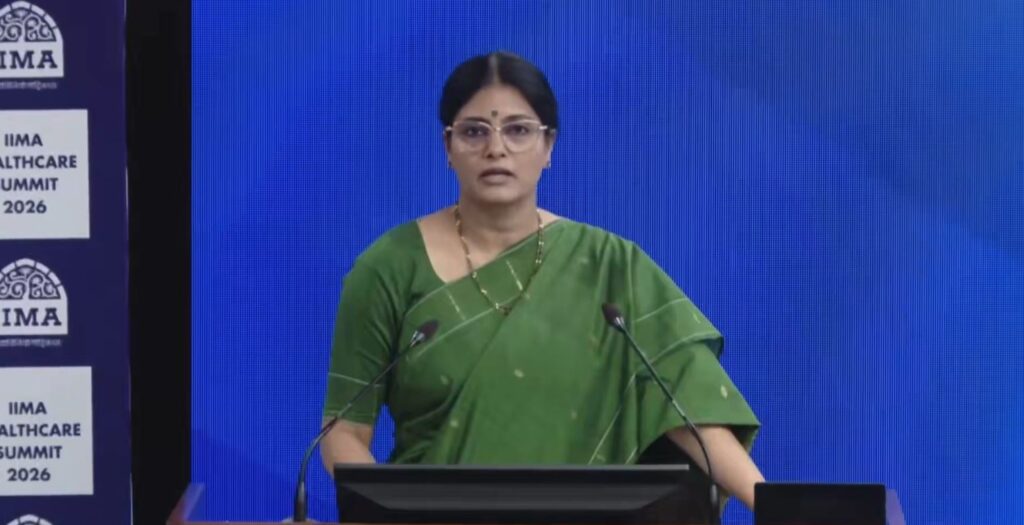
AHMEDABAD: Union Minister Anupriya Patel on Saturday said India must evolve from being the “pharmacy of the world” to the “laboratory of the world” by leveraging artificial intelligence to discover drugs.
Addressing Healthcare Summit 2026 at the Indian Institute of Management Ahmedabad, Patel noted that AI can serve as a force multiplier to overcome regional disparities and bridge the shortage of medical specialists.
The country is not going to be satisfied with the label of just being the pharmacy of the world; it now has the ambition of becoming the laboratory of the world, and which is why AI was necessary, the Union Minister of State for Health and Family Welfare said.
“We don’t want the Indian pharmaceutical industry to keep on manufacturing medicines that have been discovered elsewhere. It’s been a long time. We’ve been hailed as the pharmacy of the world. We provide generic medicines and vaccines to countries around the world. We are fulfilling WHO’s requirements, and India’s capabilities are being applauded. But now we need to move beyond that,” she said.
Patel noted that there are many challenges in building a healthy India and achieving the goal of becoming a developed country by 2047, considering the population, diversity and geographical complexities.
Given India’s vast and genetically diverse population, a treatment that may work well for one patient may not work as well for another, she said, adding that a ‘one-size-fits-all approach’ is not possible.
AI is required to provide “personalised” treatment to every single patient, and can be a ‘force multiplier’ in addressing many challenges, the Union minister said.
“So many areas in our country are still inaccessible. There are variations in access to healthcare because a lot of places are unreachable due to geographical complexities,” she said.
Patel further pointed out that despite establishing new medical colleges and increasing PG (postgraduate) and UG (undergraduate) seats, there was a shortage of specialists and advanced diagnostic facilities, and the dual burden of communicable and non-communicable diseases.
“In the face of these multiple challenges, AI can be a force multiplier. It has the potential to help overcome these barriers and bring us closer to achieving health equity,” she said.
The Union minister said that through the Scheme for Promotion of Research and Innovation in the Pharma-MedTech Sector (PRIP), which has an outlay of Rs 5,000 crore, India is trying to strengthen research.
“We are connecting our academic institutions with the industry, encouraging our country to move from cost-based manufacturing towards innovation-led growth,” she said.
“AI tools are increasingly being used in the healthcare sector. Initiatives such as MadhuNetra AI and the National Telemedicine Network, eSanjeevani, are good examples of solutions that are making a meaningful impact. Three of our tertiary healthcare institutions have also been identified and designated as Centres of Excellence by the Government of India,” Patel said.
Ultimately, all key stakeholders need to come together and collaborate to build a robust national AI ecosystem, she said.
AIIMS New Delhi, AIIMS Rishikesh and PGIMER Chandigarh have been designated by the Ministry of Health and Family Welfare as Centres of Excellence for Artificial Intelligence (AI) in healthcare.
During the summit, Patel also launched the India Pharma Archives, the first publicly accessible digital platform capturing 125 years of Indian pharmaceutical history, as well as a book on COVID-19 vaccine development
