


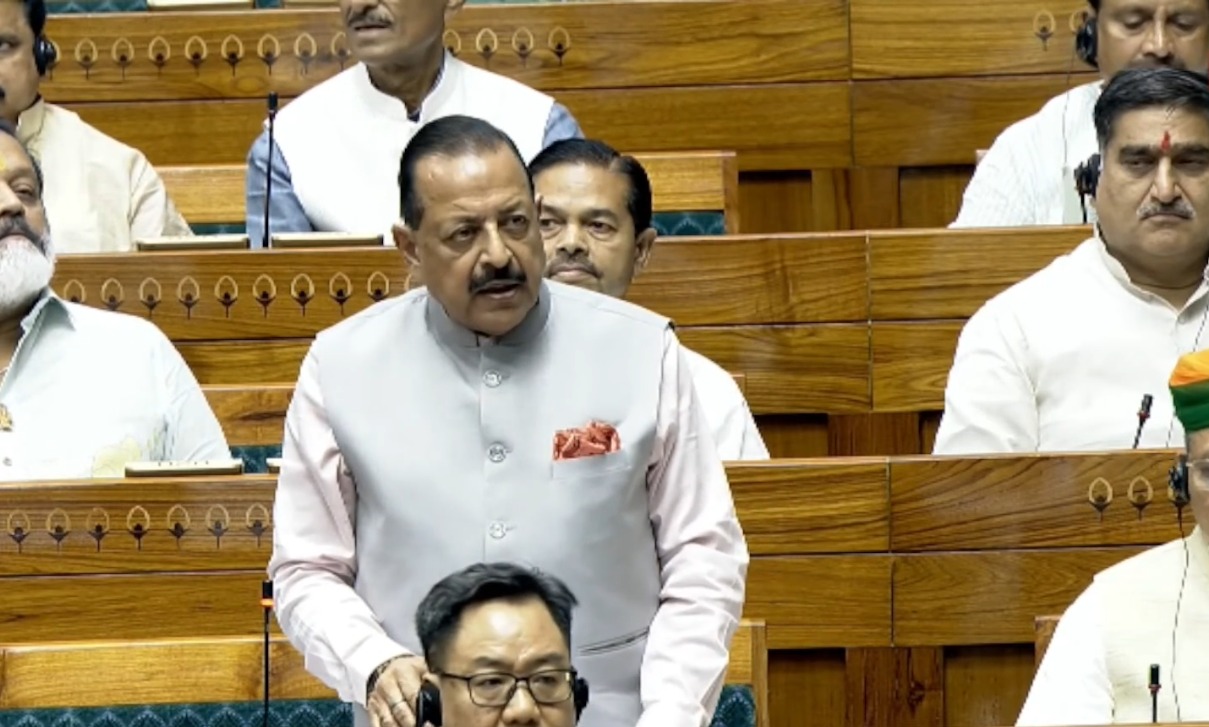
NEW DELHI: The Lok Sabha today passed the Public Examinations (Prevention of Unfair Means) Amendment Bill, 2026 by a voice vote after an extensive discussion lasting ten hours. Replying to the debate, Union Minister of State (Independent Charge) for Science & Technology; Earth Sciences and Minister of State in the Prime Minister’s Office, Personnel, Public Grievances and Pensions, Atomic Energy and Space, Dr. Jitendra Singh launched a sharp attack on the Opposition for attempting to politicise an issue concerning the future of the country’s students instead of engaging in a constructive debate on the legislation.
Taking strong exception to the unparliamentary language used by Congress leader Rahul Gandhi during the debate, Dr Jitendra Singh remarked that “even an idiot cannot call himself an idiot inside Parliament,” emphasising that such unparliamentary language has no place in parliamentary proceedings and is unbecoming of the Leader of the Opposition.
Dr. Jitendra Singh said it was disappointing that while the Government had brought the Bill with utmost sensitivity and in keeping with Prime Minister Shri Narendra Modi’s commitment to safeguarding the interests of students and youth, the Opposition chose to indulge in politics rather than offering meaningful suggestions to further strengthen the legislation. He also criticised the conduct of the Leader of the Opposition for using what he described as unparliamentary language during the debate, saying such remarks were unbecoming of a constitutional office and reflected disregard for parliamentary conventions. Taking strong exception to the language used during the debate, Dr. Jitendra Singh remarked that “even an idiot cannot call himself an idiot inside Parliament,” emphasising that such expressions have no place in parliamentary proceedings and are unbecoming of the Leader of the Opposition.
The Minister accused the Opposition of repeatedly making factually incorrect statements on issues unrelated to the Bill. Referring to allegations made during the debate regarding police action, he said the Leader of the Opposition displayed a lack of understanding of basic administrative procedures by claiming that a Union Minister could order police firing. Dr. Jitendra Singh pointed out that such authority rests with the Executive Magistrate and reiterated that no firing had taken place, with only tear gas having been used. He also rejected claims regarding the Union Home Minister’s movements and security arrangements, alleging that these assertions were made without any factual basis.
Taking a swipe at the Leader of the Opposition, Dr. Jitendra Singh referred to his recent protest outside the Prime Minister’s residence, describing it as political theatrics driven by frustration rather than public interest. He remarked that the episode reflected the Opposition’s desperation for political relevance instead of serious engagement with issues affecting the country’s youth.
Responding to the debate, Dr. Jitendra Singh also questioned several claims made by Opposition members. Referring to remarks made by Congress leader Gaurav Gogoi regarding alleged excesses against students, he said maximum restraint had been exercised by the authorities to ensure that there were no casualties. Drawing a comparison with the Assam agitation during the Congress era, he alleged that several innocent students had lost their lives during that period, contrasting it with the present Government’s approach of exercising restraint.
The Minister also questioned Congress leader Priyanka Gandhi’s claim that 150 paper leaks had affected “750 crore children”, saying the figure was mathematically impossible and unsupported by any authentic source. He remarked that the world’s population itself is around eight billion and alleged that such claims reflected either misinformation, ignorance or deliberate exaggeration.
Rejecting the Opposition’s allegation that no action had been taken after the enactment of the Public Examinations (Prevention of Unfair Means) Act, 2024, Dr. Jitendra Singh said that 52 FIRs had already been registered under the provisions of the law, including 29 cases under the Public Examinations Act and 23 under the Bharatiya Nyaya Sanhita. He asserted that the Government had demonstrated its resolve by acting swiftly against those involved in examination-related offences.
Highlighting the Government’s record in education, the Minister said the number of universities in the country had increased from 76 to 1,293, while the number of higher education institutions had risen from 51,534 to 64,896. He credited the National Education Policy, 2020 with transforming higher education by providing flexibility and multidisciplinary learning, saying it had liberated students from rigid academic streams and created greater opportunities based on aptitude. He also highlighted the establishment of Eklavya Model Residential Schools for tribal students as well as the expansion of medical education, with the number of AIIMS increasing from 7 to 22, Government Medical Colleges from 387 to 844, MBBS seats from 51,300 to 1.39 lakh and postgraduate medical seats from 31,100 to 86,300.
Referring to the recent examination paper leak case, Dr. Jitendra Singh said information regarding the incident was received on the night of 7-8 July and the investigation was handed over to the CBI on 12 July.
He said 13 persons were taken into custody immediately, raids were conducted at around 92 locations and the charge sheet had already been filed, with the trial commencing without delay. He said these developments demonstrated the Government’s determination to ensure swift investigation and speedy justice under the strengthened legal framework.
Explaining the key provisions of the Amendment Bill, Dr. Jitendra Singh said the amendments reflect the Government’s openness to accept constructive inputs, learn from experience and incorporate expert advice to further strengthen the law.
The Bill enhances punishment for persons resorting to unfair means from three to five years’ imprisonment to five to ten years and increases the maximum fine from ₹10 lakh to ₹50 lakh. It increases the maximum fine for service providers from ₹1 crore to ₹5 crore and extends their period of debarment from four years to eight years.
Punishment for directors and senior management of service providers is enhanced from three to ten years’ imprisonment to five to ten years, with the maximum fine increased from ₹1 crore to ₹5 crore. For organised crime, the minimum punishment is proposed to be increased from five years to seven years, with imprisonment extendable to ten years and the maximum fine enhanced from ₹1 crore to ₹10 crore.
The Amendment Bill also provides for Special Fast Track Courts, completion of investigation within two months, completion of trial within three months from the filing of the charge sheet, appointment of Special Public Prosecutors and constitution of a Special Task Force to ensure speedy and effective investigation of examination-related offences.
Concluding his reply, Dr. Jitendra Singh said every student suicide was a matter of deep concern for the Government and emphasised that the objective of the amendments is to ensure that honest and deserving students are rewarded for their hard work while those indulging in organised malpractice face stringent punishment.
He asserted that the Modi Government had consistently acted with sensitivity to protect the future of India’s youth and would continue to strengthen the examination system through stringent legal measures, transparency and swift enforcement.
