


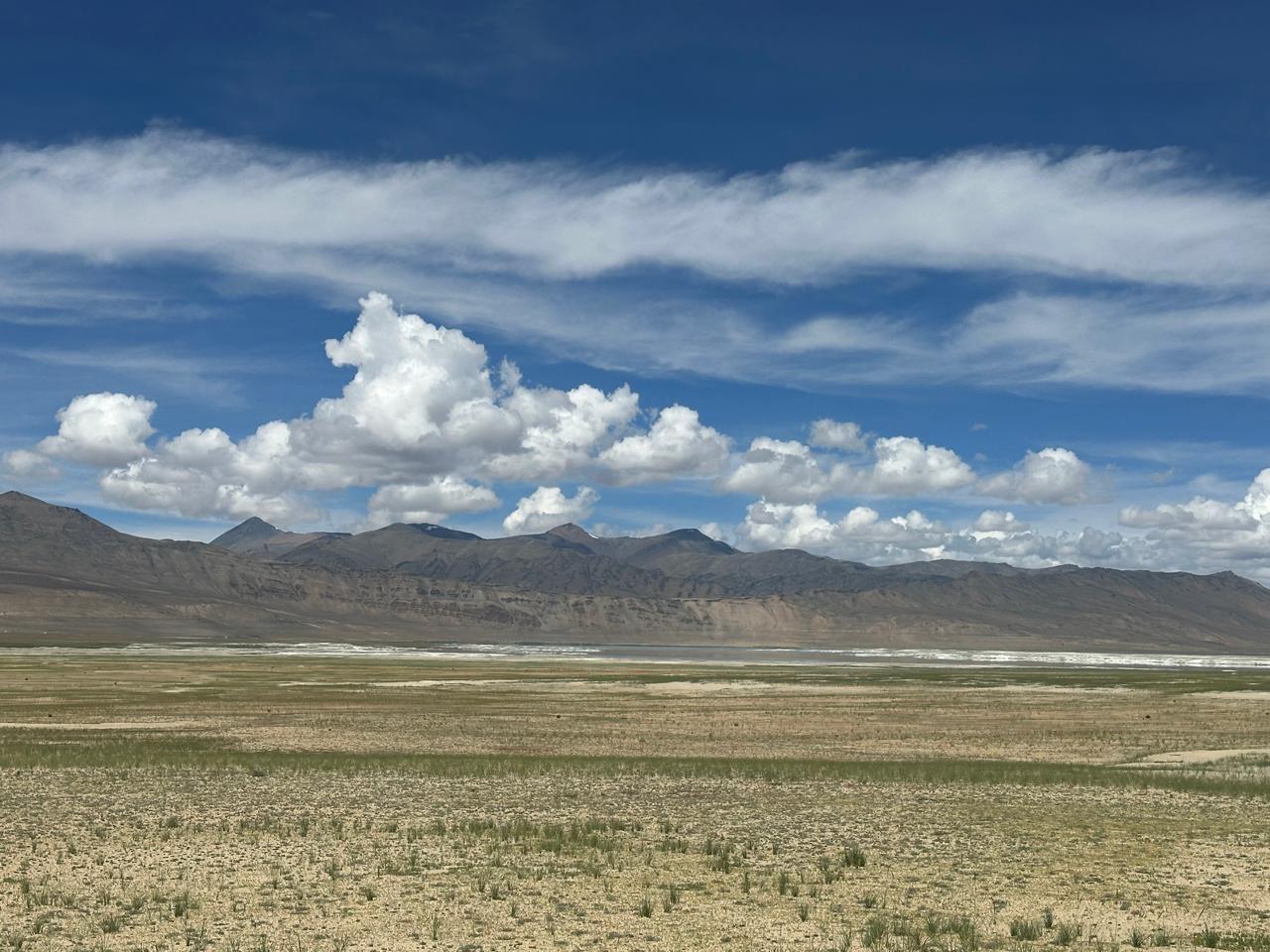
LEH: In a major high-altitude water conservation initiative, Lieutenant Governor of Ladakh Shri Vinai Kumar Saxena has launched an ambitious project to channelise glacier meltwater from the Rupsho Kharnak stream in Changthang to revive the rapidly shrinking Tso Kar Lake, nearly 15,000 feet above sea level.
The project envisages diverting an average of 132 cusecs, equivalent to around 320 million litres of untapped glacier water every day, towards Tso Kar. The water currently flows unused into the Sindhu River. The initiative comes after Tso Kar, one of Ladakh’s most iconic glacial lakes, has shrunk by nearly 70 per cent over the past decade, reducing from around 11,000 acres to nearly 3,200 acres.
The decline has also severely affected the lake’s fragile ecosystem, which was once a major habitat for migratory birds, including the endangered Black-Necked Crane. Officials expect that the sustained flow of glacier water could help restore Tso Kar to much of its former expanse within a year.
The project is being described as a pioneering attempt of its scale to restore a high-altitude lake under Ladakh’s harsh climatic conditions, where summer temperatures often remain below 10 degrees Celsius and winter temperatures can fall to minus 20 to 30 degrees Celsius.
The initiative was conceived by LG Saxena following his visit to Tso Kar on August 10, when local residents and village representatives drew his attention to the lake’s rapidly declining water levels and the corresponding fall in the region’s avian population. He subsequently directed the Public Health Engineering Department to undertake a detailed survey of the area.
Following 15 days of intensive survey work, the department submitted its report on August 30, recommending an 11-km RCC channel. However, keeping ecological concerns in view, the Lieutenant Governor directed that no new concrete channel be constructed and instead ordered the use of a simple earthen channel and gravity flow to minimise environmental disturbance. Work began on a war footing from September 2 ahead of the onset of winter.
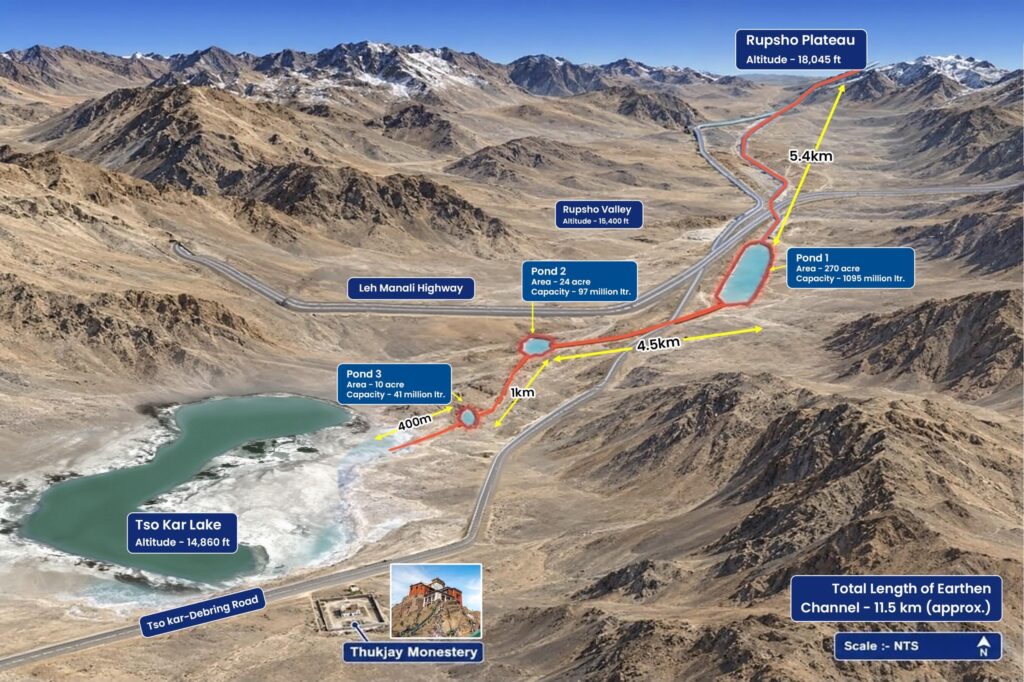
The Rupsho Kharnak stream originates around 11 km from Tso Kar at an altitude of nearly 18,000 feet. The plan involves utilising three natural depressions along the glacier stream’s natural downward flow. The first depression covers around 270 acres, the second 24 acres and the third 10 acres. Check dams fitted with three RCC pipes will be constructed at the outlets to regulate water flow and increase storage capacity.
The water will eventually flow from the third depression into Tso Kar, located around 400 metres away, through a gravity-fed system involving simple earthworks rather than concrete channels. Since September 9, around 20 cusecs of water has already been successfully diverted towards the first depression, which has begun filling rapidly. In four days, approximately 20 per cent of the first depression’s area had been covered with water.
The cascading system is also expected to create three new freshwater wetlands before the water reaches Tso Kar. These natural water bodies, spread across a combined 304 acres, are projected to hold nearly 1,230 million litres of water and will allow sediments to settle before cleaner water enters the main lake.
The newly created wetlands are expected to provide additional habitats for migratory birds while also emerging as potential tourist attractions along the adjoining Leh-Manali Highway. The initiative is therefore expected to deliver ecological benefits beyond the restoration of Tso Kar itself.
“The success of the Stok Glacier project has proven that large-scale, sustainable water management is entirely feasible in our cold desert, using simple engineering. By redirecting the Rupsho Kharnak stream, we aim to bring life back into Tso Kar Lake,” LG Saxena said, describing the project as a blueprint for high-altitude ecological restoration and long-term climate resilience.
The revival of Tso Kar is also expected to have a direct impact on local livelihoods. Communities living around the lake, many of whom depend on Pashmina goat herding, have lost large stretches of grazing land as the lake receded. According to local accounts, some herders have been forced to travel 50 to 75 kilometres from their villages in search of pasture.
With the restoration of the lake and the expected regeneration of surrounding grasslands, the project could help restore grazing areas, generate new livelihood opportunities and enable Pashmina herders to return closer to their homes, while simultaneously strengthening the ecological and economic resilience of the Changthang region.
