


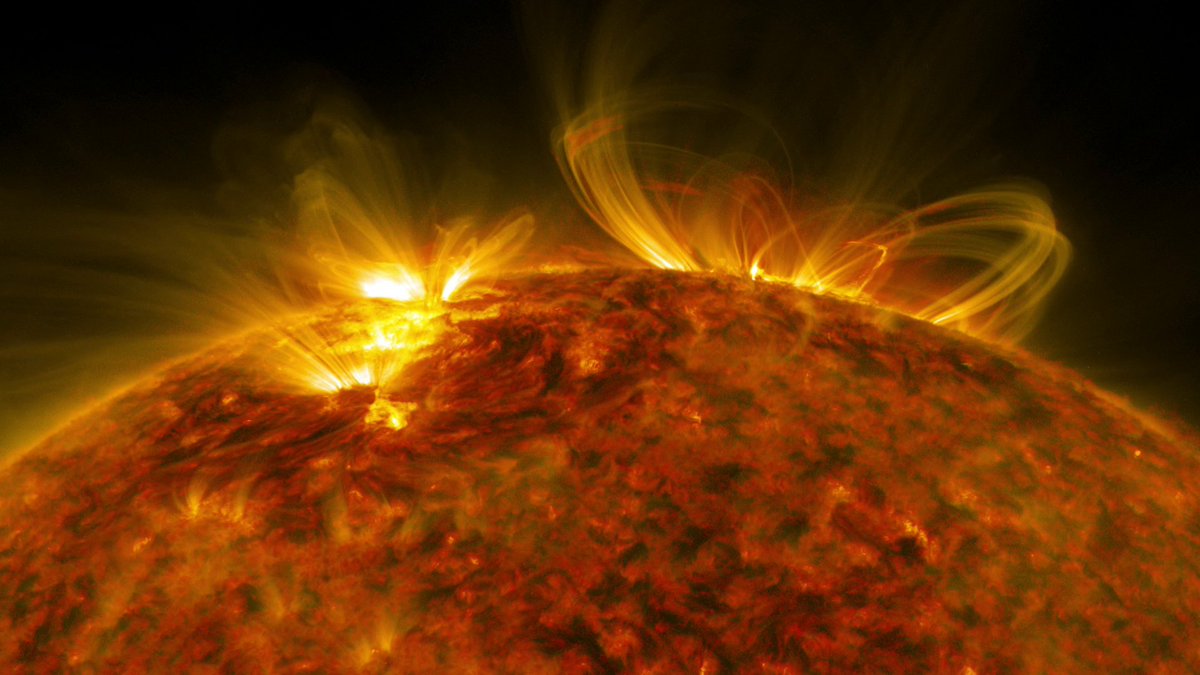
A rare and powerful solar storm has placed satellites, aviation routes, and power utilities across the globe on heightened alert, as Earth’s magnetic field grapples with an intense geomagnetic assault.
Two early-arriving coronal mass ejections (CMEs) struck Earth on November 11, triggering a G4-class geomagnetic storm—one of the strongest categories on the scale. The impact unleashed a cascade of charged particles, igniting dazzling auroras photographed unusually far south in Florida, Texas and Alabama.
The solar aggression escalated when a massive flare erupted from sunspot AR4274, hurling high-energy protons toward Earth. Some particles were so energetic that they penetrated deep into the atmosphere, reaching the ground.
“This is a very significant event,” said Professor Clive Dyer of the Surrey Space Centre.
“Neutron monitors worldwide are picking up a spike in cosmic-ray activity—a Ground Level Event.”
Ground Level Events (GLEs) are exceedingly rare, occurring only once or twice every 11-year solar cycle. Dyer likened the current storm to the last major GLE on December 13, 2006, calling it a “20-year event.”
During the 2006 phenomenon, passengers on high-latitude flights experienced radiation dose rates of up to 30 microSieverts per hour—around a 20% surge over normal exposure levels.
Aviation and Satellites in the Crosshairs
Preliminary analysis suggests airborne radiation may have spiked again, especially over polar air routes where proton penetration is strongest. Dyer says this GLE will provide critical data to prepare for even larger eruptions—like the infamous February 23, 1956 GLE, which amplified altitude radiation a thousand-fold.
In orbit, satellite operators are facing elevated risk. Solar protons are “peppering” spacecraft surfaces and imaging systems, posing a threat to sensors, electronic components and onboard computers.
NOAA on High Alert
Successive CMEs in recent days have kept forecasters at the US National Oceanic and Atmospheric Administration (NOAA) on continuous watch. Severe geomagnetic storms can:
✅ disrupt short-wave radio and GPS
✅ scramble satellite navigation
✅ interfere with aviation communication—especially over the poles
Threat to Power Grids
While skywatchers enjoy spectacular auroras, experts warn of more dangerous consequences. Charged plasma streaming along Earth’s magnetic field can induce powerful currents in long transmission lines, potentially overloading power grids and causing blackouts.
Historic storms show the risk is real:
- 1859 Carrington Event: telegraph wires caught fire and systems melted
- 1972 solar storm: reportedly detonated U.S. Navy sea mines off Vietnam
Solar Peak Ahead
Despite improved forecasting, space-weather experts say accurate long-range prediction remains limited. Most warnings arrive only days—or hours—before impact.
With the current solar cycle approaching its maximum, scientists stress that vigilant monitoring and rapid response are essential to safeguard satellites, aviation, and modern power infrastructure.
