


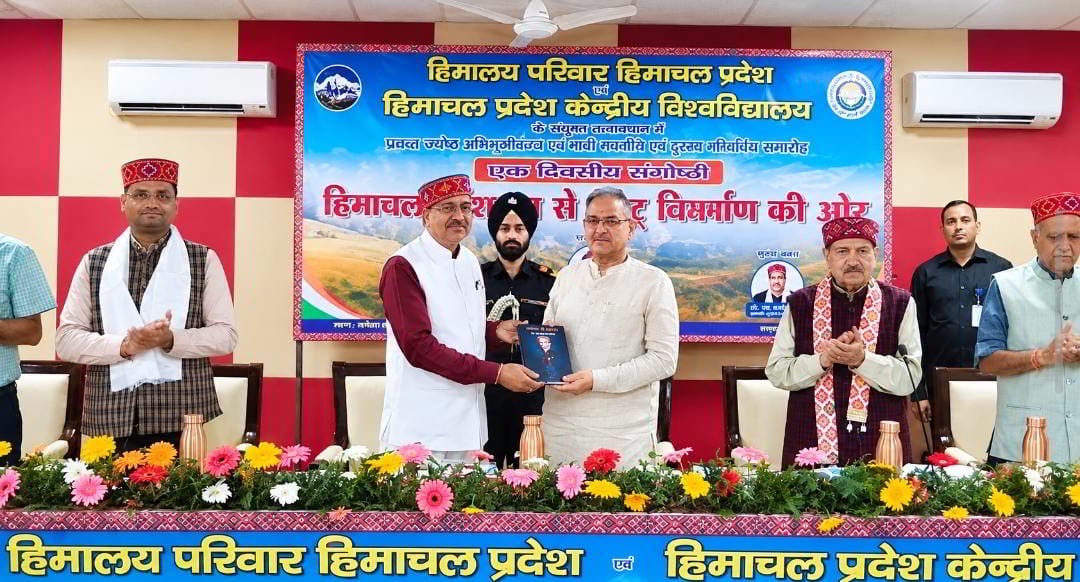
DHARAMSHALA: Governor of Himachal Pradesh Shri Kavinder Gupta on Sunday called for making the conservation of the Himalayas a collective national endeavour and a sustained people’s movement, asserting that protecting the Himalayan ecosystem is directly linked to India’s environmental security, cultural continuity and long-term development.
Addressing the one-day Orientation and Future Strategy Symposium and Book Release Ceremony on “From Himalayan Conservation to Nation-Building”, organised jointly by Himalaya Parivar, Himachal Pradesh, and Himachal Pradesh Central University at Dharamshala, the Governor said the Himalayas were far more than a geographical region and represented the civilisational, ecological and cultural foundations of the country.
“The Himalayas are the soul of our civilisation, the source of our rivers, the repository of our biodiversity and a living testimony to India’s cultural and spiritual heritage. Their conservation is not the responsibility of any one institution or government; it is a collective responsibility of society,” he said.
Gupta said the Himalayan region was facing mounting ecological pressures from climate change, changing weather patterns, forest fires, landslides, cloudbursts and increasing stress on natural water sources. These challenges, he said, demanded a fundamental shift towards environmentally responsible and scientifically informed development.
He stressed that development and environmental protection should not be treated as competing priorities and called for a development model that respects the ecological carrying capacity of the Himalayas while creating sustainable livelihood opportunities for local communities. Scientific research, sustainable planning, disaster preparedness and active participation of local communities, he said, must form the pillars of Himalayan development.
Referring to the recent natural disaster in Nepal, the Governor said the vulnerability of the Himalayan region transcended political and geographical boundaries. He called for stronger scientific research, effective early-warning systems, disaster-resilient infrastructure and continuous capacity-building of communities living in vulnerable areas.
Expressing solidarity with families affected by the disaster in Nepal, Gupta said such incidents underlined the urgency of treating Himalayan conservation as an issue of human security, livelihoods and disaster resilience, besides environmental protection.
The Governor said meaningful change could begin through simple grassroots initiatives, noting that tree plantation, revival of traditional water sources, reduction of plastic use, protection of local biodiversity and preservation of folk traditions could collectively develop into a powerful movement for environmental conservation and nation-building.
Appreciating the initiatives of Himalaya Parivar, he said bringing together forest conservation, water-source rejuvenation, disaster management, cultural preservation, youth participation and national integration offered a comprehensive framework for addressing the region’s mounting challenges.
Gupta particularly stressed the need to place youth at the centre of the Himalayan conservation movement, saying their energy, technological capabilities and innovative thinking could help develop sustainable solutions. Educational institutions, he said, could play a crucial role by connecting students with local environmental challenges and encouraging community-based research and action.
Referring to Prime Minister Narendra Modi’s “Ek Ped Maa Ke Naam” campaign, the Governor said it had provided a powerful platform for transforming environmental consciousness into a mass participatory movement and urged citizens, especially the youth, to make environmental protection a part of everyday life.
Welcoming the Dharamshala Declaration-2026 presented during the programme, Gupta said its significance would depend on translating its recommendations into measurable action on the ground. “A declaration becomes meaningful only when it leads to action,” he said, calling for the declaration to become a roadmap for strengthening Himalayan conservation, rejuvenating traditional water sources, improving disaster preparedness and deepening community participation.
The Governor said every individual could contribute to protecting the Himalayan ecosystem by safeguarding trees and water bodies, reducing plastic consumption, respecting biodiversity, supporting traditional practices, participating in disaster preparedness and preserving cultural heritage.
“The Himalayas have given us immensely. It is now our collective duty to ensure that this priceless heritage is passed on safely and sustainably to future generations. A protected Himalaya means a resilient society, a stronger nation and a more secure future,” he said.
During the programme, books including “Samras Samaj–Viksit Bharat Ka Aadhar”, authored by Ashok Berry, and “Handbook on Himachal Pradesh Excise Law”, authored by Prem Kaith, were also released. Congratulating the authors, Gupta said books remained powerful instruments of knowledge creation and social transformation and could contribute to social harmony, nation-building and greater awareness of governance and administrative processes.
Vice Chancellor of Himachal Pradesh Central University Prof. S.P. Bansal and Founder of Himalaya Parivar Dr. Indresh Kumar also shared their perspectives on Himalayan conservation and the way forward. National Executive Member Ashok Berri, National Executive President Dr. Paramjit Singh Gill, Chairman of the Department of Sanskrit at Panjab University Himanshu Aggarwal, Provincial President of Himalaya Parivar Himachal Pradesh Mohinder Singh Salaria, along with office-bearers, university faculty, officials and participants from various fields, attended the programme.
