


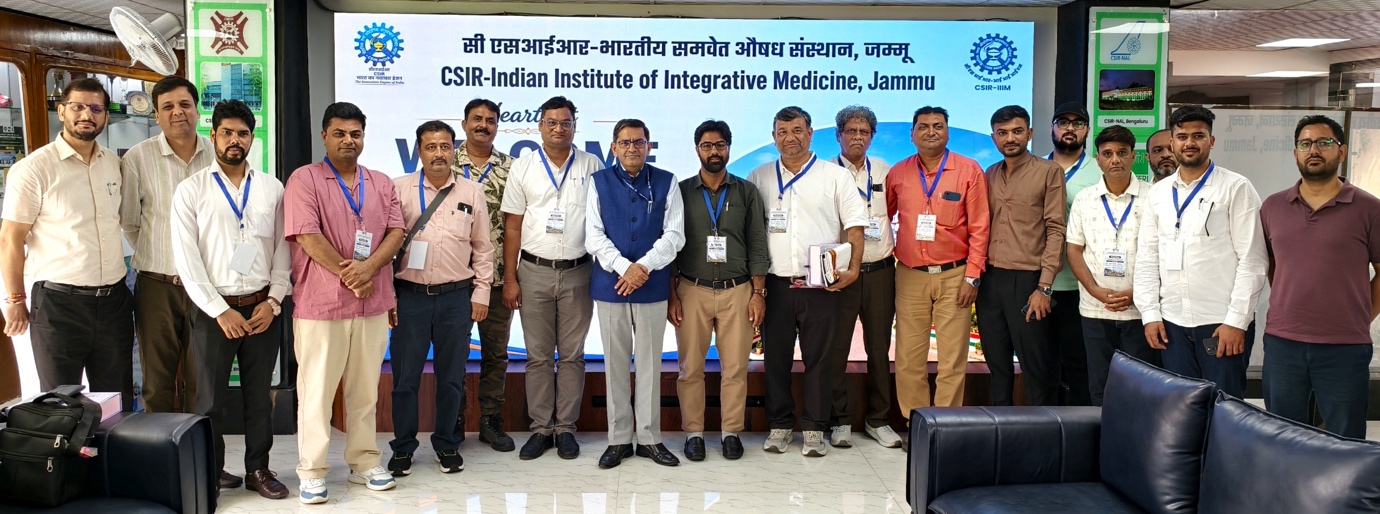
JAMMU: A media delegation from Gujarat, coordinated by the Press Information Bureau (PIB), Government of India, visited the CSIR-Indian Institute of Integrative Medicine (CSIR-IIIM), Jammu, on Tuesday to get a first-hand view of its work in drug discovery, medicinal and aromatic plants, biotechnology, farmer-oriented technologies and startup development.
The delegation comprised journalists and media professionals representing newspapers, television channels and digital platforms. During the visit, they interacted with scientists and toured key research facilities to understand how scientific research is being taken from laboratories to the field and towards commercial and societal applications.
Dr Zabeer Ahmed, Director, CSIR-IIIM Jammu and CSIR-NBRI Lucknow, briefed the delegation on the institute’s research programmes, scientific achievements, societal missions and innovation ecosystem. He highlighted CSIR-IIIM’s work at the intersection of biodiversity, traditional knowledge and modern medicine, with emphasis on natural products, medicinal and aromatic plants and drug discovery.
Dr Ahmed also highlighted the institute’s contribution under the Aroma Mission and Floriculture Mission, including its role in the lavender-based Purple Revolution. He said the institute works with farmers on quality planting material, improved cultivation practices, value addition and technology transfer, while also exploring beekeeping integration to improve pollination and create additional income opportunities.
The delegation was informed that CSIR-IIIM’s drug-discovery pipeline includes several New Chemical Entity leads targeting serious diseases, including candidates for pancreatic cancer, Alzheimer’s disease, breast cancer, colorectal cancer, acute lymphoblastic leukaemia and ovarian cancer.
The visiting journalists were also briefed about CSIR-IIIM’s advanced infrastructure supporting pre-clinical research, quality assessment, drug manufacturing, fermentation, microbial research and technology scale-up.
The institute’s work with farmers formed another major component of the visit. Its 50-acre field station at Chatha is used for farmer training, supply of quality planting material and experimental trials involving medicinal and aromatic plants, while similar activities are undertaken in Kashmir and Ladakh.
The delegation was also introduced to CSIR-IIIM’s startup ecosystem through its BioNEST Incubator and Atal Incubation Centre. The Jammu BioNEST incubator has registered 165 startups, while the Srinagar Atal Incubation Centre has registered more than 25 startup companies.
According to the institute’s presentation, CSIR-IIIM recorded 159 publications and 20 patent applications during the last year, with an average impact factor of 4.2. The institute currently has 249 PhD students, while 40 scholars were awarded PhDs during the period covered by the presentation.
Later, the delegation visited major research facilities including the Herbarium, GLP Animal House, cGMP Facility, Fermentation Facility and Quality Assurance and Quality Control Facility, where scientists explained their role in research, pre-clinical testing, quality control and technology scale-up.
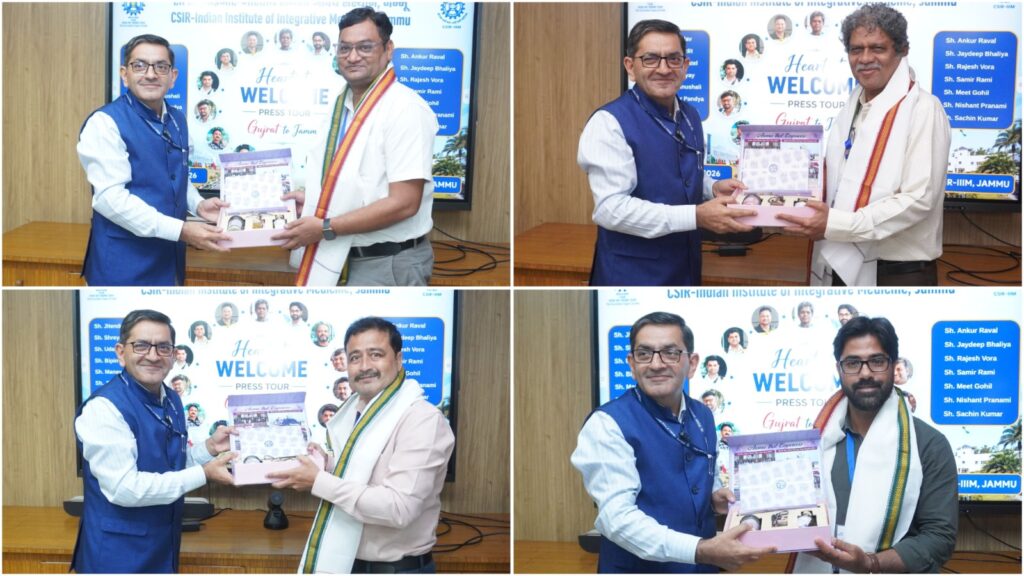
The programme began with a welcome address by Dr Saurabh Saran, PI, BioNEST IIIM-TBI, followed by a presentation on the Aroma and Floriculture Missions by Dr Suphla B. Gupta, Nodal Aroma Mission. Dr Amit Nargotra, Scientist-F, felicitated the media delegates, while Dr Vidushi Abrol conducted the proceedings.
