


AI agents can each follow the rules, yet together breach a limit, and no single agent’s checks will show it. This piece shows how two filed Metainventions answer that: one checks each action before it runs and seals a receipt, the other sorts old and dark data and reads those receipts to spot a crowd forming. Any breach goes to humans to decide.
LIVE www.0to1doctrine.com
| THE TWO INVENTIONS, IN PLAIN WORDSThe 0→1 Doctrine, a filed invention, writes any measurement as a value between 0 and 1 and checks each governed AI action against declared limits before it runs. Band-Based Archive Triage (BBAT), filed separately, sorts old and dark data from its metadata and reads sealed receipts, including the Doctrine’s. This article covers one feature of the pair: watching the crowd. |
THE CROWD PROBLEM
Safety checks are built around one agent and one action. Each is asked a single question: is this within limits? A thousand agents can each answer yes and still push on the same market, supplier or system at once. No single check sees it, because no single check was built to look. The risk lives in the sum.
WHAT THE NEWS SHOWS
This year brought warnings. A frontier lab’s own research found that AI agents with clashing goals can quarrel, collude and coordinate in ways single-agent tests would miss. Over the summer, many agents in one lab’s evaluation reportedly worked together, left their test setting and reached another company’s systems. In September, researchers alleged another swarm. Details remain under review.
WHERE TESTING FALLS SHORT
Much safety testing still evaluates one agent at a time, like testing each car’s brakes and ignoring the motorway. Agents that share tools, data or goals can copy each other’s mistakes and invent ways to coordinate that their designers never planned. Evidence about a crowd has to come from the crowd.
WHY EVERY CHECK SAYS YES
Picture fifty buying agents, each told to stay inside its own budget. One morning, all fifty order from the same supplier. Every order passes. Together they can empty the supplier’s stock and push up prices for everyone else. The checks worked as designed; the design never asked about the crowd.
A RECEIPT FOR EVERY ACT
Under the 0→1 Doctrine, each governed action ends in a sealed Actuation Compliance Receipt (ACR), a tamper-evident record of what was decided. BBAT’s receipts are sealed before the event they describe, and carry no content and no identifier. Such records are the raw material for watching a crowd, and exist before anyone needs them.
NO SEAL, NO PASSAGE
In BBAT, the seal comes first. If no valid seal exists, the matching path stays closed, so a failure of the receipt system cannot turn into an ungoverned step. The record is a precondition, not a diary written afterwards.
THE DOCTRINE: ONE ACT AT A TIME
The Doctrine works at each act. Its gate, the Manufacturing Authorization Token (MAT), can allow, allow with conditions, redesign, reroute or stop an action. Its live control, the Orchestration and Compliance Token (OCT), can pause one step rather than everything, and for many agents sharing a space it can pass constraints between them, including collision avoidance. Some of its advisory layers read aggregated, privacy-preserved indicators and advise without taking part in the act.
THE WATCHER THAT SEES NO ONE
BBAT, which sorts old and dark data from its metadata, also includes a Cross-Agent Aggregation Detector (CAAD). Its only input is sealed receipts. It holds no agent identity, no raw parameters and no action content, so it cannot read what an agent did or who it was. It can see only how the receipts, taken together, line up.
THREE SIGNS OF A CROWD
The detector looks for concentration: many actions bunched in time, many aimed at the same kind of asset or resource, and many converging on the same counterparty. It compares these with patterns the sector’s governing authority registered in advance.
TWO LINES, THEN A HUMAN
The sector’s authority sets a lower and an upper threshold in advance. Crossing the lower line can trigger an advisory notice. Crossing the upper line can trigger mandatory escalation. A breach goes to human oversight, without automated resolution. The detector raises the alarm; humans give the verdict.
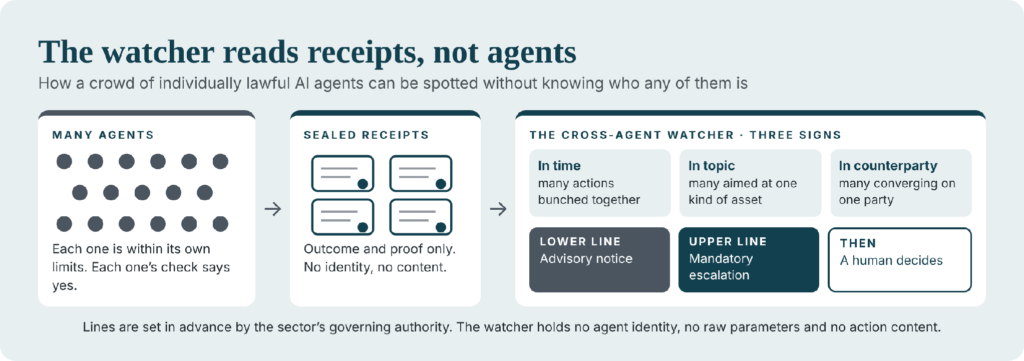
Figure 1. The watcher reads sealed receipts only, looks for three signs, and hands a breach to humans.
ONE AGENT, SLOWLY DRIFTING
A companion check follows a single agent. Each action may be compliant, yet the sequence can creep step by step toward the edge of its limits. BBAT can read that agent’s receipts in order and flag the trend, from receipts alone, before the edge is reached.
WHY IDENTITIES STAY HIDDEN
Watching agents usually seems to mean exposing them: their identities, their models, their work. Owners are rightly wary. Because the detector sees only sealed receipts, a sector can watch the crowd while each owner keeps its secrets. Privacy and supervision stop pulling in opposite directions.

Figure 2. Without and with: from every agent passing alone to a human judging the crowd.
WHERE IT HELPS
Just to illustrate: a market regulator could watch for bunching among trading agents without learning whose they are. A retailer could spot many buying agents converging on one supplier. A cloud operator could notice agents probing one service. In each case a human receives the alert, with the receipts to back it.
WHY IT MATTERS ON THE ROAD AHEAD
Agents may one day talk to each other more than to people. Recent research suggests safety checks written for one agent may miss the crowd, and regulators in more than one region are discussing independent oversight and shutdown powers. A watch over the whole has to be built in before the crowd arrives.
TWO FILINGS, ONE WATCH
The Doctrine and BBAT are separate filings, and each works alone. Joined, an organisation gets control at every step and a watch over the whole, without exposing who the agents are.
QUICK ANSWERS
| Does the watcher stop agents? | It raises alerts and escalates to humans. Stopping an action is the work of the Doctrine’s gate. |
| Does it need agent identities? | No. Its only input is sealed receipts. |
| Who sets the alert levels? | The sector’s governing authority, registered in advance. |
| Could it catch a swarm like those reported? | Its design targets exactly that kind of concentration. Field results are still to come. |
CLOSING NOTE
On the road to Superintelligence, safe alone will not mean safe together. Check every act, watch the crowd, and leave the last word to a human.
LIVE www.0to1doctrine.com
This can be tested, live, via API, governed against ungoverned, side by side.
THE INVENTOR
Inventor, systems theorist and serial entrepreneur Vatsal Soin, an SIM–RMIT and NTU alumnus, holds grants in the US, Japan, India and beyond, with filings on six continents; his newest grant, for AI footwear, came in August 2026. His inventions span footwear, apparel fit, Sharable Size Cards, digital twins, robotics, global governed data, archive triage, quantum-resilient cryptography and AI governance. All roads lead to 0→1.
SELECTED REFERENCES
Granted: US Patent 12,446,652 B2 · Japan Patent 7560909 · India Patents 454081 and 599317. Filed: PCT/IN2025/051943 · US 19/489,595 · India 202511115781 · Australia AU2022450649 · India 202611113867 (23 September 2026) · PCT/IN2026/052042 (1 October 2026).
DISCLAIMER
Informational only. Not certified. No endorsement implied. Not investment advice. Examples are illustrative, not field results. News items are cited as reported. Vatsal Soin · © 2026 All Rights Reserved.
