


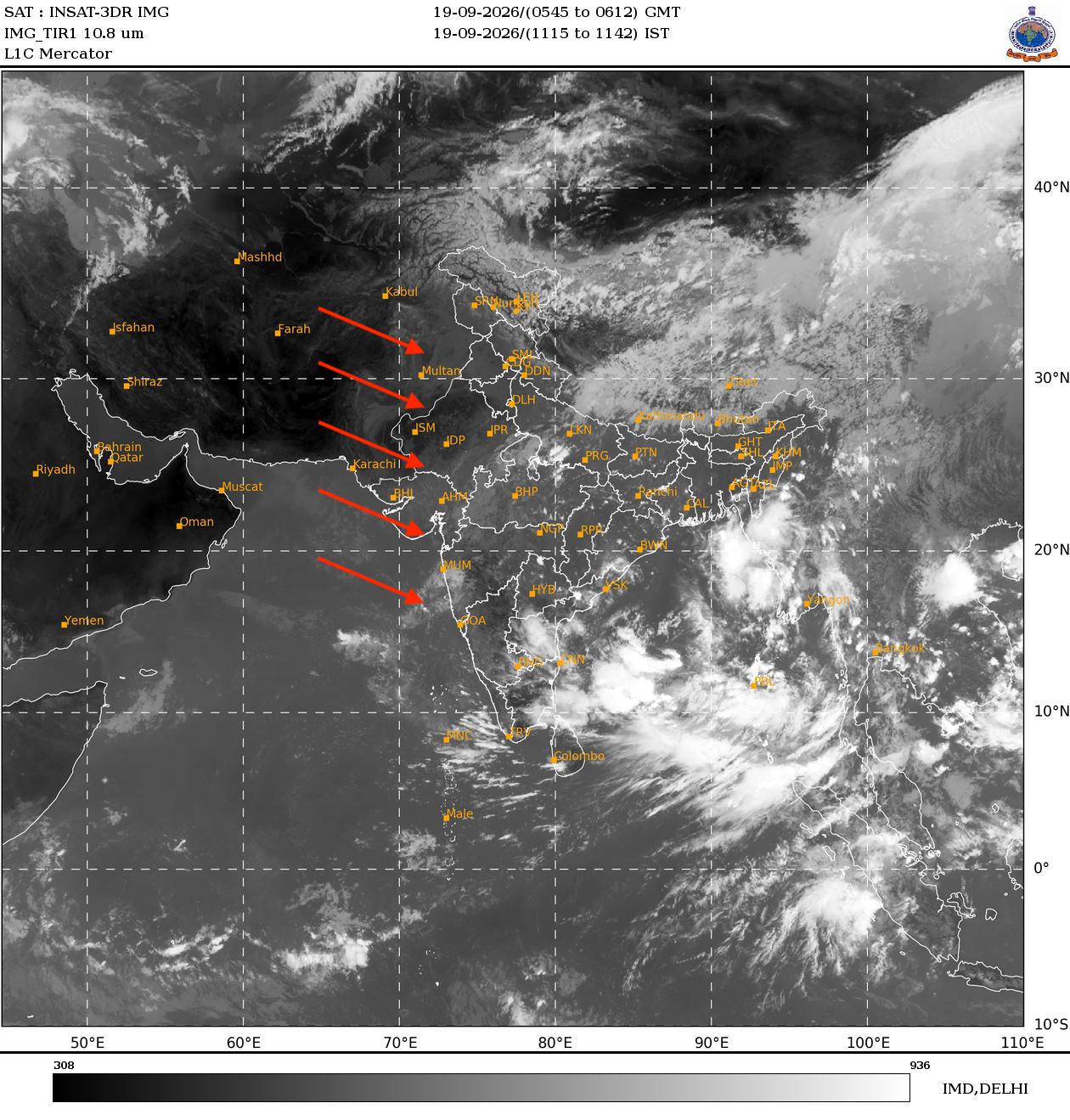
NEW DELHI: The southwest monsoon could soon begin withdrawing from large parts of India, with a massive mass of dry air expected to enter Northwest and West India after September 19-20, potentially cutting off the moisture required to sustain monsoon rainfall.
The influx of dry continental air is likely to clear much of the remaining atmospheric moisture over Northwest India, creating conditions favourable for the onset of the monsoon withdrawal process. Weather conditions are already turning conducive for the southwest monsoon to retreat from parts of West Rajasthan around September 19, signalling the beginning of the seasonal transition.
However, the withdrawal is unlikely to be uniform across the country. An incoming low-pressure system over central, eastern and adjoining parts of India could temporarily slow the retreat by maintaining moisture and rainfall activity over large areas even as dry conditions strengthen across the northwest.
The developing weather pattern could result in a sharp contrast between regions, with Northwest India gradually becoming drier while central and eastern parts continue to experience monsoon rainfall. According to the forecast, withdrawal from Central and Eastern India could be delayed until around September 30 and may resume only after the low-pressure system weakens and dissipates.
The interaction between the advancing dry air and the incoming low-pressure system is expected to play a crucial role in determining the pace of the monsoon’s final withdrawal. Normally, the process begins over Northwest India as atmospheric circulation changes, moisture availability declines and dry continental air gradually replaces the humid monsoon air mass.
This year, however, the retreat could unfold in stages rather than as a continuous and uninterrupted process. For Northwest India, the arrival of dry air after September 19-20 may represent the first major step towards the end of the rainy season, while regions farther south and east could continue to receive monsoon showers for several more days.
The result could be a late-September contrast between dry air advancing from the northwest and moisture-bearing weather systems sustaining rainfall across other parts of the country.
