


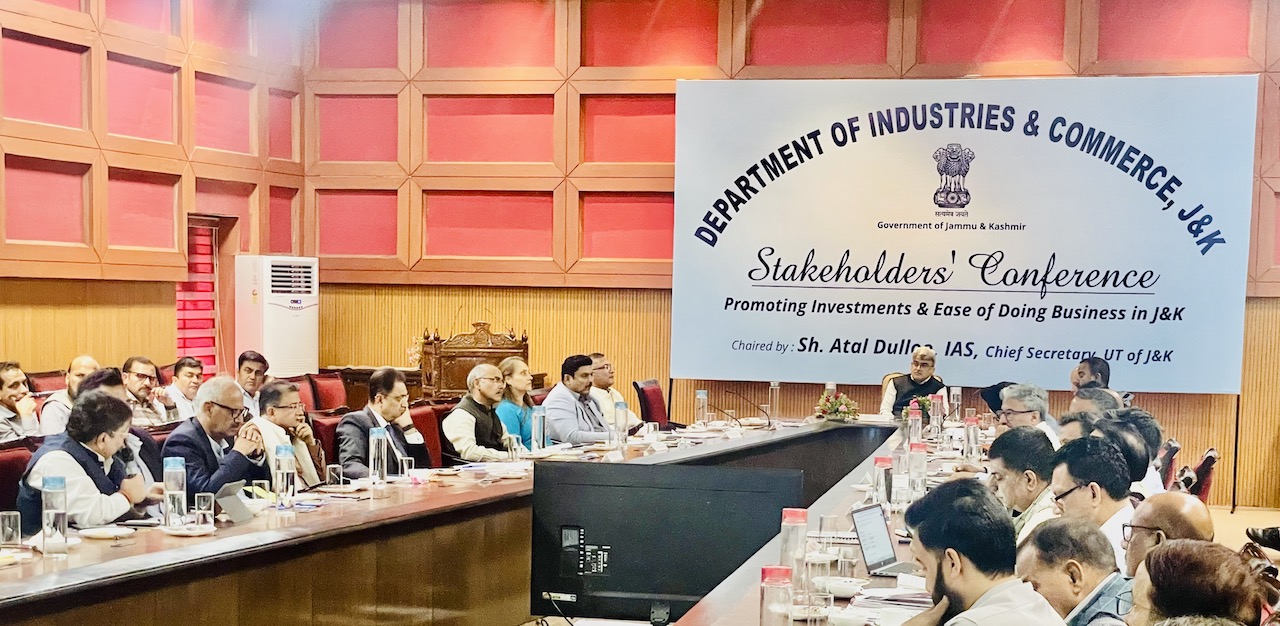
JAMMU: Chairman of the Indian Chamber of Commerce (ICC), Jammu Chapter, Rahul Sahai, on Wednesday submitted a detailed set of recommendations to Chief Secretary Atal Dulloo during a stakeholder interaction on Ease of Doing Business held in Jammu.
Sahai appreciated the Government of Jammu and Kashmir for organising the consultation and said such interactions provide an important platform for constructive dialogue between the administration and industry representatives. He welcomed the government’s efforts towards deregulation and reduction of compliances under Phase-1 of Ease of Doing Business reforms and expressed hope that Phase-2 would further strengthen the investment climate in the Union Territory.
During the meeting, Sahai presented a comprehensive memorandum covering issues related to industry, trade, MSMEs, education, tourism, IT and revenue administration. He emphasised the need for focused policy attention to ensure balanced economic development and employment generation in Jammu and Kashmir.
Raising concerns about the industrial sector, Sahai said several traditional industrial groups from Jammu were gradually shifting their investments to other states due to factors such as availability of skilled labour, lower compliance burdens and better market access. He urged the government to introduce supportive incentives and policy measures to strengthen existing industries and proposed skill development initiatives for local youth aligned with the needs of upcoming industries. He also suggested granting freehold rights for older industrial estates such as Gangyal, Digiana, Birpur and Bari Brahmana to encourage further investment and modernization.
Highlighting challenges faced by labour-intensive industries, he said sectors such as flour mills, brick kilns, steel, tiles and edible oil units were facing pressure due to disparities in raw material costs and rising operational challenges. He called for policy interventions such as compensatory mechanisms or incentives to support local manufacturing and protect employment. Sahai also raised the issue of the six per cent mandi tax imposed by the Government of Punjab and suggested measures to ensure smooth raw material supply through the Food Corporation of India or the introduction of entry tax on finished flour products coming from other states.
On trade and commerce, Sahai highlighted problems arising from traffic mismanagement in Jammu city, saying delays and lack of adequate parking facilities were affecting access to industrial estates and major markets. He recommended improved traffic planning, faster completion of infrastructure projects and development of logistics and warehouse parks around Jammu. He also called for stricter action against financial fraud in businesses, timely resolution of MSME payment issues and early decisions on lease renewals in commercial areas such as Narwal Fruit Mandi and Transport Nagar.
Addressing issues in the education sector, Sahai expressed concern that many students from Jammu and Kashmir were opting for higher education outside the region while seats in local universities remained vacant. He called for a comprehensive review of the higher education system, including challenges linked to the Common University Entrance Test and regulatory issues faced by local private institutions.
He also raised concerns about the rapid expansion of private tuition institutes operating parallel to formal schools without adequate infrastructure or regulatory oversight, which he said was contributing to the emergence of “dummy schools”.
In the tourism sector, Sahai recommended simplifying excise procedures for hotel bars, extending the validity of tourism registrations beyond annual renewals and improving traffic management at key destinations such as Katra and Patnitop. He also proposed setting up tourist facilitation centres at entry and exit points of Jammu and Kashmir on a public-private partnership basis to promote tourism across the Jammu region.
Highlighting the potential of the IT sector, Sahai suggested developing fully furnished IT parks within Jammu city to support startups and small technology companies. He also proposed utilising existing infrastructure, such as the Jammu Haat building, as an initial IT hub to create employment opportunities for local youth.
With regard to revenue administration, he stressed the need for time-bound delivery of online services such as Fard, demarcation and Girdawari, and simplification of procedures related to land clearance for Gair Mumkin Khad areas to facilitate land transactions and increase revenue through stamp duty.
Sahai also placed several policy suggestions for the upcoming New Industrial Policy of Jammu and Kashmir. These included turnover incentives for existing micro, small and medium enterprises, working capital subsidy of around five per cent and continuation of SGST benefits under SRO-31 until 2031. He also recommended interest subsidy on term loans for modernization and installation of solar power systems, along with capital subsidies for industries adopting renewable energy.
For new industrial units, Sahai proposed incentives such as turnover-linked support, working capital assistance, SGST refunds linked with plant and machinery investment, and capital and interest subsidies to encourage new investments.
He further urged the government to consider a blanket waiver of stamp duty and court fees for industrial units in transactions related to enhancement of credit facilities, loan takeovers by banks or diversification of industrial activity, saying such measures would significantly reduce the cost of doing business.
Sahai expressed confidence that the suggestions placed by the ICC Jammu Chapter would help create a more competitive, investor-friendly and employment-generating industrial ecosystem in Jammu and Kashmir. He also thanked the Chief Secretary and the government for providing stakeholders an opportunity to present their views and assured full cooperation of the chamber in supporting the Union Territory’s economic development.
