


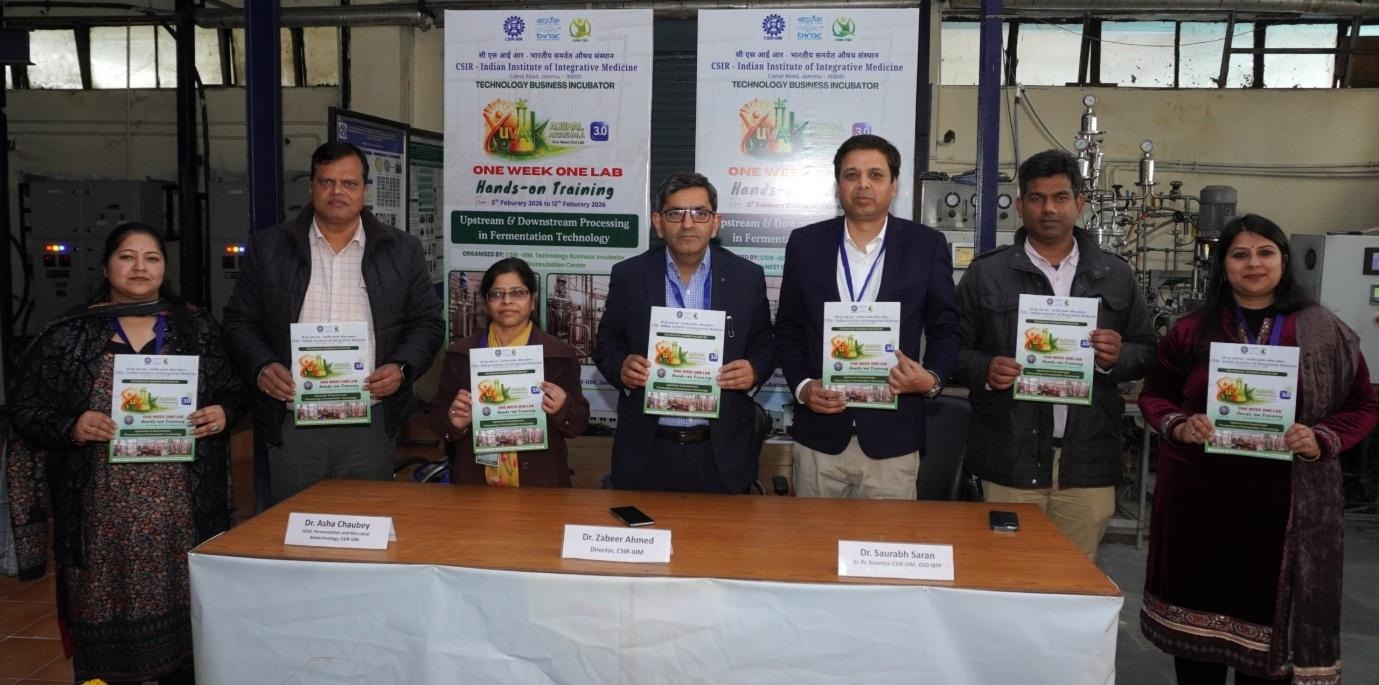
JAMMU: CSIR–Indian Institute of Integrative Medicine (IIIM), Jammu on Wednesday launched a week-long hands-on training programme on upstream and downstream processing in fermentation technology under its “One Week One Lab” initiative, bringing together young biotechnology students for practical exposure in advanced bioprocessing.
The programme, titled Yuva Kaushal Karyashala 3.0, is being organised by CSIR-IIIM in collaboration with its Technology Business Incubator (TBI) and BioNEST Bioincubation Centre. Students from Lovely Professional University and other institutions are participating in the training, which will continue till February 12.
Dr. Zabeer Ahmed, Director, CSIR-IIIM, Dr Asha Chaubey, Chief Scientist, Fermentation and Microbial Biotechnology, Dr Saurabh Saran, Senior Principal Scientist, Fermentation and Microbial Biotechnology Division and Principal Investigator at IIIM-TBI, Er. Anil Kumar Katare from the Quality Management and Instrumentation Division, and Dr Kanhaiya Kumar from the Fermentation and Microbial Biotechnology Division were present on the occasion.
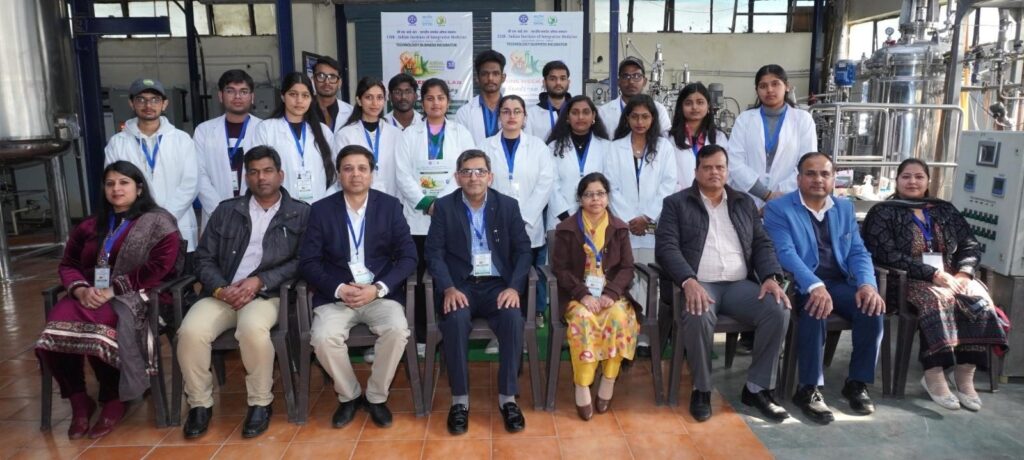
A training manual for participants was also released by the dignitaries during the inaugural session, followed by an interaction between the Director and students.
Addressing the gathering, Director Zabeer Ahmed described the training as a significant opportunity for young minds to gain industry-relevant skills. He said practical exposure is essential alongside academic learning and can open pathways for entrepreneurship in emerging biotechnology domains.
He highlighted the region’s rich biodiversity and microbial resources, noting that these offer strong potential for fermentation-based industries such as antibiotics, bioactive compounds and other high-value products.
He observed that India continues to rely on imports for several fermentation-derived products, which creates scope for local innovation and enterprise. Stressing the role of youth in nation-building, he called for closer collaboration among scientists, educators, industry and policymakers to achieve the vision of a developed India by 2047.
He also familiarised students with IIIM’s wider research ecosystem, including natural product research, extraction, isolation, synthetic modification and pre-clinical drug discovery in areas such as cancer, neurodegenerative and metabolic diseases.
Earlier, Dr Asha Chaubey delivered a lecture on the fundamentals and applications of fermentation technology, outlining its relevance in pharmaceuticals, bio-products and industrial biotechnology.
Welcoming the participants, Dr Saurabh Saran said the workshop is designed to bridge the gap between classroom learning and real laboratory experience. He noted that exposure to live fermentation processes, instrumentation and scale-up techniques is crucial for students entering the biotechnology sector.
He also spoke about the role of the Technology Business Incubator in promoting innovation and entrepreneurship, adding that students with promising ideas can receive mentorship and incubation support to develop startups. He also encouraged participants to actively engage with scientists and make full use of the institute’s facilities.
The vote of thanks was presented by Dr Vidushi Abrol, Business Manager at IIIM-TBI, who acknowledged the support of the institute’s leadership, scientists, technical staff and media, and credited the guidance of Dr Asha Chaubey and the TBI team for the smooth conduct of the programme.
