


NEW DELHI: The Indian Army on Tuesday outlined ten major milestones achieved in 2025, underscoring a decisive shift towards future-ready warfare driven by precision, technology absorption, jointness and indigenisation.
In a detailed statement, the Army said the year’s most significant military development was Operation Sindoor, launched in May 2025 following the Pahalgam terror attack carried out by “Pakistan Army-backed terrorists”.
The Army said the entire operational planning for Operation Sindoor was undertaken by the Military Operations Branch, while execution was monitored from the Directorate General of Military Operations (DGMO) Ops Room, with the Chief of Defence Staff and all three Service Chiefs present.
During the operation, nine terrorist camps across the border were destroyed—seven by the Indian Army and two by the Indian Air Force. The strikes were described as precise, calibrated and time-bound, reinforcing deterrence while maintaining escalation control.
The Army also detailed how it successfully countered Pakistan’s retaliation attempts. Between the nights of May 7 and May 10, Pakistan attempted to target military and civilian assets using drones. Indian Army Air Defence units neutralised all aerial threats, preventing damage or casualties and demonstrating the effectiveness of integrated counter-UAS and layered air defence systems.
Along the Line of Control, more than a dozen terror launch pads were destroyed using ground-based weapons, disrupting infiltration routes and terror logistics. On May 10, the Pakistani Director General of Military Operations approached his Indian counterpart seeking a ceasefire, following which an understanding was reached to halt firing and military action.
On long-range firepower, the Army highlighted major progress in its BrahMos and Pinaka systems. On December 1, a BrahMos unit of Southern Command, along with elements of the Andaman and Nicobar Command, conducted a combat missile launch, validating high-speed flight stability and terminal accuracy under simulated battle conditions. Work on extended-range BrahMos variants is currently underway.
Two additional Pinaka Multi Barrel Rocket Launcher (MBRL) regiments were operationalised on June 24, and as 2025 drew to a close, the Army successfully tested the Pinaka Long Range Guided Rocket (LRGR) with a range of approximately 120 km. The capability significantly enhances the Army’s deep-strike precision and deterrence against enemy infrastructure and armoured thrusts.
In aviation, the Army inducted six AH-64E Apache attack helicopters, receiving the first three on July 22 and the remaining three in December. With all six now operational, the Apache unit is expected to substantially enhance the Army’s strike capability against enemy armour, including tanks and infantry fighting vehicles.
The Army also announced the rollout of new battlefield structures. In October, a capability demonstration in Rajasthan showcased Bhairav Battalions and Ashni Platoons. Plans are underway to raise 25 Bhairav light commando battalions and deploy Ashni drone platoons across infantry units for intelligence, surveillance and reconnaissance (ISR) and precision strikes. New Shaktibaan Regiments and Divyastra Batteries, equipped with unmanned systems and loiter munitions, were also highlighted.
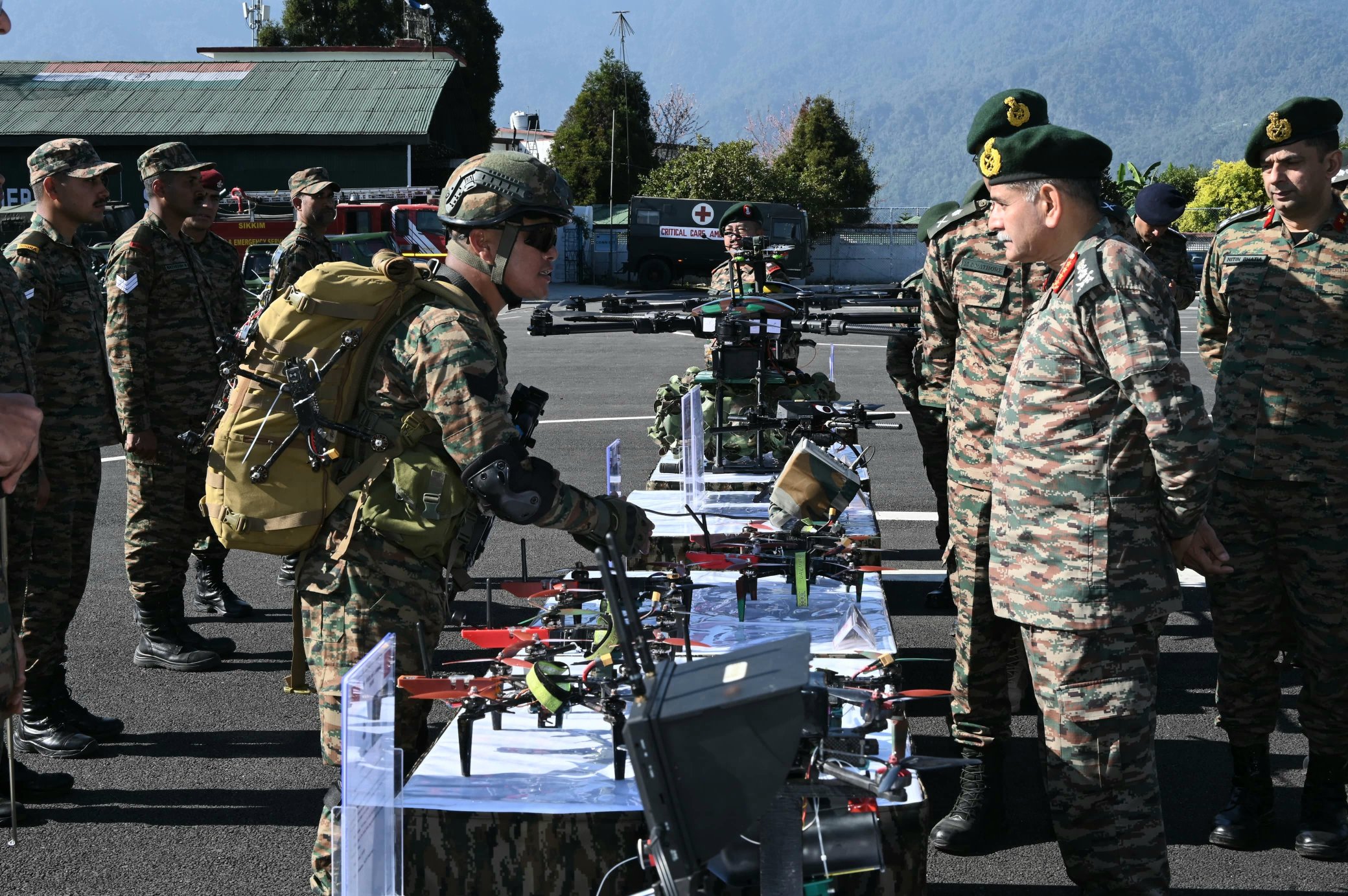
On procurement and indigenisation, the Army noted that the past two years were observed as the “Years of Tech Absorption”, with 91 per cent of ammunition now indigenised. Over the year, the Army inducted nearly 3,000 remotely piloted aircraft, 150 tethered drones, swarm drones, logistics drones for high-altitude areas and kamikaze drones.
Progress in digital transformation was also underlined, including the establishment of edge data centres and the development of in-house applications such as the Equipment Helpline and Sainik Yatri Mitra App.
Senior leadership discussions during the Army Commanders’ Conference in Jaisalmer in October focused on grey-zone warfare, jointness and innovation. Grey-zone warfare involves indirect methods such as cyberattacks, misinformation, economic pressure and the use of proxy groups without escalating into full-scale conflict.
The Army further highlighted expanded military diplomacy, citing major joint exercises with France, the United States, Thailand, Australia, Sri Lanka, the United Kingdom and the UAE, aimed at enhancing interoperability, counter-terror capabilities and regional partnerships.
Innovation initiatives such as Inno-Yoddha 2025-26 were also spotlighted. Under the programme, 89 innovations were submitted, with 32 selected for further development, reinforcing the Army’s push towards innovation, Atmanirbharta (self-reliance) and future readiness.
