


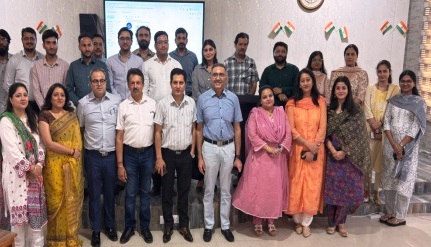
JAMMU: A two-day Capacity Building Programme (CBP) for Jammu & Kashmir Accounts Service Probationary Officers commenced today at the Northern Zonal Accountancy Training Institute (NZATI), Jammu.
The programme is being conducted by The Business School (TBS), University of Jammu, in collaboration with NZATI, with the objective of enhancing the professional competencies of probationary officers through expert-led sessions on financial management, performance evaluation, public-private partnerships, organisational behaviour, emerging technologies and communication skills.
Director Finance and Principal NZATI Rajesh Talwar formally inaugurated the programme, welcoming Director Accounts & Treasuries Jammu Rajesh Kotwal and the participating officers. The inaugural session highlighted the importance of continuous capacity building and professional development for officers entrusted with managing public finances.
Prof Amisha Gupta, Director & Professor, The Business School, University of Jammu, and Programme Consultant & Lead Coordinator, outlined the academic framework, learning outcomes and significance of the training initiative. Dr Farah Choudhary, Associate Professor TBS University of Jammu and Programme Consultant & Coordinator, briefed participants on the programme structure and training methodology.
The inaugural day featured four technical sessions delivered by academicians and finance professionals. The first session, on Financial Management (Part I), was conducted by Prof Sameer Gupta of The Business School, University of Jammu, who highlighted the importance of sound financial planning, budgeting and resource allocation in public administration.
The second session, on Evaluating Financial Performance of Public Sector Undertakings, was delivered by CA Rishu Kawatra, who discussed key financial indicators, performance assessment techniques and best practices for evaluating PSUs. CA Mohit Mahajan conducted the third session, on Public Private Partnership (Part I), focusing on the concept, significance and evolving role of PPP models in infrastructure development and public service delivery.
The fourth session, on Public Private Partnership (Part II), was led by CA Lalit K Gupta, who elaborated on project structuring, risk-sharing mechanisms and relevant PPP case studies.
Participants actively engaged with resource persons through discussions and interactive exchanges throughout the day.
