


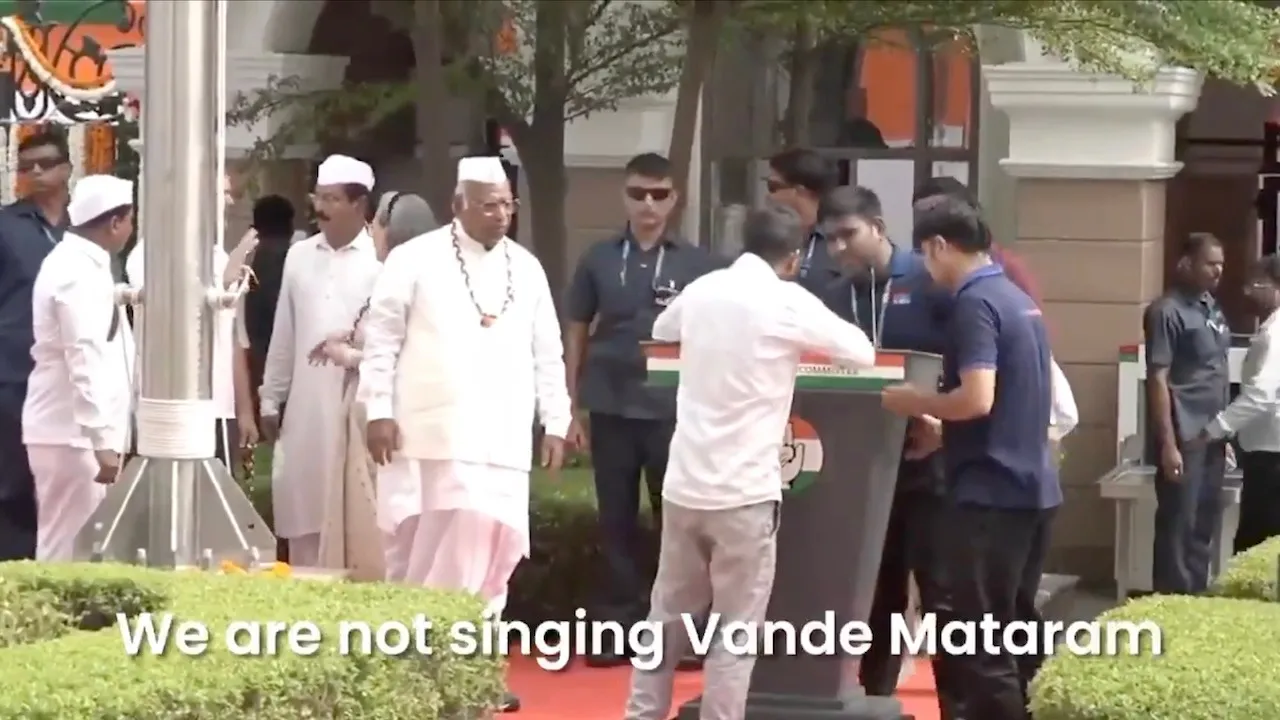
NEW DELHI: A fresh political controversy erupted following the Congress’ Independence Day celebrations after a video from the party headquarters showed Leader of Opposition Rahul Gandhi referring to the rendition of Vande Mataram as “our own song,” while a separate clip triggered allegations that senior Congress leaders had tried to halt the full version of the national song.
The controversy relates to the Independence Day programme held at Indira Bhawan, the All India Congress Committee headquarters in New Delhi, on Saturday.
In a video circulating on social media, Rahul Gandhi is heard saying in English, “We are not singing Vande Mataram. It’s our version of Vande Mataram,” before adding in Hindi, “Hum yahan pe apna gaana gaa rahe hain” — “We are singing our own song here.”
The remarks drew criticism from political opponents and commentators, who accused the Congress leader of distancing himself from the national song. The precise context in which Gandhi made the remarks, however, has become part of the wider political dispute.
The row intensified after another video from the same event showed Congress Parliamentary Party chairperson Sonia Gandhi making gestures while the full rendition of Vande Mataram was underway.
BJP leaders alleged that Sonia Gandhi was asking for the rendition to be stopped after the initial stanzas. Madhya Pradesh Chief Minister Mohan Yadav was among those who accused Sonia and Rahul Gandhi of showing disrespect towards the national song and demanded an apology.
BJP IT cell chief Amit Malviya also shared the footage and alleged that Sonia Gandhi appeared uncomfortable with the complete rendition and signalled for it to be stopped.
The Congress strongly rejected the charge.
Senior Congress leader Jairam Ramesh said the entire song was sung without interruption and maintained that Sonia Gandhi’s gestures were related to arranging a chair for party president Mallikarjun Kharge, who had been standing for a prolonged period.
Congress leaders also maintained that Sonia Gandhi herself participated in the rendition and that there was no attempt by the leadership to stop the song.
The episode has revived debate over the Congress’ historical practice of singing selected stanzas of Vande Mataram. The party has cited the position adopted by the Congress Working Committee in 1937, when the first two stanzas were preferred for official use amid discussions involving senior national leaders of the period.
This year’s Independence Day celebrations had already placed renewed focus on Vande Mataram. The national song was included in the official Red Fort ceremony for the first time, ahead of the national anthem, as part of the 80th Independence Day observance.
The controversy also comes amid political debate over legal protection for Vande Mataram. While the existing Prevention of Insults to National Honour Act, 1971 provides statutory protection to national symbols including the National Flag, Constitution and National Anthem, claims concerning the exact scope and commencement of any 2026 amendment extending equivalent penalties to Vande Mataram require reference to the final notified law.
The BJP has seized on the Independence Day footage to accuse the Congress leadership of being uncomfortable with a key national symbol, while the Congress has dismissed the allegations as politically motivated and insisted that the complete rendition at its headquarters was allowed to proceed without interruption.
The competing claims have turned what began as a ceremonial Independence Day programme into the latest political flashpoint between the ruling BJP and the principal Opposition party.
