


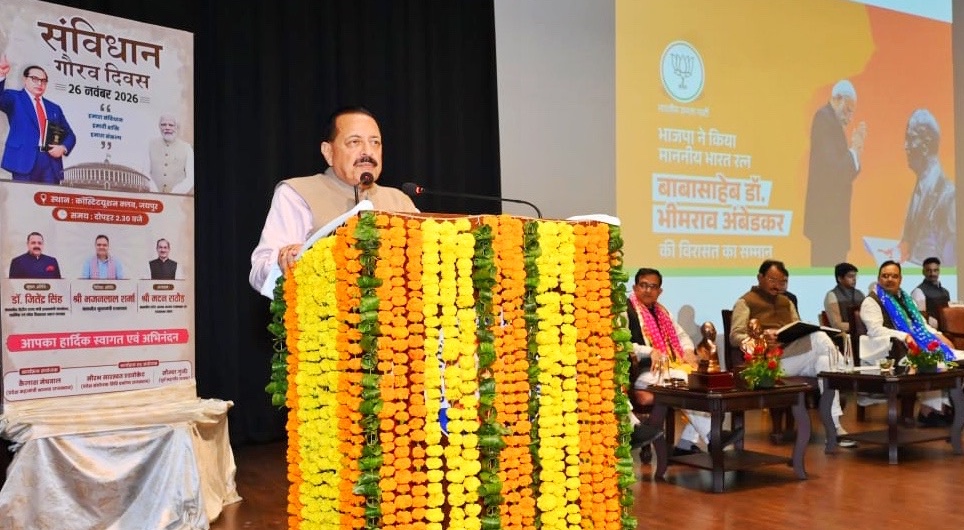
JAIPUR: Union Minister of State (Independent Charge) for Science & Technology and Earth Sciences and MoS in the Prime Minister’s Office, Personnel, Public Grievances and Pensions, Atomic Energy and Space, Dr. Jitendra Singh, today said that Prime Minister Narendra Modi redeemed the injustice done to Bharat Ratna Dr. Babasaheb Bhimrao Ambedkar by Congress and restored his rightful place in the history.
Addressing a Samvidhan Gaurav Diwas programme organised in Jaipur on Constitution Day, in the presence of Rajasthan Chief Minister Bhajanlal Sharma, Dr. Jitendra Singh said that Congress, driven by family politics, rejected and sidelined several towering national leaders, including Babasaheb Ambedkar, Netaji Subhas Chandra Bose and Sardar Vallabhbhai Patel, while attempting to diminish their contributions to the country’s history.
Congratulating the organisers for bringing together prominent personalities and representatives from different sections of society, Dr. Jitendra Singh said that the nationwide celebration of Constitution Day reflects the commitment of the Modi Government towards recognising Babasaheb’s contribution to nation-building. He recalled that Prime Minister Modi, upon entering Parliament for the first time as Prime Minister, bowed before the Constitution, sending a powerful message that the Constitution must remain at the centre of India’s democratic governance.
Dr. Jitendra Singh said that despite being the principal architect of the Indian Constitution, Babasaheb Ambedkar faced repeated political opposition and neglect under Congress governments. Referring to the elections of 1946, 1952 and 1954, he said that Congress repeatedly worked against Babasaheb’s electoral prospects, with Jawaharlal Nehru personally campaigning against him during the 1954 by-election. He also recalled that Babasaheb resigned from Nehru’s Cabinet in 1951 following differences over the treatment of Dalit issues, economic policies, the Kashmir question, foreign policy and the Hindu Code Bill.
The Minister said that even after Babasaheb’s demise, successive Congress governments failed to accord him the recognition he deserved. He referred to the absence of a national memorial at 26 Alipur Road during the Nehru era and the fact that Babasaheb was conferred the Bharat Ratna only in 1990. He said that the contrast between the treatment of Babasaheb and the extensive memorialisation of the Nehru-Gandhi family reflected Congress’s dynastic approach to national history. He also recalled the controversy over the derogatory cartoon depicting Babasaheb in an NCERT textbook published during the Congress-led UPA government.
Recalling the Emergency imposed by Indira Gandhi in 1975, Dr. Jitendra Singh said that the suspension of fundamental rights, imprisonment of political opponents, censorship of the press and the 42nd Constitutional Amendment represented one of the darkest chapters in India’s democratic history. He said that constitutional institutions and democratic freedoms were compromised to protect political power.
Dr Jitendra Singh said that the Janata Party government, of which Bharatiya Jan Sangh was a part, initiated steps to restore constitutional order and democratic values after the Emergency, including restoring the five-year term of Parliament and State Legislatures.
Under former Prime Minister Atal Bihari Vajpayee, the Minister recalled that five important constitutional amendments strengthened safeguards for Scheduled Castes and Scheduled Tribes, addressed issues relating to promotions in government services and facilitated the filling of vacancies in reserved posts. Dr. Jitendra Singh also recalled the launch of Sarva Shiksha Abhiyan under Shri Vajpayee’s leadership, advancing Babasaheb’s vision of education for all.
Dr. Jitendra Singh said that the constitutional reforms undertaken under Prime Minister Narendra Modi reflect the principle of Nation First rather than considerations of political survival or family interests. He referred to the 102nd Constitutional Amendment granting constitutional status to the National Commission for Backward Classes, the 103rd Amendment providing 10 per cent reservation for Economically Weaker Sections, the 104th Amendment extending the reservation of seats for Scheduled Castes and Scheduled Tribes in Parliament and State Legislatures until 2030, and the 105th Amendment restoring the power of States to identify socially and educationally backward classes.
The Minister also referred to the 106th Constitutional Amendment providing for 33 per cent reservation for women in Parliament and State Legislatures, describing it as a landmark step towards women’s participation in democratic institutions. He said that the Modi Government strengthened the SC/ST (Prevention of Atrocities) Act through stricter provisions and enhanced financial assistance for victims. The abrogation of Article 370 and Article 35A in 2019, he added, was another historic step towards national integration, consistent with Babasaheb’s concerns about provisions that could compromise the unity of the country.
Dr. Jitendra Singh said that Prime Minister Modi has translated respect for Babasaheb into concrete national initiatives. The development of Panchteerth, comprising Janmabhoomi at Mhow, Deeksha Bhoomi at Nagpur, Mahaparinirvan Bhoomi in Delhi, Chaitya Bhoomi in Mumbai and Shiksha Bhoomi in London, represents a major effort to preserve his legacy. He also referred to the Dr. Ambedkar International Centre in Delhi, whose foundation stone was laid by Prime Minister Modi in 2015 and which was inaugurated in 2017, along with the installation of Babasaheb’s statues at the Supreme Court and the Ministry of Law and Justice.
The Minister said that initiatives such as the BHIM App, digitisation and publication of Babasaheb’s writings and speeches, commemorative coins marking his 125th birth anniversary and the nationwide celebration of Constitution Day on November 26 have taken his legacy to a wider audience. Recalling that Shri Narendra Modi had led the Samvidhan Gaurav Yatra in Gujarat in 2010 as Chief Minister, Dr. Singh said that the year-long ‘Hamara Samvidhan, Hamara Swabhiman’ campaign during 2024–25 further demonstrated the Prime Minister’s commitment to constitutional awareness.
Dr. Jitendra Singh said that it was now essential to take Babasaheb’s ideas and contributions to universities, higher education institutions and young people so that future generations understand his role beyond political narratives. Emphasising the need for evidence-based awareness of India’s history, he urged citizens to carry forward the message of social harmony, equality and fraternity.
Concluding his address, Dr. Jitendra Singh said that “Nation First, Party Second, Self Last” must become the guiding mantra for every citizen. He urged everyone to take this message to at least four other people in society and contribute towards preserving Babasaheb Ambedkar’s legacy and strengthening the constitutional values of the nation.
