


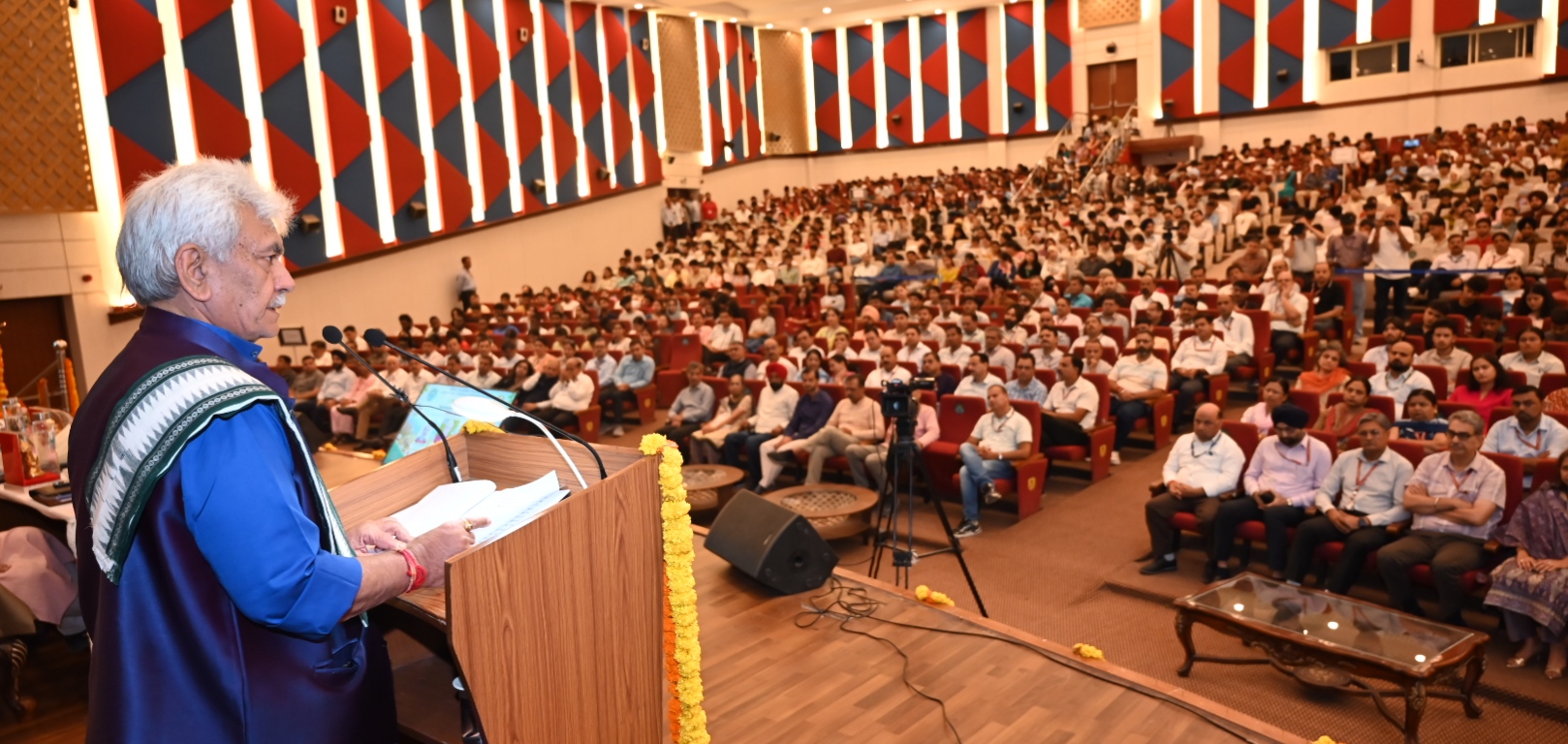
JAMMU: Lieutenant Governor Manoj Sinha on Sunday inaugurated the National Dialogue on “Millets for Health: Building Healthy Ecosystems, Climate-Resilient Agriculture and Sustainable Food Systems” at Sher-e-Kashmir University of Agricultural Sciences and Technology (SKUAST), Jammu, calling millets a potential pathway to healthier communities, greater farm resilience and a sustainable future for Jammu and Kashmir.
Expressing gratitude to Padma Shri Dr Khadar Vali, popularly known as the “Millet Man of India”, and Umendra Dutt of Kheti Virasat Mission for promoting the Millets Mission in Jammu and Kashmir, the Lieutenant Governor said the gathering was not merely a seminar but a celebration of a rural agricultural revolution rooted in India’s traditional wisdom.
Sinha highlighted the role of Prime Minister Narendra Modi in promoting millets as “nutri-cereals” and popularising the term “Shree Anna”, noting that the initiatives subsequently contributed to the United Nations observing 2023 as the International Year of Millets. He said the global recognition had helped bring India’s traditional food knowledge into renewed focus.
Tracing the long-standing role of sorghum, pearl millet, finger millet, kodo millet, little millet, foxtail millet and barnyard millet in sustaining rural communities, the Lieutenant Governor said crops once dismissed as the “food of the poor” were now gaining importance at the intersection of traditional knowledge and modern agricultural science.
He said millets had historically supported small and marginal farmers because they could withstand difficult weather conditions and generally required fewer agricultural inputs than several conventional crops. With climate change creating new challenges for agriculture, he said the food systems of the future would need to combine nutrition, farm profitability and environmental sustainability.
Highlighting the relevance of millet cultivation in Jammu and Kashmir, Sinha said more than 80 per cent of farmers in the region were small and marginal farmers who remained vulnerable to uncertain weather conditions. He said millets, with their relatively lower water and input requirements, could provide farmers with greater resilience and reduce risks associated with cultivation.
“I see the Millets Mission as the greatest hope for the smallest farmer in our villages,” Sinha said, adding that the administration had prepared a strategy under the Holistic Agriculture Development Plan to promote the health of future generations, improve farmers’ prosperity and protect the environment.
The Lieutenant Governor also underlined the nutritional benefits of millets, including dietary fibre, a low glycaemic index and essential minerals such as iron, calcium, magnesium and zinc. He urged people to incorporate traditional millet-based foods, including bajra rotis, ragi preparations and barnyard millet rice, into their diets as part of efforts to address lifestyle-related health concerns such as diabetes, obesity and hypertension.
On the economic potential of millets, Sinha called for greater focus on value addition, processing, packaging and branding. Citing India’s millet production of around 18 million tonnes in 2024–25 and its share of about 38 per cent of global production, he stressed the need to encourage women’s self-help groups and young entrepreneurs in Jammu and Kashmir to develop millet-based enterprises under initiatives such as One District, One Product.
Calling for coordinated efforts by farmers, researchers, doctors, entrepreneurs and citizens, the Lieutenant Governor said food systems needed to become more diverse, nutritious, sustainable and resilient. He urged households to include millet products in their diets and called upon stakeholders to take the message of millet cultivation to villages, describing millets not merely as a heritage of the past but as a strategy for the future of Jammu and Kashmir.
During the event, Sinha also released several publications, including A Laboratory Manual on Soil Microbiology, Fundamentals of Geographical Information Systems and Remote Sensing, and Package of Practices for Minor Millets.
Padma Shri Dr Khadar Vali, SKUAST-Jammu Vice Chancellor Prof B.N. Tripathi, Kheti Virasat Mission Executive Director Umendra Dutt, Dr Anjani Kumar of IFPRI, SKUAST-Jammu Director Research Prof S.K. Gupta, besides experts, policymakers, researchers, senior officials, progressive farmers, agri-preneurs, members of self-help groups, faculty and students, attended the inaugural ceremony.
