


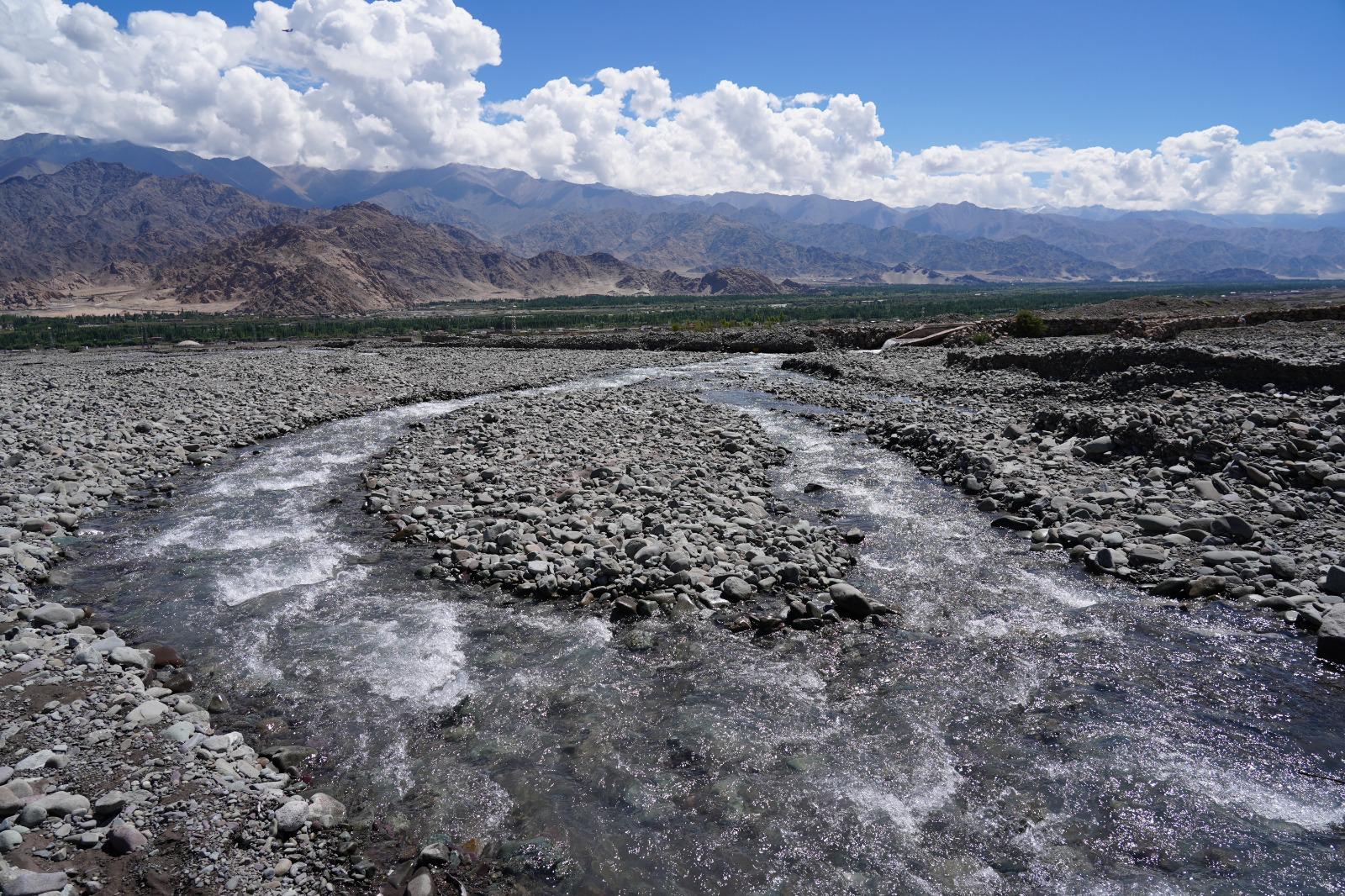
LEH: In a major water-management initiative, the Ladakh administration has started harnessing around 90 million litres of glacier water every day from Stok Nallah and diverting it into the Igoo-Phey Irrigation Canal to strengthen irrigation and agricultural security in the Union Territory.
The glacial-melt water, which earlier flowed downstream into the River Indus, is now being channelised into the canal through simple earthwork without any capital expenditure.
The initiative, spearheaded by Lieutenant Governor Vinai Kumar Saxena, is expected to benefit nearly 12 villages and augment irrigation across more than 1,000 acres of barren land that had remained water-starved.
According to the administration, Stok Nallah is fed by the Stok Kangri Glacier near Leh. Following directions issued by the Lieutenant Governor on August 14, the Irrigation and Flood Control Department created two trenches using a JCB to divert excess glacier water into the Igoo-Phey Canal.
The discharge from Stok Nallah was assessed at around 36.60 cusecs, equivalent to nearly 90 million litres of water in 24 hours.
Of this, around 26 cusecs has already been diverted — 19 cusecs towards Igoo village upstream and 7 cusecs towards Phey village downstream. Planning is underway to utilise the remaining 10 cusecs.
The intervention is expected to increase water flow in the Igoo-Phey Canal from around 50 cusecs to nearly 80 cusecs.
Earlier, limited availability had forced water distribution to villages on a roster basis. With the additional supply, the administration expects daily water availability to all 12 villages connected with the canal.
The 43-km-long Igoo-Phey Canal was constructed between 1979 and 2005. About 200 metres of the canal had been built underground to allow Stok Nallah water to pass over it without disturbing the canal flow.
The administration said the glacial runoff, despite being available for decades, had remained largely unutilised, contributing to repeated water shortages in the canal system.
Lieutenant Governor Saxena said the successful diversion demonstrated that large-scale, sustainable water management was feasible in Ladakh’s cold desert conditions.
“By successfully saving 90 million litres of glacier water daily and diverting this huge volume of water from the Stok Nallah into the Igoo-Phey and Yokyur canals, we have proven that large-scale, sustainable water management is entirely feasible in our cold desert,” he said.
He described the initiative as a major step towards a “Green, Water-Secure and Self-Sustaining Ladakh” and said the administration would replicate similar low-cost interventions across the Union Territory.
The administration has already identified several other streams for possible diversion, including Matho Nallah, Tuchik Chenmo Nallah, Tuchik Chon Nallah and Stakna Nallah.
Officials said future projects would follow principles of gravity-based engineering, minimal wastage, environmental sustainability and low-cost execution.
The administration expects reliable irrigation to improve crop yields, expand cultivable areas, raise farm incomes and generate greater employment in rural Ladakh.
