


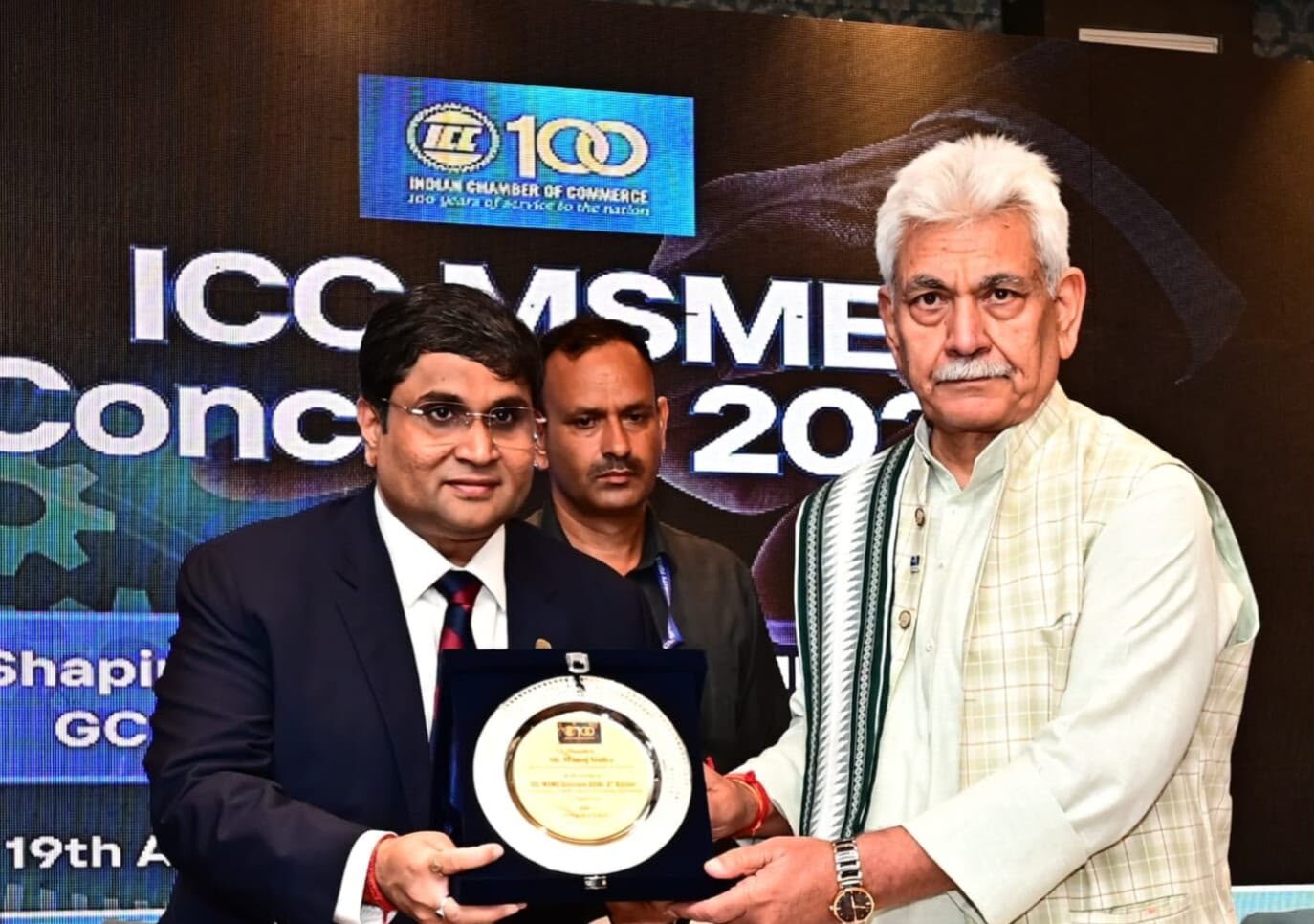
JAMMU: Lieutenant Governor Manoj Sinha on Wednesday said Micro, Small and Medium Enterprises (MSMEs) are the “heartbeat” of India’s economy and called for technology adoption, easier access to credit, stronger supply chains and administrative reforms to make small businesses globally competitive.
Addressing the 2nd Edition of ICC MSME Conclave 2026, organised by the Indian Chamber of Commerce (ICC), Jammu Chapter, at Regale Park here, Sinha said India was at a defining economic crossroads where innovation, agility and technology were reshaping enterprise.
The conclave was held on the theme “Shaping the Future of MSMEs, Religious Tourism, Nano GCCs and Technology-Led Growth.”
“MSMEs are contributing 31.3 per cent to GDP and nearly half of India’s exports. They are also the second-largest provider of employment after agriculture. MSMEs are the heartbeat of our economy and the true builders of India’s resilience and self-reliance,” the Lieutenant Governor said.
Nano GCCs Can Open New Opportunities
Highlighting the emergence of Nano Global Capability Centres (GCCs), Sinha said smaller specialised teams could now deliver high-value technological capabilities that were once largely confined to major corporations.
He said the development represented a democratisation of technology, enabling mid-sized enterprises in tier-II cities to build and scale world-class capabilities.
Artificial intelligence, automation and digital infrastructure, he said, were reducing barriers and creating fresh opportunities for cities such as Jammu and Srinagar.
The Lieutenant Governor described the conclave as a “call to action” to reimagine the potential of MSMEs, embrace the Nano GCC model and place technology at the centre of the country’s next phase of inclusive growth.
J&K Investments, Start-Ups See Sharp Rise
Sinha said Jammu and Kashmir had emerged as an example of wide-ranging transformation, with investments worth ₹5,824 crore during 2025-26, which he said represented a 13-fold increase over pre-2021 averages.
He said investments received during the past four years had exceeded those made during the preceding seven decades.
The number of start-ups, he said, had risen from 69 in 2020 to 1,305 in 2025-26, while Udyam registrations increased from 24,000 in 2021 to 6.16 lakh.
The Lieutenant Governor identified affordable credit, technological upgradation, supply-chain integration and market access among the major challenges confronting MSMEs.
He also called for administrative reforms wherever required to eliminate red tape and create a more enabling business environment.
Push for Green Technology, Exports
Sinha advocated sustainable trade and greater adoption of green technologies and renewable energy by MSMEs.
He also stressed formalisation of micro industries to expand their access to institutional credit and called for stronger education-industry partnerships, incubation centres and design studios within industrial clusters.
Highlighting Jammu and Kashmir’s export potential, the Lieutenant Governor called for large-scale promotion of initiatives such as “One District, One Export Hub.”
“Our bright future rests upon the aspirations of small and medium businesses. Let us build an ecosystem that is robust, globally competitive, environmentally conscious and inclusive,” he said.
Sinha said the objective should be to build an economy in which every region, section and talent in Jammu and Kashmir gets opportunities to progress and young people become job creators rather than merely job seekers.
He also called upon industry leaders and stakeholders to contribute towards building a terror-free, corruption-free, merit-based and prosperous society.
Shrine Board Introduces Cash Recycler Machines
Referring to discussions around offerings at temples, the Lieutenant Governor said two Cash Recycler Machines (CRMs) had been installed for handling offerings at Shri Mata Vaishno Devi Shrine and the remaining machines would be installed within 15 days.
He said the move was aimed at eliminating human interface in cash handling, with neither Shrine Board employees nor bank staff having direct involvement in the process.
Religious Tourism Major Economic Driver: Rahul Sahai
Earlier, ICC Jammu Chapter Chairman Rahul Sahai said Jammu and Kashmir had witnessed significant progress in peace, infrastructure, tourism and industrial development, creating renewed confidence among entrepreneurs and investors.
Sahai particularly highlighted the development of religious and pilgrimage tourism and said Jammu’s identity as the “City of Temples” was being strengthened through new initiatives.
He cited infrastructure developed for the Tawi Aarti and the growing popularity of the Aarti at Raghunath Ji Temple as new spiritual and cultural attractions for Jammu.
He also praised improvements in infrastructure, connectivity, healthcare, sanitation and security for the Shri Amarnath Ji Yatra and said the proposed museum at Katra would further enrich the pilgrimage experience.
Highlighting Jammu’s religious tourism potential, Sahai referred to Shri Mata Vaishno Devi Ji, Shiv Khori, Shri Raghunath Ji Temple, Bawe Wali Mata, Sudh Mahadev, Mantalai, Purmandal-Utterbehni, Machail Mata and Sukrala Mata, among other destinations.
He advocated integrated pilgrimage circuits and better infrastructure to encourage pilgrims to stay longer and explore Jammu’s temples, heritage, cuisine, culture and natural attractions.
Sahai said religious tourism supported thousands of MSMEs, including hotels, restaurants, transporters, tour operators, traders, artisans and other local service providers.
He also referred to the revival of spiritual and religious activities in Kashmir, including the Mata Kheer Bhawani Mela, improved arrangements at Shankaracharya and Zeashta Devi temples and the revival of the historic Sharda Temple at Teetwal.
Conclave Focuses on Industry, Finance and Technology
The conclave featured a session titled “Jammu: The Gateway of Faith – Unlocking the Potential of Religious & Pilgrimage Tourism”, which discussed integrated pilgrimage circuits, connectivity, artificial intelligence, digital transformation and heritage tourism.
Another session, “Accelerating Industrial & MSME Growth in J&K: Infrastructure, Finance & Investment, Innovation & Exports,” focused on logistics, warehousing, green manufacturing, private industrial estates, digital finance, institutional credit, TReDS, ease of doing business, exports and global value chains.
Representatives from the Industries and Commerce Department, Railways, financial institutions, academia, tourism, religious and cultural organisations and industry participated in the discussions.
Commissioner Secretary Industries and Commerce Vikramjit Singh, ICC Jammu Chairman Rahul Sahai, Dharmarth Trust Trustee Vikramaditya Singh, Quintes Global CEO Rakesh Sinha, ICC Regional Director Debmalya Banerjee, Director Industries and Commerce Jammu Dr Arun Kumar Manhas and other officials and industry representatives attended the conclave.
Nagrota MLA Devyani Rana, Deputy Commissioner Jammu Dr Rakesh Minhas, JMC Commissioner Dr Devansh Yadav, Mission YUVA CEO Harvinder Singh and SSP Jammu Joginder Singh were also present.
