


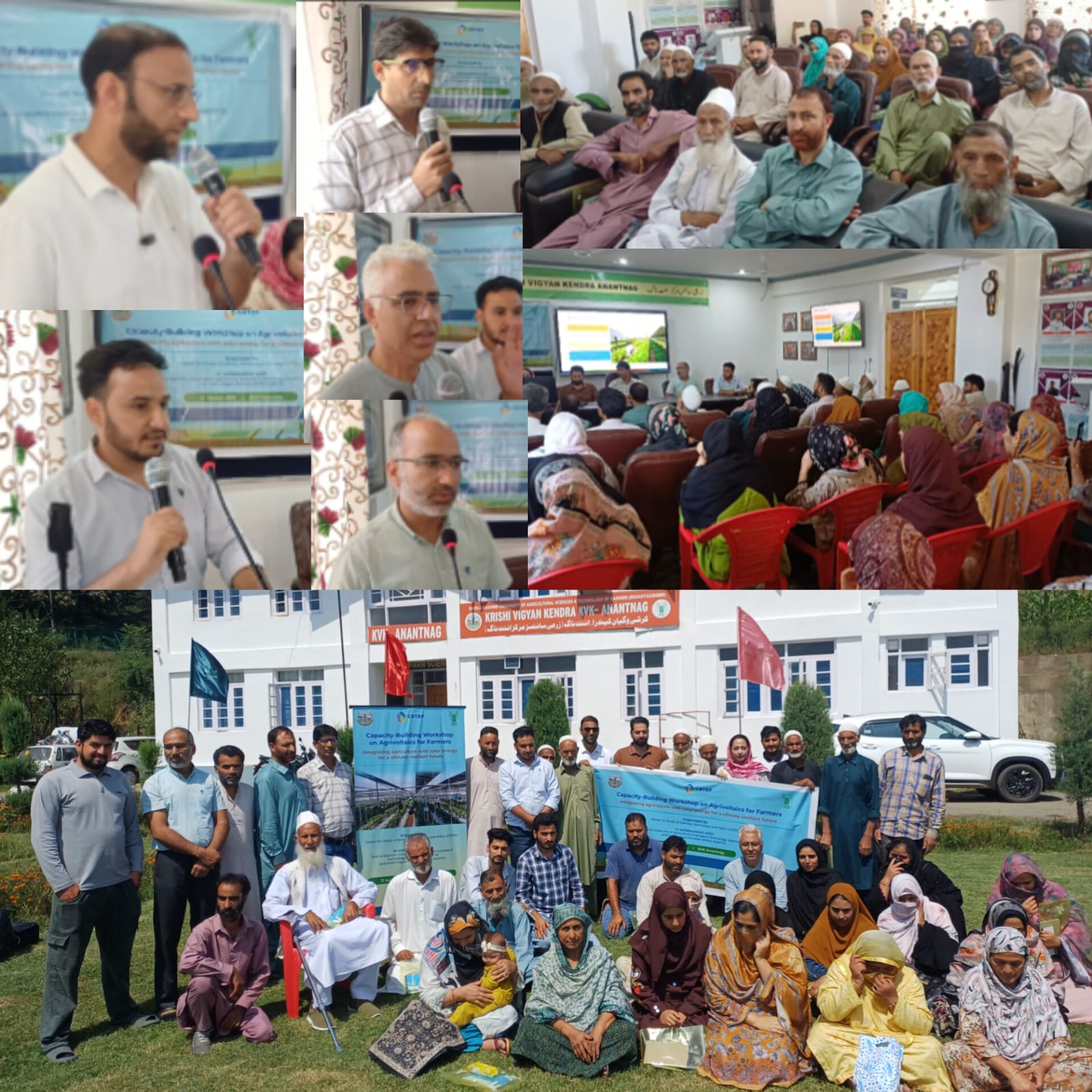
ANANTNAG: Krishi Vigyan Kendra (KVK)-Anantnag, SKUAST-Kashmir, in collaboration with the Centre for Study of Science, Technology and Policy (CSTEP), Bengaluru, today organized a Capacity Building Workshop on Agrivoltaics for Farmers entitled “Integrating Agriculture with Solar Energy for a Climate-Resilient Future” at KVK-Anantnag.
The workshop aimed to sensitise farmers and other stakeholders about the emerging concept of agrivoltaics, which integrates agricultural production with solar photovoltaic energy generation on the same land. The programme highlighted the potential of agrivoltaic systems to enhance farm income, promote renewable energy adoption, improve resource-use efficiency and contribute towards climate-resilient agriculture.
Speaking on the occasion, Dr. Ishtiyaq A. Khan, Senior Scientist & Head, KVK-Anantnag, emphasized that agrivoltaics represents a promising opportunity for the farming community of Jammu & Kashmir, particularly in the context of rising energy requirements, climate variability and the need for sustainable agricultural practices. He stressed the importance of generating location-specific technologies and demonstrating suitable agrivoltaic models under the agro-climatic conditions of the region.
Umer Majeed, Analyst, CSTEP, Bengaluru, shared technical insights on different agrivoltaic configurations, opportunities for integrating crops with solar energy systems, resource optimization, economic considerations and the potential role of farmers in the emerging renewable-energy-based agricultural economy.
The participants were also sensitized about the importance of selecting suitable crops and designing solar structures in a manner that maintains agricultural productivity while enabling efficient solar power generation.
During the technical deliberations, KVK scientists discussed various aspects of agrivoltaics, including site suitability, crop selection, solar-panel configurations, irrigation requirements, land-use efficiency, energy generation, investment requirements, economics and long-term sustainability.
The scientists emphasized that agrivoltaic systems need to be designed according to the specific farm conditions, cropping systems and energy requirements of individual farmers.
As a key outcome of the workshop, it was desired that interested farmers may prepare Detailed Project Reports (DPRs) for establishment of suitable agrivoltaic systems on their respective farms, taking into consideration the available land, existing cropping pattern, irrigation facilities, power requirements, investment potential and technical feasibility.
KVK-Anantnag and the collaborating experts expressed their willingness to facilitate farmers in understanding the technical requirements and developing appropriate models based on site-specific conditions.
The workshop also provided an interactive platform for farmers, Krishi Shakis and other stakeholders to discuss their concerns, opportunities and practical experiences related to solar energy and agriculture.
The technical sessions focused on creating awareness about the potential benefits, challenges and future scope of agrivoltaics in the region.
The programme underscored the need for collaborative research, field demonstrations, capacity building and farmer-oriented business models to facilitate the adoption of agrivoltaic technologies.
It was highlighted that integration of agriculture with renewable energy could open new avenues for income diversification while contributing to the broader goals of sustainable and climate-smart agriculture.
The workshop concluded with a call for strengthening collaboration among SKUAST-K, KVKs, CSTEP, farmers, government departments and other stakeholders for developing and demonstrating viable agrivoltaic models suited to the local conditions of Jammu & Kashmir.
