


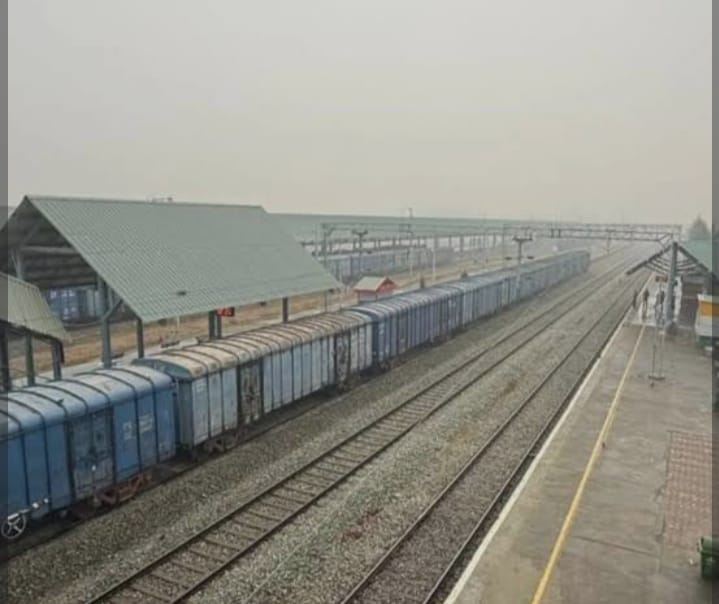
JAMMU: Strengthening its logistics and freight transportation capabilities, Northern Railway’s Jammu Division has achieved a major milestone by successfully transporting a full rake of food grains to the Kashmir Valley within 24 hours.
In a significant development, a goods train comprising 42 BCN wagons loaded with rice was dispatched from Sangrur Goods Shed of Ambala Division on January 21 and is scheduled to reach the Anantnag Goods Terminal in less than 24 hours. The rake is carrying approximately 2,768 tonnes of rice, marking the first-ever movement of a full rake of food grains to the Kashmir Valley by rail.
Earlier, on December 21, a partial rake of 21 BCN wagons belonging to the Food Corporation of India (FCI) had reached Anantnag Goods Terminal from Ajitwal Goods Shed of Firozpur Division, carrying around 1,384 tonnes of food grains. Building on the success of that operation, the Jammu Division, under the guidance of Senior Divisional Commercial Manager Uchit Singhal, held sustained consultations with FCI to enhance logistics efficiency and reduce transportation costs.
The successful movement of a full rake is expected to significantly strengthen the food supply chain and distribution network in the Valley. Rail-based transportation will ensure faster, uninterrupted and cost-effective movement of food grains from Punjab and other parts of the country to Kashmir, compared to traditional road transport.
Senior Divisional Commercial Manager Jammu, Uchit Singhal, termed the achievement a historic moment for Jammu and Kashmir. “The arrival of the first full rake of 42 BCN wagons represents a major boost to freight movement and logistics capacity in the region. It will ensure smoother supply of essential commodities to traders and the general public while laying a strong foundation for economic growth,” he said.
Railways and the Food Corporation of India have jointly initiated this food grain goods train service for Kashmir. Officials said that in the coming months, more food items and essential commodities will be transported directly to the Valley by rail, benefiting local markets and strengthening the region’s overall supply chain.
