


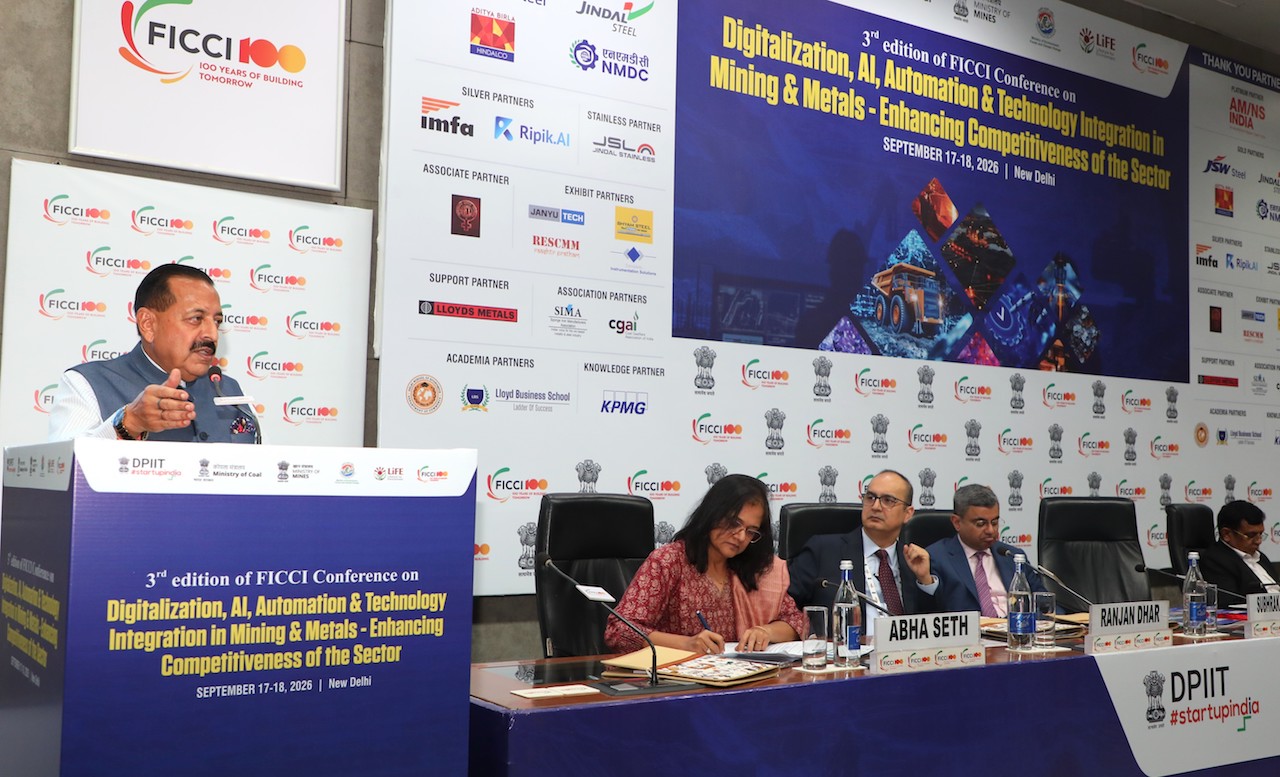
NEW DELHI: India seeks technology-driven competitive advantage in mining and metals, and needs to move from a resource advantage to a technology-driven competitiveness in mining and metals, with technology integrated across the entire value chain, from geological exploration and mining to processing, logistics, recycling and downstream manufacturing, Union Minister of State (Independent Charge) for Science & Technology and Earth Sciences and MoS PMO, Personnel, Public Grievances, Pensions, Atomic Energy and Space, Dr. Jitendra Singh, said today.
He said the competitiveness of the sector would increasingly depend not merely on how much mineral is extracted or metal is produced, but on how efficiently, safely, sustainably and intelligently India converts its geological resources into high-value, resilient and circular material supply chains. He called for moving beyond isolated technology pilots towards connected, scalable and trusted technology systems that can transform the sector at industrial scale.
Dr. Jitendra Singh was addressing the inaugural session of the 3rd Edition of the FICCI Conference on “Digitalization, AI, Automation & Technology Integration in Mining & Metals: Enhancing Competitiveness of the Sector” at FICCI Federation House, New Delhi. The two-day conference, brings together policymakers, industry leaders, technology providers, startups, researchers and international partners to discuss technology adoption across India’s mineral-based industries. KPMG in India is the knowledge partner for the conference.
The Minister said India’s mining and metals sector is entering a defining phase as the country moves towards Viksit Bharat @ 2047, with the sector playing a central role in infrastructure development, energy transition, manufacturing growth, self-reliance and economic competitiveness. He said the country’s growth over the past decade, supported by infrastructure, domestic manufacturing, digital infrastructure, innovation and investment, has created the scale and capabilities required for technology-led expansion across major sectors.
Dr. Jitendra Singh said the competitiveness challenge for mining and metals is changing rapidly. Declining ore grades, deeper and more complex deposits, energy and logistics costs, geopolitical concentration of critical-mineral supply chains, decarbonisation requirements and changing customer expectations are creating the need for a new technology-led approach. Technology, he said, must therefore be treated not as an isolated capital investment or a collection of pilots, but as a strategic enabler spanning the mineral resource-to-metals-to-downstream value chain.
The Minister said digital technologies can bring together geological, operational, equipment, process, energy, logistics and market data, enabling faster and more precise decision-making through greater visibility, prediction, coordination and automation. Process technologies can improve extraction and recovery, unlock low-grade ores and residues, reduce energy and water intensity, support lower-carbon metal-making, and strengthen capabilities in separation, refining, advanced materials and recycling, thereby reducing costs and improving the competitiveness of Indian minerals and metals in domestic and global markets.
Dr. Jitendra Singh called for India to build domestic capabilities in separation, purification, refining, advanced materials, magnet manufacturing, recycling and associated equipment, skills and intellectual property. He said technologies that have already matured should be deployed and scaled, while underutilised resources should first undergo process validation and then be scaled. Where strategic capabilities are not yet available at commercial scale, India should build them or partner selectively while developing domestic know-how.
The Minister said the Ministry of Science and Technology can connect scientific excellence with industrial outcomes in advanced materials, artificial intelligence, robotics, cyber-physical systems, sensing, clean energy, biotechnology, geospatial technologies and deep-tech entrepreneurship. He said the 25 Technology Innovation Hubs established under the National Mission on Interdisciplinary Cyber-Physical Systems provide a platform for technology translation, entrepreneurship and industry collaboration in areas directly relevant to smart mines, plants and supply chains.
Referring to the ₹1 lakh crore Research, Development and Innovation Scheme, Dr. Jitendra Singh said it is designed to catalyse private-sector participation in high-impact R&D and strategic technologies. The scheme can support transformative projects at Technology Readiness Level 4 and above through long-term financing, equity support for start-ups and deep-tech funding mechanisms, he said.
The Minister said the next phase of technology-led transformation requires bringing together national missions, research institutions, industry problem statements, start-ups, test facilities and risk capital, so that promising technologies can move from laboratory to pilot and from pilot to industrial scale. Sector-wide transformation, he said, would require value-focused technology adoption, strong digital infrastructure, industrial-scale testing and demonstration, skilled human capital and deeper collaboration among government, industry, academia and innovators.
Dr. Jitendra Singh urged the mining and metals industry to identify a focused set of high-value operational and process challenges and establish facilities, data and domain expertise for collaborative development and validation. He also encouraged laboratories, universities and Technology Innovation Hubs to work closely with industry requirements, including performance specifications, cost targets, qualification standards and clear pathways to commercial deployment.
Calling for technology solutions designed around Indian operating realities, the Minister said technology companies and start-ups must take into account varied geology, brownfield plants, tough environmental conditions, affordability, interoperability and scale. He said the success of technology adoption should be measured not merely through prototypes, patents or pilots, but through technologies that are qualified, adopted, replicated and commercialised, along with the value they create for the economy, industries, environment, workforce and communities.
“We should not be content only by adopting the next generation of mining and metals technologies. Our ambition should be to develop, demonstrate and scale technologies in India, for India and for the world,” Dr. Jitendra Singh said. He also congratulated FICCI and KPMG in India on the release of the thought leadership report accompanying the conference.
Dr. Jitendra Singh called for collective efforts to build a mining and metals ecosystem that is technologically advanced, globally competitive and environmentally responsible, aligned with the vision of Atmanirbhar Bharat and Viksit Bharat @ 2047.
