


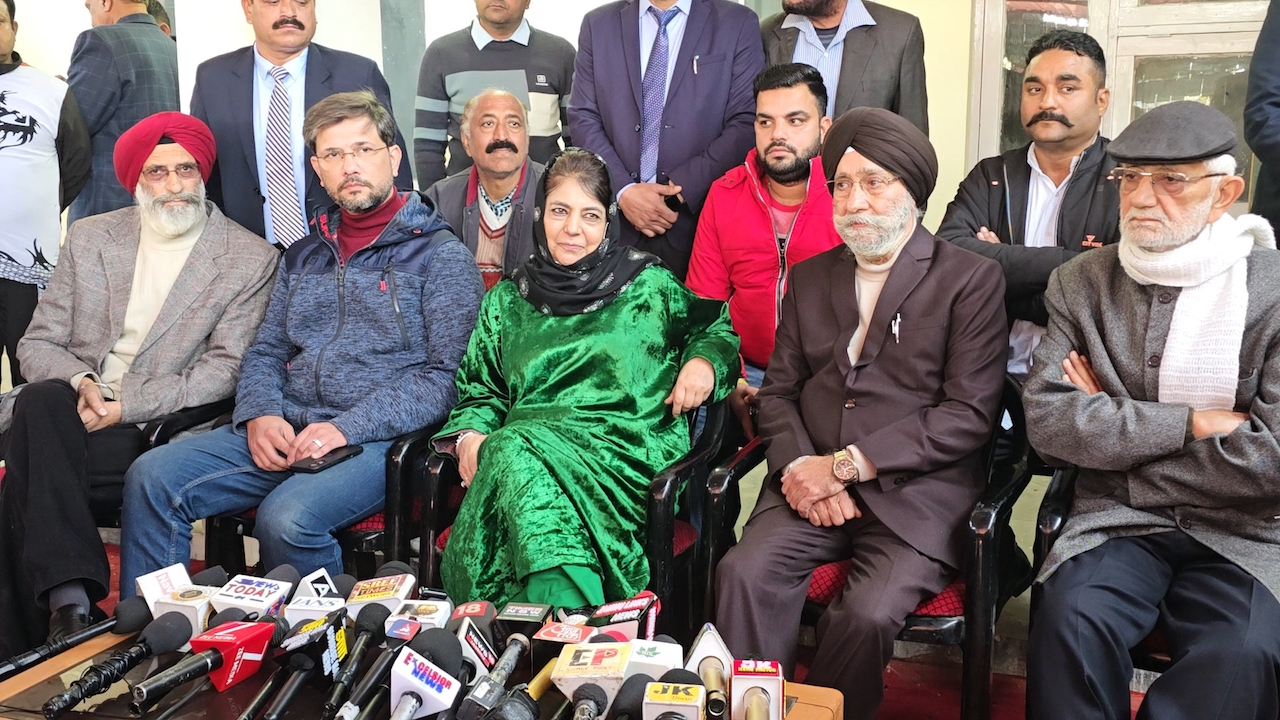
JAMMU: PDP president and former Jammu and Kashmir chief minister Mehbooba Mufti on Tuesday said her party’s sole agenda is the restoration of peace, prosperity and unity in Jammu and Kashmir through dialogue, development and inclusive governance.
Rejecting allegations that her proposal for granting divisional status to the Pir Panjal and Chenab Valley regions was linked to the Dixon Plan, Mufti said the demand was purely administrative and aimed at ensuring balanced development of “neglected” areas.
Criticising both the National Conference (NC) and the BJP for politicising the issue, Mufti said the PDP has consistently worked for dialogue and reconciliation. “The PDP has only one agenda — restoration of peace in Jammu and Kashmir with dignity and respect. Dialogue should be held within Jammu and Kashmir and also with Pakistan, as demonstrated by Mufti Mohammad Sayeed during the Atal Bihari Vajpayee era,” she told reporters.
She recalled that during that period, cross-border routes such as Poonch–Rawalakote and Uri–Muzaffarabad were opened. “We want improvement in the situation so that the Army can return to the barracks. Power projects should either be returned to Jammu and Kashmir or adequate compensation be provided. Our aim is prosperity, unity and the government reaching out to the people,” she said.
Responding to NC president Farooq Abdullah’s remarks linking her proposal to the Dixon Plan, Mufti said she respects him and considers him a tall leader of Jammu and Kashmir, but added that “he seems to have forgotten that his father Sheikh Mohammad Abdullah was arrested for the same formula.”
“That may have been the agenda of the National Conference and its founder, for which he was dismissed and jailed. It can never be the agenda of the PDP,” she asserted.
The Dixon Plan, proposed in 1950 by UN representative Sir Owen Dixon, had suggested regional divisions as a possible solution to the Jammu and Kashmir dispute between India and Pakistan.
Mufti said Pir Panjal, comprising Rajouri and Poonch, is a backward region bearing the brunt of cross-border hostilities, while the Chenab Valley — Ramban, Doda and Kishtwar — is environmentally fragile and frequently affected by natural disasters.
“Democracy demands empowerment of people and governance closer to them. I spoke about administrative decentralisation, not the Dixon Plan. My father spent his entire life keeping Jammu and Kashmir united,” she said, adding that Mufti Mohammad Sayeed formed a government with the BJP to honour the people’s mandate.
Lashing out at the BJP, Mufti said it was ironic for the party to accuse her of implementing the Dixon Plan when it had already bifurcated the erstwhile state by carving out Ladakh in 2019 and seeking separate statehood for Jammu.
“We are not seeking to merge Pir Panjal or Chenab Valley with Kashmir. We want separate divisional status for both regions for the benefit of the people,” she said, alleging that the BJP had effectively implemented the Dixon Plan by redrawing the Anantnag parliamentary constituency to include Poonch and Rajouri.
Mufti also condemned reports of journalists being summoned to police stations in Srinagar and expressed disappointment that the issue was not raised or condemned by the National Conference leadership.
