


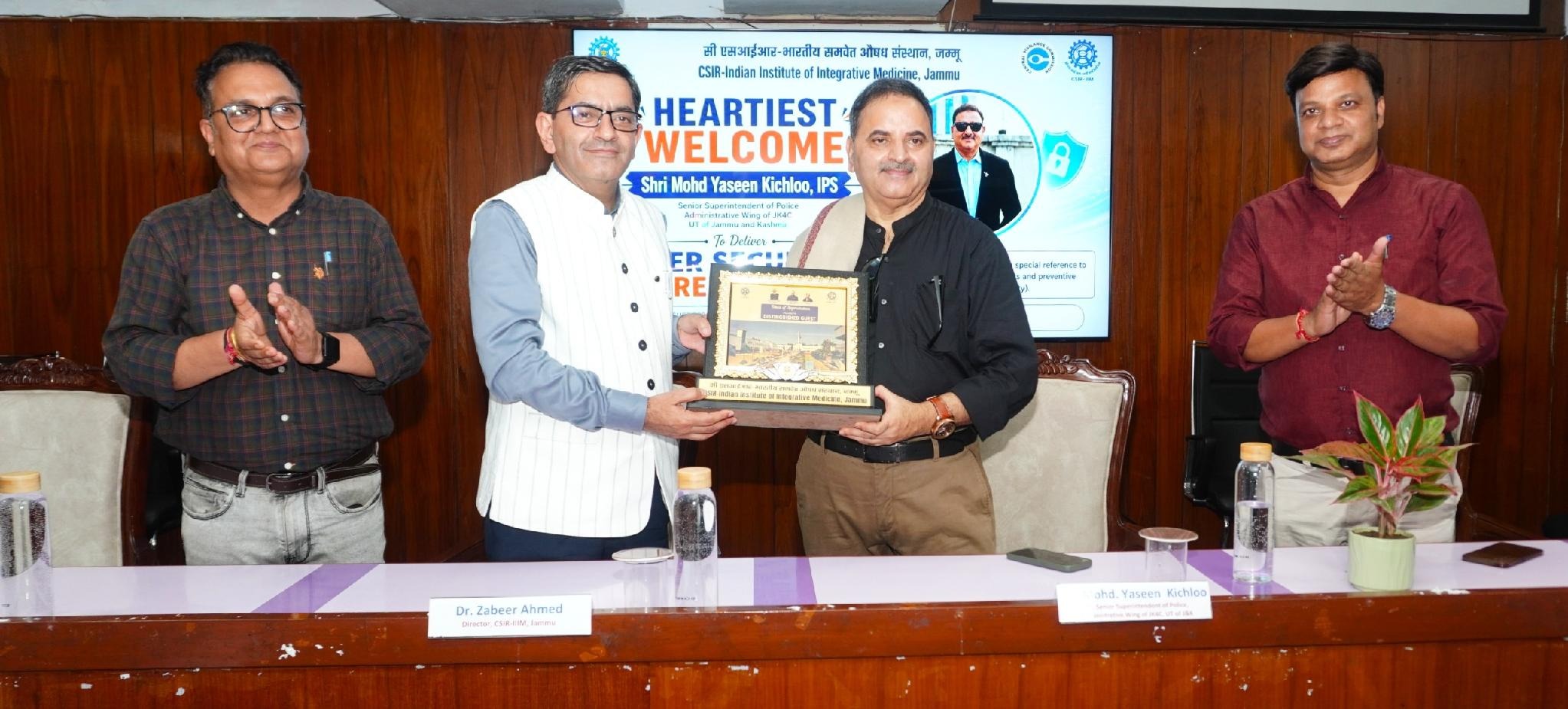
JAMMU: CSIR-Indian Institute of Integrative Medicine (CSIR-IIIM), Jammu, on Tuesday organised a Cyber Security Awareness Talk as part of its three-month campaign on Preventive Vigilance, being held ahead of Vigilance Awareness Week 2026 under the theme “Probity for Prosperity.”
The programme was held under the leadership of Dr. Zabeer Ahmed, Director, CSIR-IIIM Jammu and Director, CSIR-National Botanical Research Institute (CSIR-NBRI), Lucknow, who also addressed the gathering.
Speaking on the occasion, Dr. Zabeer Ahmed emphasised the growing importance of cyber security in scientific and research institutions. He stressed the need for scientists, officers and employees to remain vigilant while handling digital platforms, research information and institutional data.
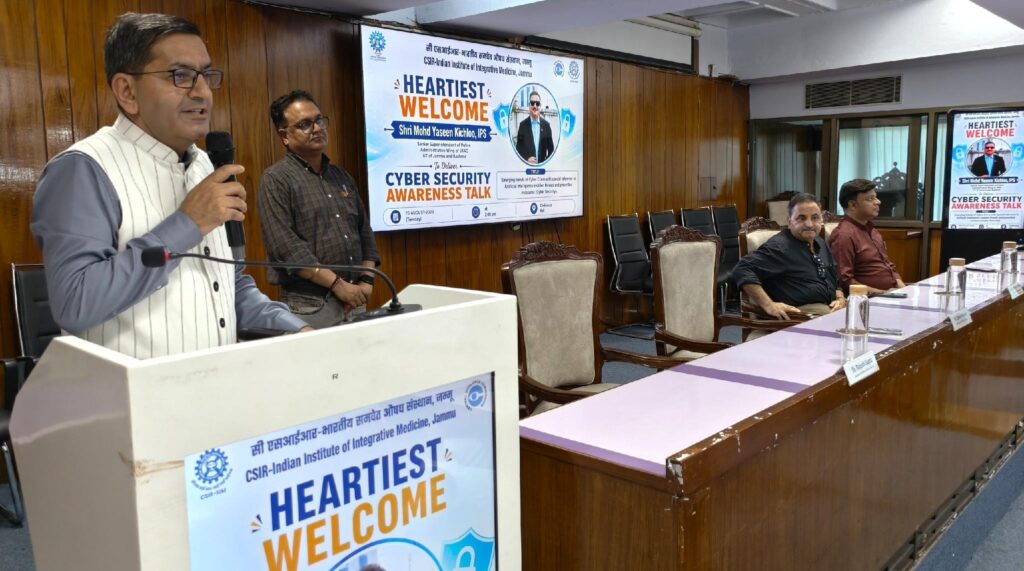
He said that with rapid advances in artificial intelligence and digital technologies, cyber threats are also becoming increasingly sophisticated, making awareness and preventive measures essential for protecting valuable scientific information and intellectual property.
Mohd Yaseen Kichloo, IPS, Senior Superintendent of Police, Administrative Wing of JK4C, J&K UT, delivered the awareness talk on “Emerging Trends of Cyber Crime with Special Reference to Artificial Intelligence-Enabled Threats and Preventive Measures (Cyber Security).”
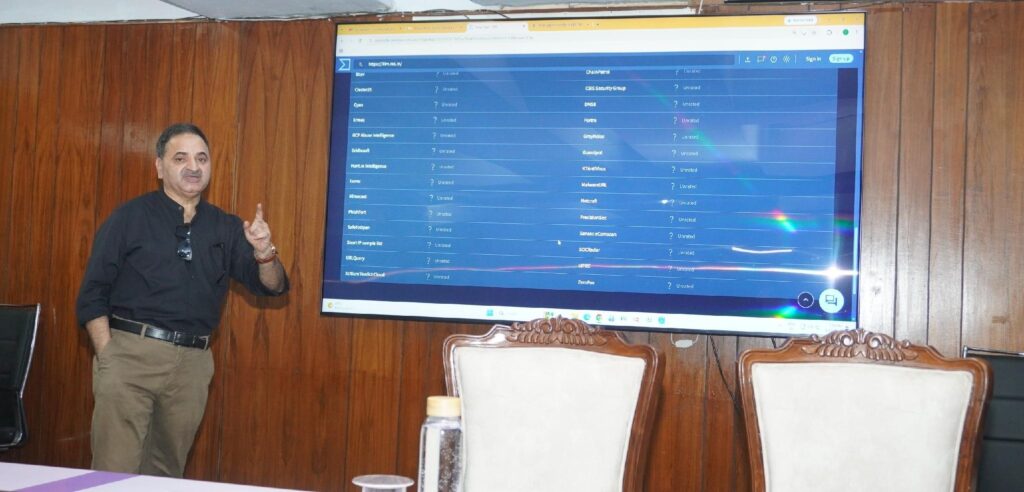
Addressing the participants, Kichloo said cybersecurity is no longer confined to computers and networks but has become a shared responsibility at the personal, organisational and national levels. He cautioned that research institutions such as CSIR-IIIM Jammu can be potential targets for cyber actors because of the valuable scientific research, intellectual property, patents, technologies and processes available with them.
Explaining the changing nature of cybercrime, Kichloo said the biggest vulnerability is often not the device but the human being using it. Cybercriminals increasingly use social engineering to exploit trust, fear, urgency and authority to obtain confidential information.
He advised employees to remain extremely careful about sharing passwords, OTPs, PINs, banking details and other credentials, even when a request appears to come from a senior officer or a trusted person.
Giving an example, he explained how criminals can use caller-ID spoofing to make a fraudulent call appear to be coming from the number of a senior official. He advised employees to independently verify such calls by contacting the concerned person through an official number already available in the organisation’s records.
Kichloo also highlighted the growing threat of AI-powered voice cloning, explaining that cybercriminals can use publicly available audio and video content to create synthetic versions of a person’s voice and use them to make fraudulent calls appear genuine.
He further warned about deepfake technology, through which criminals can manipulate a person’s face and voice to create highly convincing video calls. He urged employees not to rely solely on a familiar voice, phone number or video and to independently verify any unusual or urgent request before taking action.
The speaker also emphasised that cybersecurity extends beyond conventional computers to smartphones, smart watches, digital machines and other connected devices, all of which need appropriate protection.
Rajesh Gupta, Administrative Officer, CSIR-IIIM Jammu, delivered the welcome address and welcomed the speaker and participants to the programme. Sh. Kaushal Kumar, Controller of Administration, CSIR-IIIM Jammu, and other officers and officials were also present on the occasion.
