


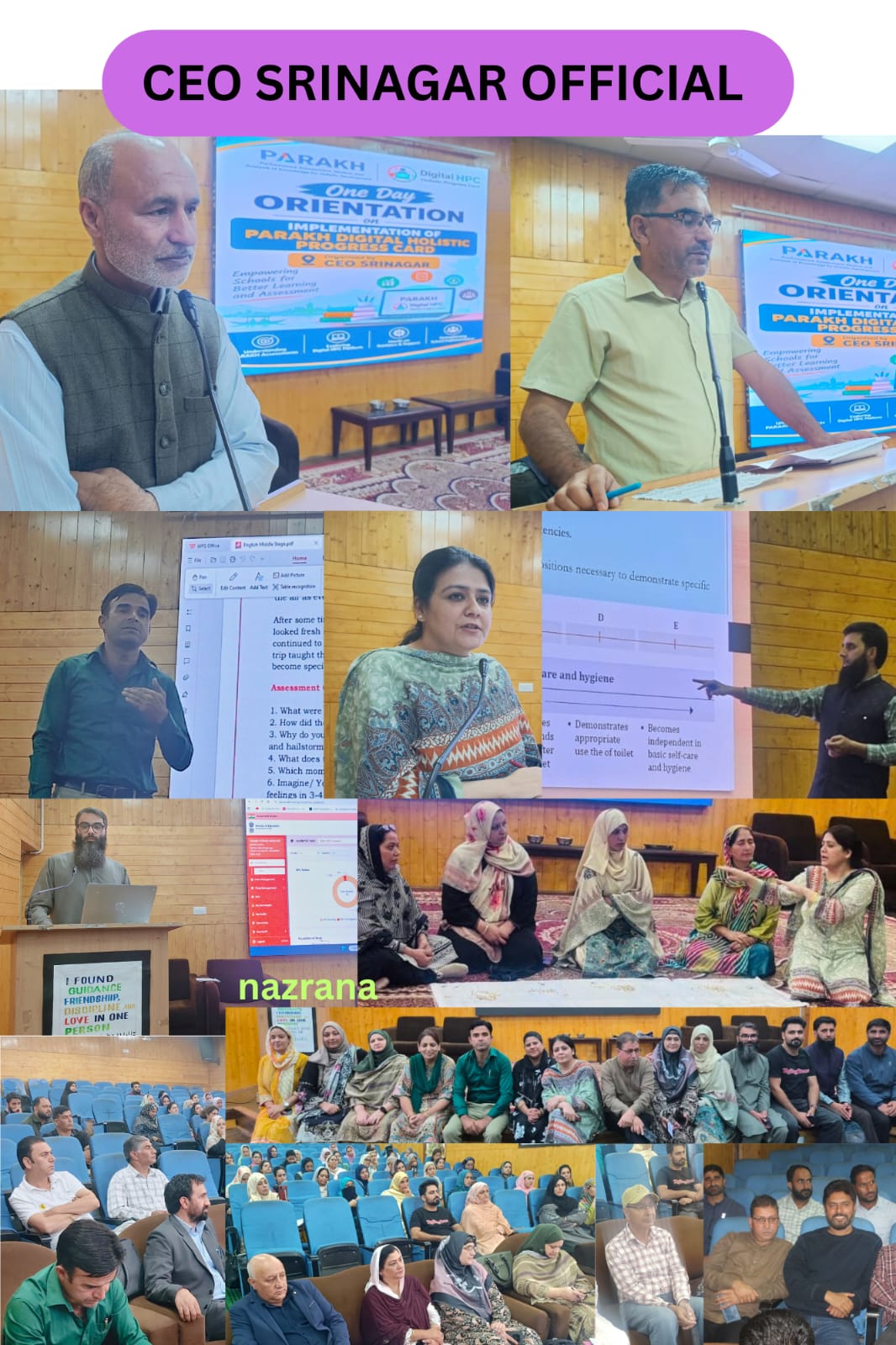
SRINAGAR: In a significant stride towards realising the vision of the National Education Policy 2020, Ghulam Mohi-ud-din Bhat, Chief Education Officer (CEO), Srinagar, organised a one-day orientation workshop on PARAKH and the Implementation of the Digital Holistic Progress Report Card.
The workshop was held at the auditorium of Government Girls Higher Secondary School Kothibagh, Srinagar, and witnessed enthusiastic participation from education stakeholders across the district.
The orientation session was graced by eminent educationists including Fayaz Ahmad, UT Nodal Officer, Samagra Shiksha; Ghulam Hussan Reshi, UT Nodal Officer, PARAKH; Sameena Wani, Principal, GGHSS Kothibagh; Fayaz Ahmad, Faculty, DIET Srinagar; along with District Resource Persons and Zonal Resource Persons of District Srinagar.
In his inaugural address, CEO Srinagar expressed deep appreciation for the sustained academic support provided by the District Resource Persons and Zonal Resource Persons throughout the academic year. He underlined that the successful implementation of Vidya Pravesh and the competency-based teaching-learning process at the grassroots level in District Srinagar was made possible only through the collective dedication and hard work of the entire teaching faculty of the district.
Highlighting the transformative potential of modern assessment practices, the Chief Education Officer remarked, “The Holistic Progress Report is the very soul of our education system. It moves beyond conventional marks-based evaluation and captures the overall development of every child. The time has now come for every school in the district to adopt and institutionalise the practice of the Digital Holistic Progress Report Card. Our District Resource Persons and Zonal Resource Persons are both technically proficient and pedagogically sound, and they stand fully prepared to guide and support schools in this important transition.”
The technical sessions began with a highly insightful presentation by UT Nodal Officer, PARAKH. In his address, the Nodal Officer comprehensively explained the importance, objectives and broader vision of PARAKH. He emphasised that the role of the teacher has undergone a fundamental transformation in the present educational landscape. Teachers are no longer mere transmitters of knowledge; they are facilitators, mentors and designers of meaningful learning experiences. He strongly urged all educators to continuously upgrade their skills and equip themselves with the latest pedagogical techniques so that classroom practices remain aligned with the principles of competency-based education and holistic assessment.
Hilal Ahmad Wani, UT Resource Person, offered a detailed insight into the concept, structure and significance of the Holistic Progress Report Card during a focused session.
Nazrana, District Resource Person, Academic Monitoring Committee, conducted an engaging live demonstration on the systematic conduction of classroom activities and the formation of assessment rubrics. Bashir Ahmad Gojri, UT Resource Person, elaborated on various activity designs under the Holistic Progress Card framework, while Zaid, District Resource Person, Academic Monitoring Committee, gave a practical live demonstration of the Digital Holistic Progress Report Card, enabling participants to understand its smooth and effective application in schools.
The workshop concluded with a meaningful panel discussion that provided participants an opportunity to share experiences, seek clarifications and deliberate on effective implementation strategies. Participants expressed their gratitude to the Chief Education Officer, Srinagar, for conceptualising and organising the orientation programme, and to the UT Nodal Officers and all resource persons for conducting highly enriching, practical and inspirational sessions
