


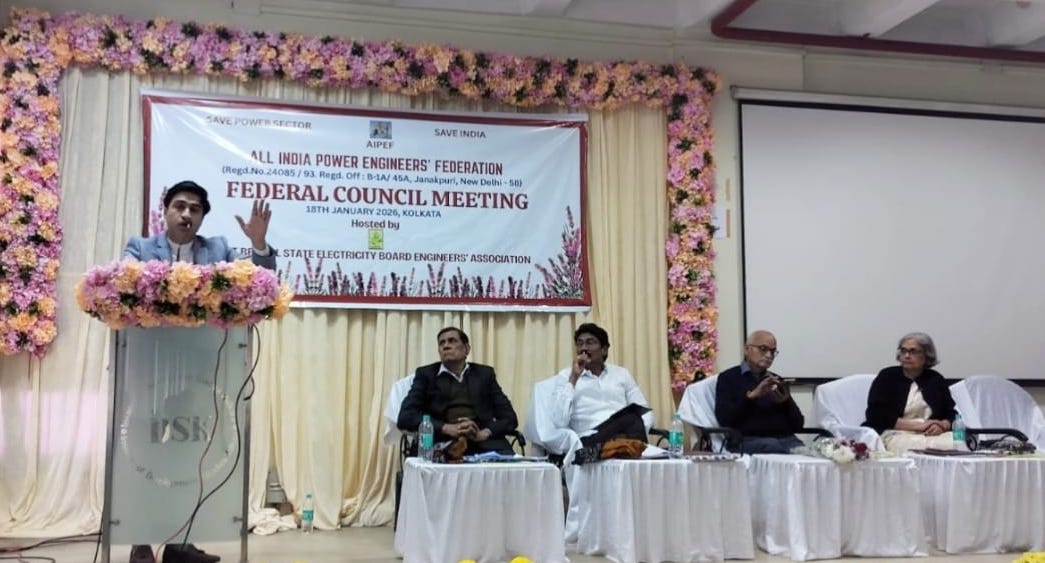
KOLKATA: The All India Power Engineers Federation (AIPEF) has resolved to launch a nationwide movement against the proposed Electricity (Amendment) Bill 2025 and the ongoing privatization of the power sector, particularly in Uttar Pradesh, warning of a countrywide agitation if the government does not withdraw the measures.
The decision was taken during the AIPEF Federal Council meeting held in Kolkata, West Bengal, which was attended by representatives from power engineers’ associations across several states and Union Territories.
Sachin Tickoo, General Secretary of Jammu & Kashmir Electrical Engineers’ Guild Association (JKEEGA) and Vice Chairman, AIPEF, along with Ankush Sharma and Ankush Gupta, Provincial Secretaries, participated in the meeting.
Addressing the Federal Council, Sachin Tickoo appealed to the Central and State Governments to halt the privatization of the power sector, stating that such moves are against the interests of farmers and poor consumers. He demanded the immediate withdrawal of the Electricity (Amendment) Bill 2025, issued by the Ministry of Power, asserting that the public sector must retain control over electricity generation, transmission, and distribution.
The Federation warned that failure to roll back the Bill and the privatization process in Uttar Pradesh would force power engineers and employees across the country to take to the streets in a joint nationwide agitation. A resolution was passed calling upon power engineers in all states and Union Territories to prepare for a countrywide strike against privatization.
AIPEF said it would form a joint front with farmers and consumers to launch a mass public movement and appealed to the general public to support electricity workers in their own interest.
The Federal Council meeting was presided over by Shailendra Dubey, Chairman of AIPEF, and attended by senior office bearers including Secretary General P. Ratnakar Rao, Patron P.N. Singh, Senior Vice Chairman Moupali Mukhopadhyay, and others.
The Federation noted that the Electricity (Amendment) Bill has been introduced six times, with earlier attempts failing due to strong resistance from power engineers, employees, and consumers. According to AIPEF, the Bill aims to privatize the entire power sector, allowing private companies to profit using government infrastructure while leaving subsidized consumers—farmers and the poor—with public utilities, thereby weakening them financially.
AIPEF also warned that provisions related to the removal of subsidy and cross-subsidy would lead to a sharp rise in electricity tariffs, making power unaffordable for the common man.
The Federation termed the alleged linking of financial assistance to forced privatization as “arm-twisting and blackmail” and said such actions would be strongly opposed.
Citing Odisha as an example, AIPEF claimed that repeated privatization experiments in the state had failed, including those involving AES, Reliance Power, and later Tata Power, with the Odisha Electricity Regulatory Commission issuing notices over poor consumer services.
The Federation also demanded the rollback of plans to privatize the transmission sector under tariff-based competitive bidding and asset monetization, warning that unchecked privatization would harm consumer interests.
Strongly condemning the alleged repression of power employees in Uttar Pradesh, AIPEF demanded the withdrawal of all punitive actions and asserted that privatization would not be imposed through fear.
Representatives from Kerala, Telangana, Tamil Nadu, Karnataka, Maharashtra, Gujarat, Chhattisgarh, Madhya Pradesh, Meghalaya, Odisha, West Bengal, Jharkhand, Jammu & Kashmir, Punjab, Uttarakhand, Delhi, Uttar Pradesh, and Damodar Valley Corporation participated in the meeting.
