


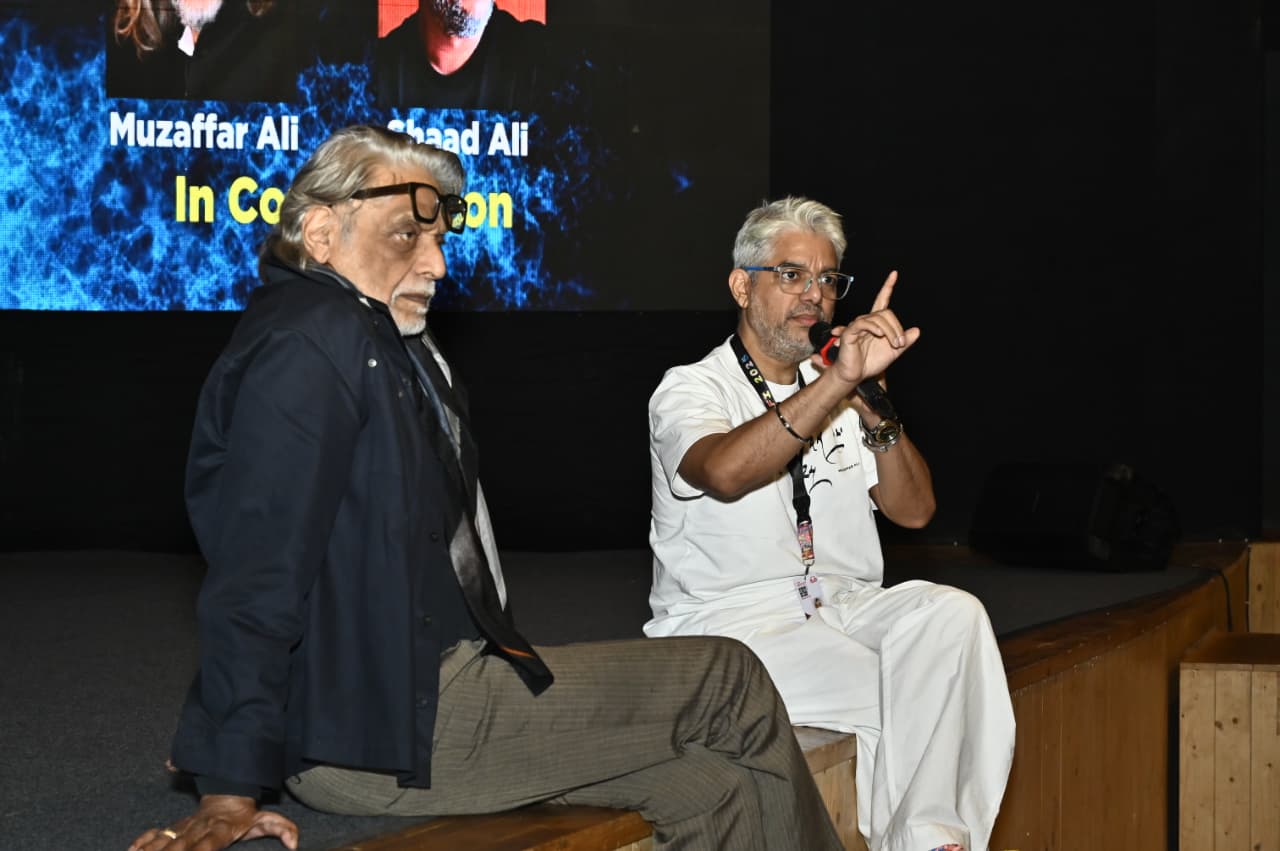
GOA: An evocative In-Conversation session titled “Cinema and Culture: Reflections from Two Eras” at IFFI 2025 offered audiences a rare glimpse into an intergenerational dialogue — where memory met modernity, and dreams passed gently from father to son.
Filmmaker Ravi Kottarakara opened the session with a heartfelt felicitation of the acclaimed duo, praising their artistic influence and enduring contributions to Indian cinema.
Moderating the session with affection and sharp insight, filmmaker Shaad Ali guided his father, cinematic visionary Muzaffar Ali, through a reflective journey spanning decades of creativity, rebellion, and reinvention.
Shaad began with a seemingly simple question — What did you dream of becoming as a child?
Muzaffar Ali’s response unfolded like one of his own lyrical frames: childhood drawings, the allure of poetry, art prizes, and a world where cinema arrived later — as liberation. Calcutta, he recalled, opened the door to experimentation, where films became “a space where imagination roams freely.”
“Filmmaking is about what your chemistry, botany, geology is,” he said — grounding artistry in the very elements of being.
His early life, marked by witnessing the struggles of migrant workers, infused the soul of his debut Gaman — a story of displacement that won the Silver Peacock at IFFI. But recognition, he admitted, never made him feel triumphant:
“Success did not empower me. It only reminded me that new struggles always await.”
The conversation turned to music — a defining feature of Umrao Jaan. Rootedness, he said, guided every choice from staging to storytelling.
“Poetry makes you dream — and the poet must dream with us.”
Music, for him, is surrender: a collective emotion shaped by philosophy and humility.
Then came a film that became legend without completion — Zooni. Conceived in Kashmir as a bilingual epic, it was challenged by weather, culture, logistics — ultimately pausing a dream too large for its time.
“It was a dream beyond many dreams,” he said, recalling the heartbreak.
Yet, he reaffirmed his belief that Kashmir’s cinema must rise from within:
“Kashmir has everything. You don’t need to invite talent — you need to grow it there.”
Shaad Ali shared how the ongoing restoration of Zooni has become a healing journey — revisiting reels, music, and memory. A moving short film, Zooni: Lost and Found, was screened, capturing a story of art paused, rediscovered, and still full of promise.
During the Q&A interaction, when asked about films that honour Kashmir’s authentic culture rather than superficial backdrops, Muzaffar Ali’s response was unwavering:
Zooni was meant to be that film.
As the session came to a close, the audience understood they had witnessed more than a cinematic conversation. They had seen legacy in motion — a father passing on his world of dreams, and a son carrying forward the flame — not by imitation, but through evolution.
In that moment, cinema felt less like a career — and more like an inheritance of hope.
