


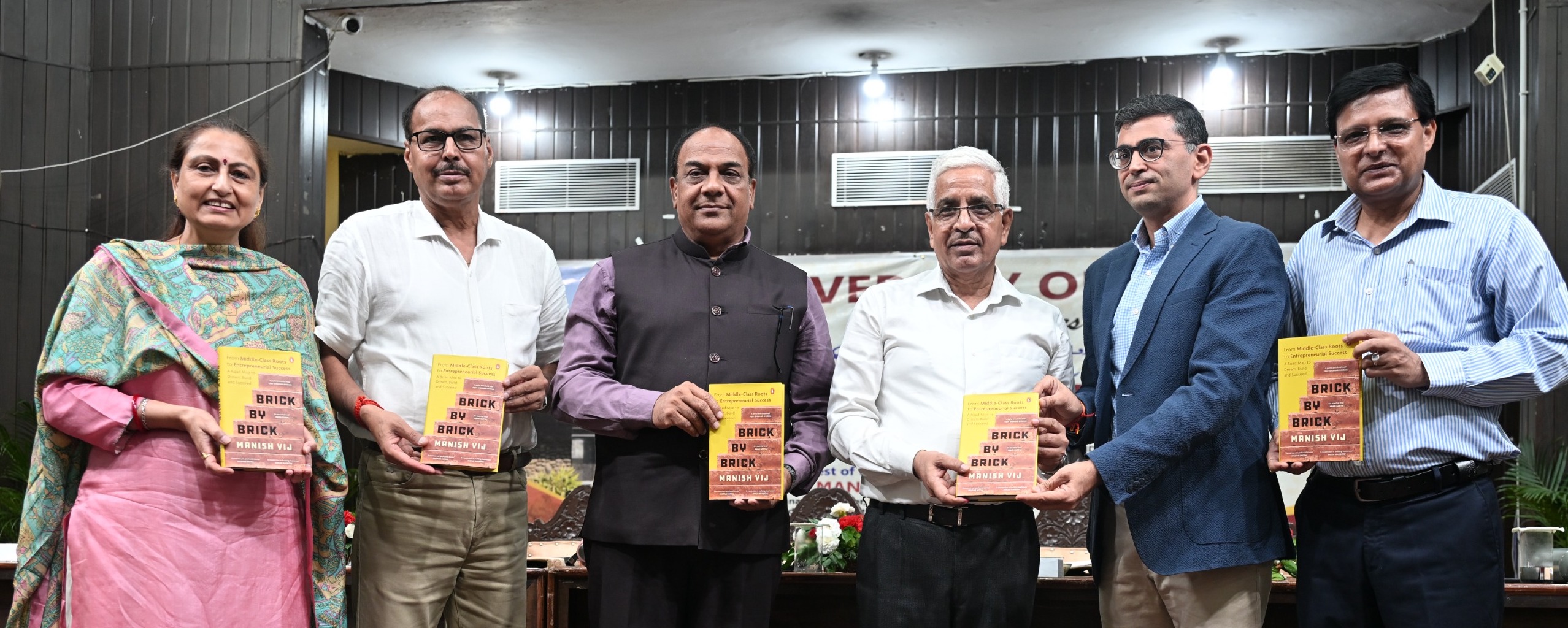
JAMMU: The University of Jammu celebrated its 58th Foundation Day with Vice-Chancellor Prof. Umesh Rai calling upon the University fraternity to move beyond conventional, marks-oriented education and build an academic ecosystem focused on problem-solving, project-based learning, research, innovation, entrepreneurship and societal relevance.
Addressing the gathering, Prof. Rai said the Foundation Day was not merely an occasion to celebrate the University’s 58-year journey but also an opportunity to reflect on the institution it must become for future generations.
He said the University of Jammu had reached a stage where it should have the confidence to create new models of higher education rather than simply follow established ones.
“I want the University of Jammu to be an example for others,” Prof. Rai said, urging the University community to work collectively towards making it a model institution for the country.
The Vice-Chancellor emphasised that changing times required universities to rethink how students are taught, assessed and prepared for life. He said education could no longer remain excessively centred on marks, examinations and rote learning, stressing that students should increasingly be assessed on their ability to think, collaborate, create and solve problems.
“We cannot determine the future of today’s students according to the standards and circumstances of our own student days,” he said.
Focus on project-based, interdisciplinary learning
Prof. Rai called for greater emphasis on project-based and interdisciplinary learning, encouraging students from different disciplines to work together on real-life challenges. He said the University had already begun experimenting with such approaches and urged faculty members to make project-mode learning an integral part of curriculum design.
Referring to the University’s new undergraduate-postgraduate programme, he said the initiative seeks to bring students from different academic streams onto a common multidisciplinary platform, with exposure to areas including Information Technology, mathematics, data, communication skills, coding, Artificial Intelligence and financial literacy.
He cautioned the academic fraternity against allowing innovative programmes to eventually revert to conventional teaching practices.
“Please do not take it towards rote learning. Take it towards project-mode learning and real-life problem-solving,” he said.
Research and innovation at the centre
Placing research at the heart of the University’s future, Prof. Rai highlighted the institution’s growth in research performance, with citations increasing from around 944 to 10,549. He also noted that admissions had risen from around 1,800 last year to more than 2,800 this year, which he said reflected growing confidence in the University.
He highlighted the University’s participation in the National Research Foundation’s Partnership for Accelerated Innovation and Research programme in collaboration with IIT Delhi, stressing the importance of meaningful institutional and interdisciplinary collaborations.
Research and innovation at the University, he said, are expanding into emerging areas including energy storage, health sciences, cybersecurity, communication, financial technologies, biometric authentication and patient-safety technologies.
However, Prof. Rai stressed that technology alone could not define the university of the future.
“Education means understanding oneself and understanding society,” he said, underlining the importance of values, ethics, wisdom, culture and humanities alongside technological advancement.
Centre for Regional Studies proposed
Prof. Rai also stressed the University’s responsibility towards the region and society from which it draws its identity. He highlighted the proposed Centre for Regional Studies, Culture, Dialects and Emotional Intelligence, which will focus on the culture, literature, dialects, traditions and heritage of Jammu and Kashmir, besides exploring their possible links with tourism, entrepreneurship and the economy.
“If we do not strengthen our own culture, literature, dialects and traditions, nobody else will come and do it for us,” he said.
He also referred to the Jammu and Kashmir Sahitya Sanskriti Samagam, which brought together diverse literary and cultural traditions from across the region and witnessed participation of more than 50,000 people.
Infrastructure expansion underway
The Vice-Chancellor outlined various infrastructure initiatives, including strengthening of digital infrastructure, expansion of land resources, new academic and skill-development facilities and improvement of boys’ and girls’ hostels.
He credited generations of teachers, employees, students, alumni and other stakeholders for building the University over the past 58 years and said the present generation had the responsibility to strengthen that legacy.
Calling himself merely a “catalyst” in the University’s transformation, Prof. Rai said every member of the University fraternity had a role in shaping its future.
Guest highlights education, research and employment
Chief Guest Dr. Dheer Singh, Director, ICAR-National Dairy Research Institute (NDRI), Karnal, congratulated the University fraternity and said universities were institutions that shape individuals, society and the nation.
He identified education, research and employment as three crucial dimensions of a modern university and called for research to move beyond laboratories and academic publications towards technologies, products, enterprises and solutions for society.
Referring to Jammu and Kashmir’s potential in agriculture, handicrafts, local products and knowledge traditions, Dr. Singh said research and innovation could generate employment and economic value.
He also underlined the importance of Artificial Intelligence and digital transformation, while stressing that technology must remain connected with values, ethics and social responsibility.
Industry-academia partnership, AI focus stressed
Guest of Honour Shri Manish Vij, Managing Partner, Smile Group and Founder, Vanna Ventures, New Delhi, called for stronger industry-university partnerships and greater interdisciplinary learning.
Using the letter “T” as an analogy, he said its vertical line represented depth and specialisation, while the horizontal line represented cross-functional and interdisciplinary learning.
He urged universities to focus on live industry projects, interdisciplinary education and the opportunities presented by Artificial Intelligence.
Vij said projects should address real business and societal problems rather than merely end with certificates or reports. He also suggested extending AI applications beyond Computer Science to areas such as law, psychology, biology, agriculture and management.
“The University of Jammu has an opportunity to become an AI university for India,” he said.
Distinguished alumni, students and employees felicitated
A major highlight of the celebrations was the felicitation of distinguished alumni who have excelled in judiciary, civil administration, tourism and entrepreneurship, besides student achievers and best-performing University employees.
Among the distinguished alumni honoured was Justice Wasim Sadiq Nargal, alumnus of Law and presently Judge of the High Court of Jammu & Kashmir and Ladakh. His legal career spans more than three decades.
Shri Udham Dass, JKAS, alumnus of the Department of History and presently Additional Secretary at the Lieutenant Governor’s Secretariat, was also honoured. A Gold Medallist in M.A. History from the University, he could not attend the function due to official engagements, and his memento was received on his behalf by the Registrar.
Ms Ansuya Jamwal, JKAS, alumna of The Business School and presently Additional Deputy Commissioner, Jammu, was felicitated for her contribution to public administration.
The University also honoured Shri Vijay Kumar, Joint General Manager-Tourism, IRCTC Ltd., North Zone, New Delhi, and Shri Rajat Salgotra, a Gold Medallist in MBA International Business and Founder and CEO of Samast Eco Alternatives Pvt. Ltd., for their professional and entrepreneurial achievements.
Student achievers in sports, cultural activities, NSS and NCC were also felicitated for their accomplishments at University, national and international levels.
The University honoured its best-performing employees, including Vikas Bhat, Neeru Gupta, Ashwani Kumar and Jagtar, for their dedication and contribution.
Earlier, the University organised a Nasha Mukt Pledge, led by Prof. Umesh Rai, reaffirming its commitment towards a drug-free society.
The programme also featured cultural performances showcasing the creativity of students and the region’s rich cultural traditions.
Prof. Neelu Rohmetra, Dean Research Studies, welcomed the gathering and described the University’s 58-year journey as a testimony to resilience, perseverance and the contribution of generations of stakeholders.
The vote of thanks was delivered by Dr. Neeraj Sharma, Registrar, University of Jammu. The event was attended by senior faculty members, Deans, Rectors and Directors of offsite campuses, University officers, faculty members, research scholars, students, non-teaching employees, distinguished alumni, invited guests and members of the media fraternity.
