


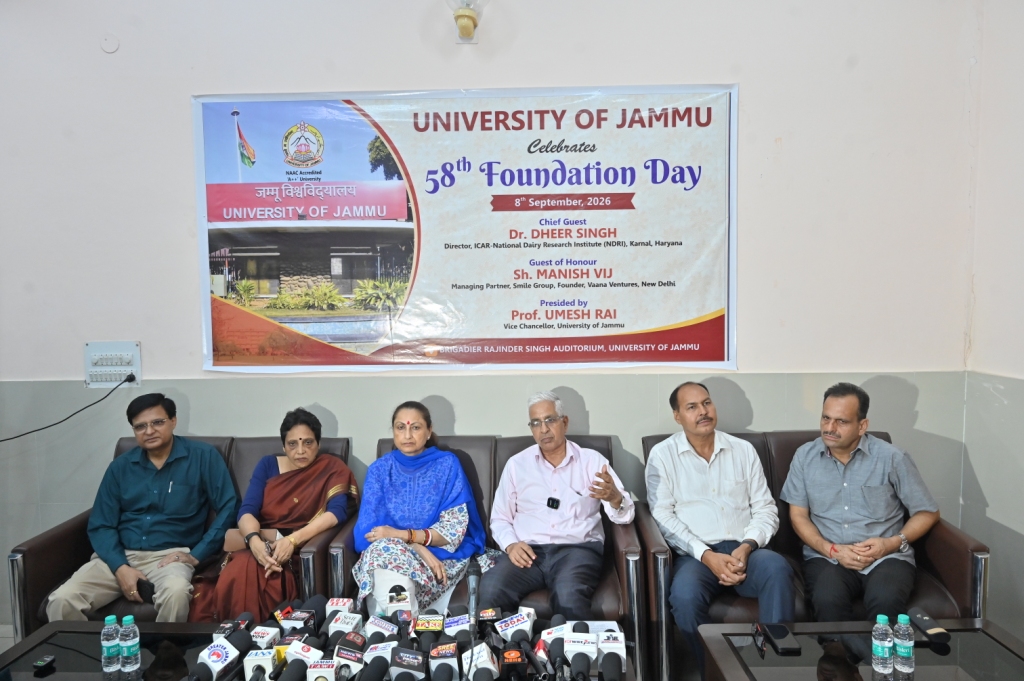
JAMMU: Ahead of the University of Jammu’s 58th Foundation Day celebrations, Vice Chancellor Prof. Umesh Rai on Monday outlined an ambitious roadmap for the institution, emphasising academic excellence, research, innovation, skill development, entrepreneurship and preservation of Jammu and Kashmir’s cultural heritage.
Addressing media persons at a Curtain Raiser Luncheon, Prof. Rai said the Foundation Day was not merely an occasion to recall the University’s journey but also an opportunity to reflect on the institution it seeks to become in the coming years. He said the University was working towards an education model that would prepare students for the future while keeping them connected with their culture, society and roots.
“The University must prepare its students for the future while keeping them connected with their culture, society and roots. Our effort is to create an institution where students get opportunities not only to earn a degree, but also to learn, innovate, create, participate and grow,” Prof. Rai said.
The Vice Chancellor said the NAAC A++ accredited University, ranked 51st in the University category and 21st among State Public Universities in the NIRF rankings, had been steadily expanding its academic portfolio in keeping with the National Education Policy 2020.
For the first time during the current academic session, the University has introduced five-year integrated programmes across disciplines with a combined intake capacity of 500 students. Prof. Rai said the move was part of efforts to provide greater academic flexibility and wider learning opportunities to students.
The University has also witnessed a sharp rise in admissions, with enrolment increasing from around 1,400 students last year to more than 2,800 this year. Prof. Rai attributed the increase to the growing relevance of the academic programmes being offered and the confidence being placed in the institution by students.
The University has expanded its doctoral, undergraduate and postgraduate offerings in recent years, including Ph.D. programmes in Physical Education, Rural Studies, Journalism and Mass Communication, Engineering and Technology and Philosophy. New programmes have also been introduced in Disaster Management, Data Science, Political Science, Sociology, Physical Education and Sports, Library and Information Science and Teacher Education.
At the University Institute of Engineering and Technology (UIET), Kathua Campus, B.Tech in Electronics and Communication Engineering has been introduced from the current academic session, while the Academic Council has approved B.Tech in Robotics and Automation from the next academic year.
The University’s off-site campuses are also witnessing increased academic activity. At Poonch Campus, Prof. Rai said, newly introduced programmes in Political Science and Sociology had received encouraging response, with admissions registering a significant increase during the current session.
The newly established Department of Foreign Languages is offering certificate and diploma courses in Spanish, German, French, Japanese, Chinese, Korean and Russian, among others. The initiative is aimed at equipping students with global communication skills while widening their academic and employment prospects.
Research, Prof. Rai said, remains another major focus area. The University of Jammu has joined the ANRF-Partnerships for Accelerated Innovation & Research (PAIR) programme as a Spoke institution in collaboration with IIT Delhi, with Environmental Sustainability, Photonics and Energy Technologies identified as thematic areas.
The University’s research impact has also recorded substantial growth, with annual citations rising from 944 in 2022 to 10,549 in 2025. Ph.D. admissions increased from 133 in 2024-25 to 177 in 2025-26, registering a growth of around 33 per cent.
International academic collaborations are being expanded alongside domestic research partnerships. The Department of Botany has entered into a collaboration with Henan University of Science & Technology, Luoyang, China, while the Department of Computer Science and IT at Bhaderwah Campus has partnered with Luleå University of Technology, Sweden. Three faculty exchange programmes have already been conducted under the Sweden collaboration.
Innovation across disciplines is also being encouraged, with the University receiving multiple patents sanctioned by the Indian Patent Office. The patented work covers areas including energy storage, medical and health sciences, smart waste management, cybersecurity, network security, Li-Fi communication, biometric authentication and healthcare devices.
On infrastructure, Prof. Rai said the Ministry of Defence approved a land exchange in July 2026, paving the way for the Army to vacate more than 147 kanals of land adjoining the University campus after more than five decades.
He said another 10 kanals had been allotted to the University for the Institute of Music and Fine Arts (IMFA), while the University had, for the first time, established its Kashmir Campus at Bemina on 50 kanals of allotted land.
Prof. Rai acknowledged the support of Union Defence Minister, the Lieutenant Governor of Jammu and Kashmir, the UT administration, Divisional Commissioner and other authorities in resolving the long-pending land-related issues.
Several major infrastructure projects are currently underway, including the Innovation Tower, a building for the Department of Journalism and Media Studies, multipurpose halls and a shooting range, C-Type quarters and extensions of the Administrative and Academic Blocks.
Under new CAPEX projects, ₹15 crore has been allocated for the IMFA building and ₹14 crore for the Philosophy building, while ₹5.5 crore has been earmarked for repair and renovation of boys’ and girls’ hostels. Infrastructure and sports facilities are also being strengthened at the University’s off-site campuses.
The University is simultaneously pursuing a major digital transformation. Prof. Rai said 17 Samarth ERP modules had been implemented, while campus-wide high-speed networking had been strengthened with more than 1,100 LAN points across hostels. Nearly ₹5 crore has been invested in modernising the University’s IT infrastructure.
An MoU with INFLIBNET, Gandhinagar, has further strengthened digital library services, research support and scholarly communication.
While embracing emerging technologies and new academic disciplines, the University, Prof. Rai said, remained committed to preserving India’s knowledge traditions and the cultural heritage of Jammu and Kashmir.
He highlighted the establishment of the Aurobindo Gyan Kendra and the Gandhian Centre for Peace and Conflict Studies, besides the University Council’s approval for the Centre for Regional Studies, Culture, Dialects & Emotional Intelligence of Jammu & Kashmir (CRCD&EI).
The proposed centre is envisaged as a living archive of the region, with a focus on documenting and digitising oral histories, dialects, folklore and cultural practices while involving local communities in preservation efforts.
Student engagement has also emerged as an important component of the University’s academic vision. Prof. Rai said GOONJ, the University’s multi-genre youth festival, and UTSAAH — The Student Club Cluster — were providing students with greater opportunities in sports, culture, literature and creative pursuits.
The Earn While You Learn Scheme is another initiative aimed at providing part-time work opportunities and financial support to students while helping them develop practical skills and self-reliance.
On employability and placements, Prof. Rai said the Centre for Distance and Online Education organised its first-ever Job Fair, attracting 15 reputed companies and 565 aspiring candidates. In another placement drive held in collaboration with Century Bank Brokers, Dubai, more than 500 students participated, around 400 were shortlisted and 150 secured placements.
The University has also expanded its outreach through the Jammu Vishwavidyalaya: Sahitya-Sanskriti Samagam and its collaboration with the Consortium for Educational Communication for the 17th PRAKRITI International Documentary Film Festival. Activities under the 100 Days of Nasha Mukt Bharat Abhiyaan have also sought to engage students through sports, literature, music, street theatre, awareness campaigns and community participation.
Looking ahead, Prof. Rai said the University’s next phase would focus strongly on skilling, entrepreneurship, start-ups and academic flexibility, with the objective of preparing students not only for employment but also for creating employment opportunities.
“Our students should be able to pursue education according to their passion. Through skilling, entrepreneurship, start-ups and academic flexibility, we want to empower our young people so that they are not dependent only on government jobs but are also capable of creating self-employment and employment for others,” he said.
Prof. Rai said the University’s larger vision was to emerge as an academically strong, research-driven and technologically enabled institution while remaining deeply connected with the society, languages and cultural traditions of Jammu and Kashmir.
He also acknowledged the role of the media in taking the University’s academic work, research, student achievements and initiatives to the wider public, and called for stronger engagement between the institution and the media on issues concerning higher education, research, innovation, students and society.
The interaction was attended by Dean Research Studies Prof. Neelu Rohmetra, Dean Academic Affairs Prof. J.P. Singh Joorel, Dean Planning and Development Prof. Sangeeta Gupta, Dean Students Welfare Prof. Prakash Chand Antahal and Registrar Dr. Neeraj Sharma. The event was conducted by Media Officer Mansi Mantoo.
Among those present were Press and Media Committee Convenor Prof. Dushyant Rai, Prof. Garima Gupta, Prof. Suvidha Khanna, Prof. Pankaj Kumar and Dr. Pallavi Sachdeva.
