


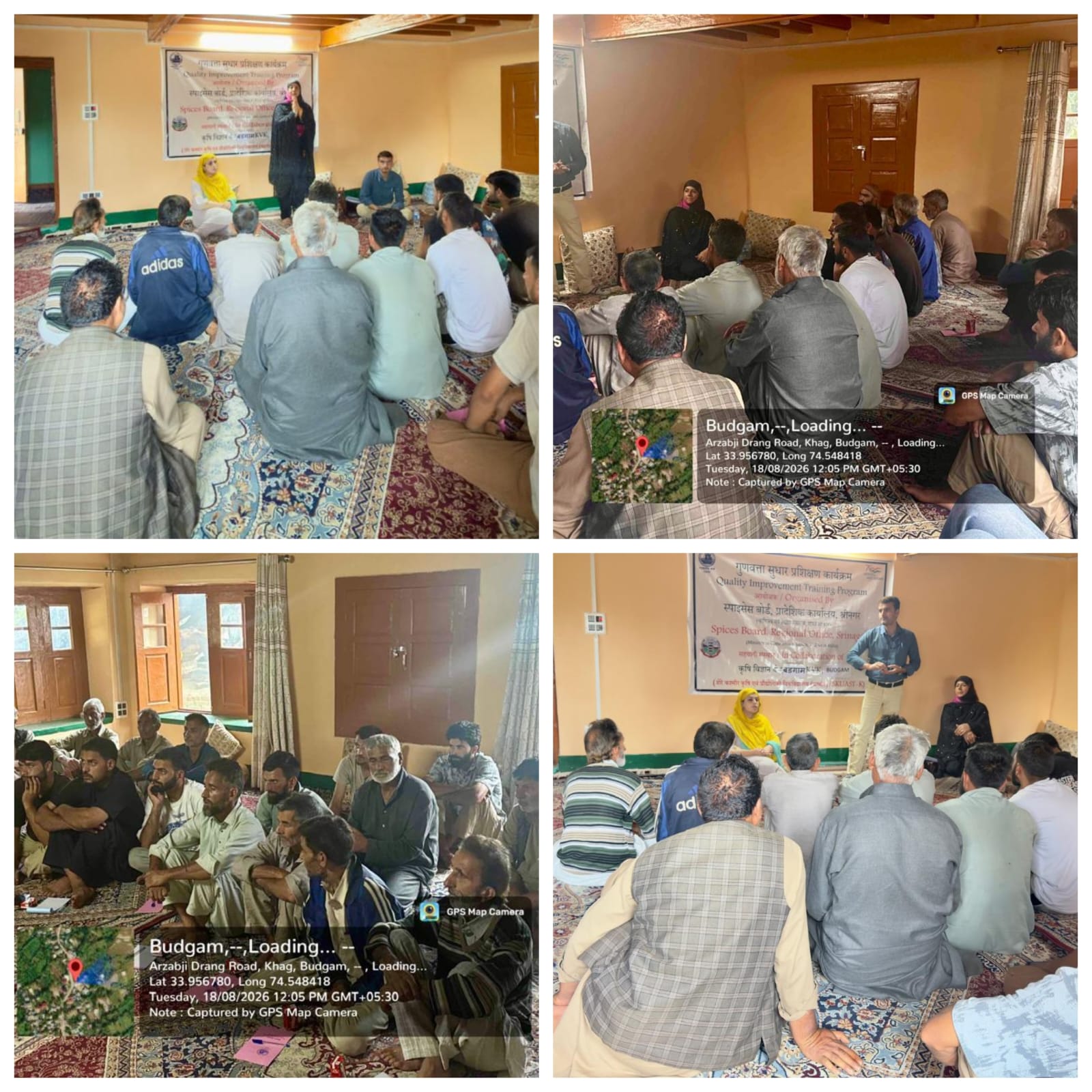
BUDGAM: In an effort to extend agricultural outreach to remote and tribal regions, Krishi Vigyan Kendra (KVK) Budgam of Sher-e-Kashmir University of Agricultural Sciences and Technology of Kashmir (SKUAST-Kashmir), in collaboration with the Regional Office of the Spices Board, Srinagar, organised a one-day training and awareness programme for spice growers in the tribal area of Khag Drung in Budgam district.
The programme was led by Ashutosh Gautam of the Spices Board and Dr. Ambreen Nabi of SKUAST-Kashmir, KVK Budgam, and focused on strengthening farmers’ knowledge of spice production, post-harvest management, quality standards, sustainable production practices and market opportunities.
During the inaugural session, Dr. Iram Farooq provided the participants with an overview of the objectives of the programme and the activities of the Spices Board. She also highlighted the outcomes of previous collaborations between the Spices Board and Krishi Vigyan Kendras, particularly in facilitating improved market linkages and expanding opportunities for farmers.
In the technical session, Ashutosh Gautam elaborated on the various activities and support mechanisms of the Spices Board. He apprised the participants about the existing schemes, eligibility criteria, application procedures, training opportunities and market linkage initiatives available to spice growers.
He also discussed improved production practices and post-harvest management of saffron and Kashmiri red chilli, besides sensitising farmers about organic production practices, the Participatory Guarantee System (PGS), and the 8th edition of the National Programme for Organic Production (NPOP).
Later, Dr. Ambreen Nabi provided comprehensive insights into the responsible and judicious use of insecticides, pesticides and synthetic crop nutrients. She highlighted the challenges arising from the indiscriminate application of synthetic crop protection and production supplements in agriculture and emphasised the need for adopting safer, need-based and scientifically recommended practices.
Dr. Nabi also discussed the importance of Maximum Residue Limits (MRLs) in spices and suggested appropriate measures to address residue-related concerns, stressing that compliance with quality and food safety standards is essential for accessing better markets and ensuring consumer safety.
The programme provided an important platform for direct interaction between spice growers, scientists and officials of the Spices Board. The collaborative initiative aimed to equip farmers in the remote tribal region with updated scientific knowledge, promote sustainable and quality-oriented spice production, and strengthen their access to institutional support, training and market opportunities.
No:-INF/DDI/K-26/2317/
