


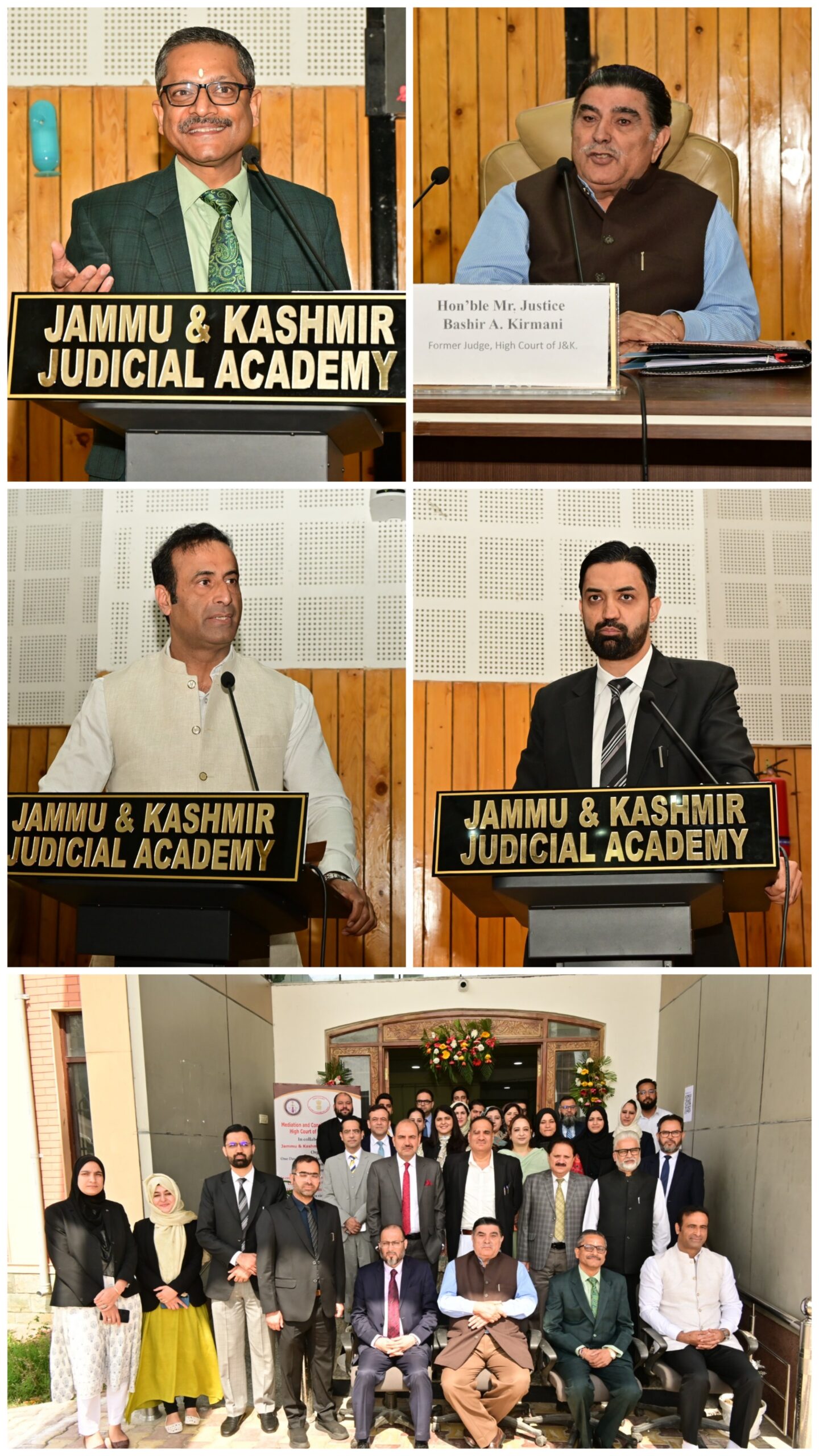
SRINAGAR: A one day training programme for the Referral Judges was conducted today at the Jammu & Kashmir Judicial Academy, Srinagar, in hybrid mode under the aegis of the Mediation & Conciliation Committee (MCC), High Court of J&K and Ladakh, in compliance with the directions of the Supreme Court in view of the “Mediation for the Nation 3.0” Drive.
In the inaugural address, Justice Rajnesh Oswal while addressing the participants described the programme as a focused “Judicial Master Class” aimed at equipping the Referral Judges with the practical tools for effective case referral. He emphasized that mediation is relevant across all spheres of life and highlighted the crucial role of Referral Judges as the primary gatekeepers of justice delivery system, responsible for identifying disputes that are better suited for mediation rather than formal adjudication. He stressed that mediation adopts an interest-based approach, offering parties faster, confidential and relationship-preserving solutions, particularly in complex human and commercial disputes.
Justice Oswal cautioned that Referral Judges must exercise careful judicial screening to ensure that appropriate cases are referred and unsuitable matters are not. He identified the commercial, matrimonial, family, property, neighbourhood and suitable chequedishonour disputes as having good potential for mediation. He stressed caution in cases involving power imbalances, settled law, serious fraud or urgent intervention. He highlighted the importance of judicial communication in encouraging the litigants to opt for mediation. He concluded that referring the right case to the right forum at the right time can reduce docket congestion, save litigants’ time and costs and enhance the quality of justice.
Earlier, an introductory address was presented by Naseer Ahmad Dar, Director, J&K Judicial Academy. He emphasised that Mediation is an important instrument for achieving fair, expeditious and cost-effective justice. He said that mediation transforms disputes from adversarial contests into processes of dialogue and mutually acceptable resolution. He underscored the pivotal role of Referral Judges in identifying the suitable cases, making thoughtful and timely referrals, sensitizing litigants and advocates and ensuring meaningful participation in the mediation process.
The technical sessions of the day were conducted by Justice Bashir A. Kirmani, Former Judge, High Court of J&K. He elaborated on the relevance and importance of Alternative Dispute Resolution (ADR), particularly with reference to Section 89 of the Code of Civil Procedure, 1908 and discussed the various modes of ADR. He explained the basic concept, nature and advantages of mediation, emphasizing its role in facilitating amicable and mutually acceptable resolution of disputes. He also dwelt upon the different stages of the mediation process and the role of the mediator, highlighting the importance of communication, voluntary participation and a constructive approach towards settlement. These themes corresponded to the first session of the programme, which specifically focused on ADR, Section 89 CPC and the fundamentals of mediation.
In the second session, Justice Kirmani focused on the practical role of Referral Judges, stressing the need for judicial officers to exercise proper discretion while deciding when and which cases should be referred to ADR. He dealt with the appropriate stage of referral, consent of the parties, identification of cases suitable for mediation and the importance of avoiding unnecessary delay in trial. He further highlighted the role of the Judge in motivating and preparing lawyers and litigants for mediation, framing appropriate referral orders and understanding the court’s responsibilities after the conclusion of mediation proceedings. His deliberations thus provided the participating Judicial Officers with practical guidance for making effective, timely and case-sensitive referrals and for strengthening the use of mediation as an integral part of the justice delivery process.
The programme was moderated by Faizan ul Haq Iqbal, Coordinator, Main Mediation Centre (Registrar Rules), High Court of J&K and Ladakh.
The programme remained interactive and participatory throughout, with the Judicial Officers actively engaging in discussions on the Guidelines for Referral Judges and the Do’s and Don’ts checklist. The deliberations provided a practical platform for sharing experiences and addressing issues relating to timely, informed and appropriate referrals to mediation.
