


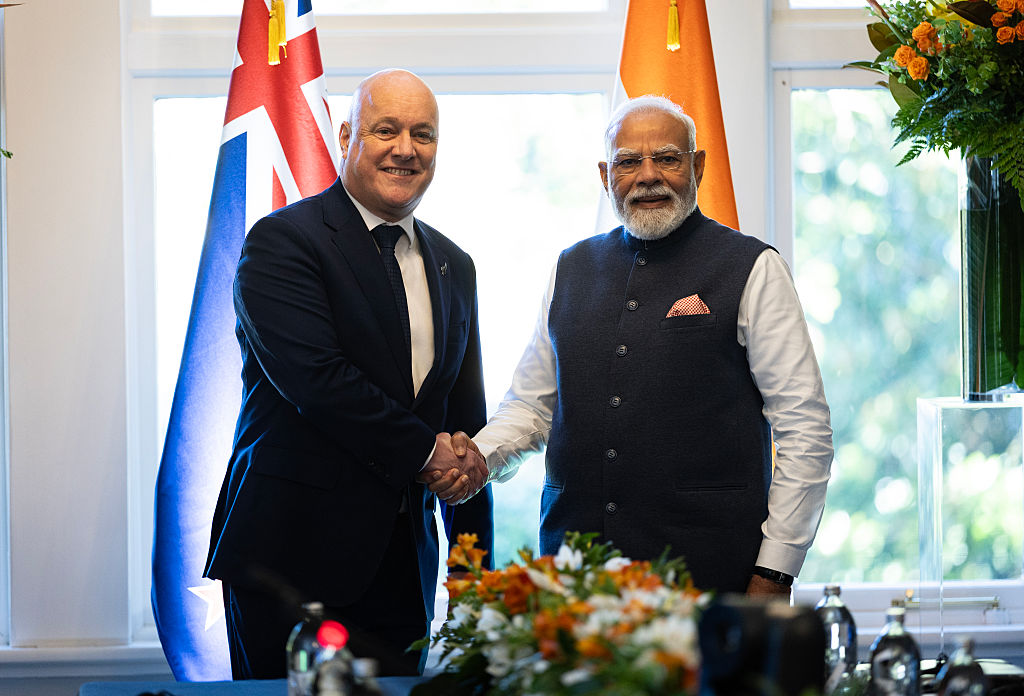
New Zealand’s Parliament on Wednesday cleared the India-New Zealand Free Trade Agreement (FTA), with lawmakers voting 93-29 in favour of the legislation, taking the bilateral trade pact closer to implementation.
New Zealand Prime Minister Christopher Luxon, in a post on X, welcomed the parliamentary approval, saying the agreement would open greater access to India’s large consumer market and support economic growth in New Zealand.
“People told me a Free Trade Agreement with India wasn’t possible. Well, today that deal passed its final vote in Parliament. It’s happening. National said we said we’d secure a Free Trade Agreement with India in our first term, and we’ve delivered. This landmark deal means more jobs, higher incomes for Kiwis. It means more New Zealand products being sold in India by opening the door to 1.4 billion Indian consumers. It’s one of the ways we will grow the economy to help you get ahead fixing the basics and building the future,” Luxon said in his post.
The bill was passed with the support of the ruling National Party and the main opposition Labour Party, securing a clear majority in Parliament.
The FTA was signed by India and New Zealand on April 27.
India is now looking to bring the agreement into force “as soon as possible”, with Commerce Secretary Rajesh Agrawal saying last week that it could potentially become operational in October.
Under the agreement, New Zealand will provide duty-free access for 100 per cent of Indian exports to its market, covering all tariff lines. The pact is also aimed at improving competitiveness and employment opportunities in India’s labour-intensive sectors, including textiles and apparel, leather and footwear, gems and jewellery, engineering goods and processed foods.
The agreement provides for a USD 20 billion investment commitment by New Zealand in India over 15 years, aimed at strengthening long-term economic cooperation between the two countries.
For New Zealand exports to India, 70.03 per cent of tariff lines have been offered market access, covering 95 per cent of bilateral trade. India has excluded 29.97 per cent of tariff lines, including sensitive products such as dairy, several agricultural products, sugar and certain metals and other goods.
The agreement provides for immediate elimination of duties on 30 per cent of tariff lines covering products such as wood, wool, sheep meat and raw hides. A further 35.60 per cent of tariffs will be eliminated gradually over three, five, seven or 10 years.
Some products, including wine, pharmaceutical drugs, polymers and certain aluminium, iron and steel products, will receive tariff reductions, while a small number of products will be covered by tariff-rate quotas, including Mānuka honey, apples, kiwifruit and albumins.
The pact also includes agricultural cooperation focused on improving productivity and capabilities in sectors including kiwifruit, apples and honey. The two sides will work on planting material, research, technical assistance, orchard management, post-harvest practices, supply chains and food safety.
In services, New Zealand has committed across 118 sectors, with Most-Favoured Nation treatment in 139 sectors, according to an official release.
The agreement also creates new mobility opportunities for Indian students and professionals. It includes a Temporary Employment Entry visa pathway with a quota of 5,000 skilled Indians for stays of up to three years, covering occupations including AYUSH practitioners, yoga instructors, Indian chefs and music teachers, as well as professionals in IT, engineering, healthcare, education and construction.
A Working Holiday Visa arrangement will allow 1,000 young Indians each year to travel to New Zealand for up to 12 months.
The agreement also includes an annex on student mobility and post-study work provisions, under which eligible Indian students can work up to 20 hours a week while studying and receive extended post-study work visas depending on their qualification.
The FTA further provides for cooperation in areas including investment, research and innovation, technology, skills, renewable energy, digital services and infrastructure.
The parliamentary approval marks another step towards implementation of the India-New Zealand FTA, with both sides having set out measures covering trade in goods and services, investment, agriculture, mobility and customs procedures.
