


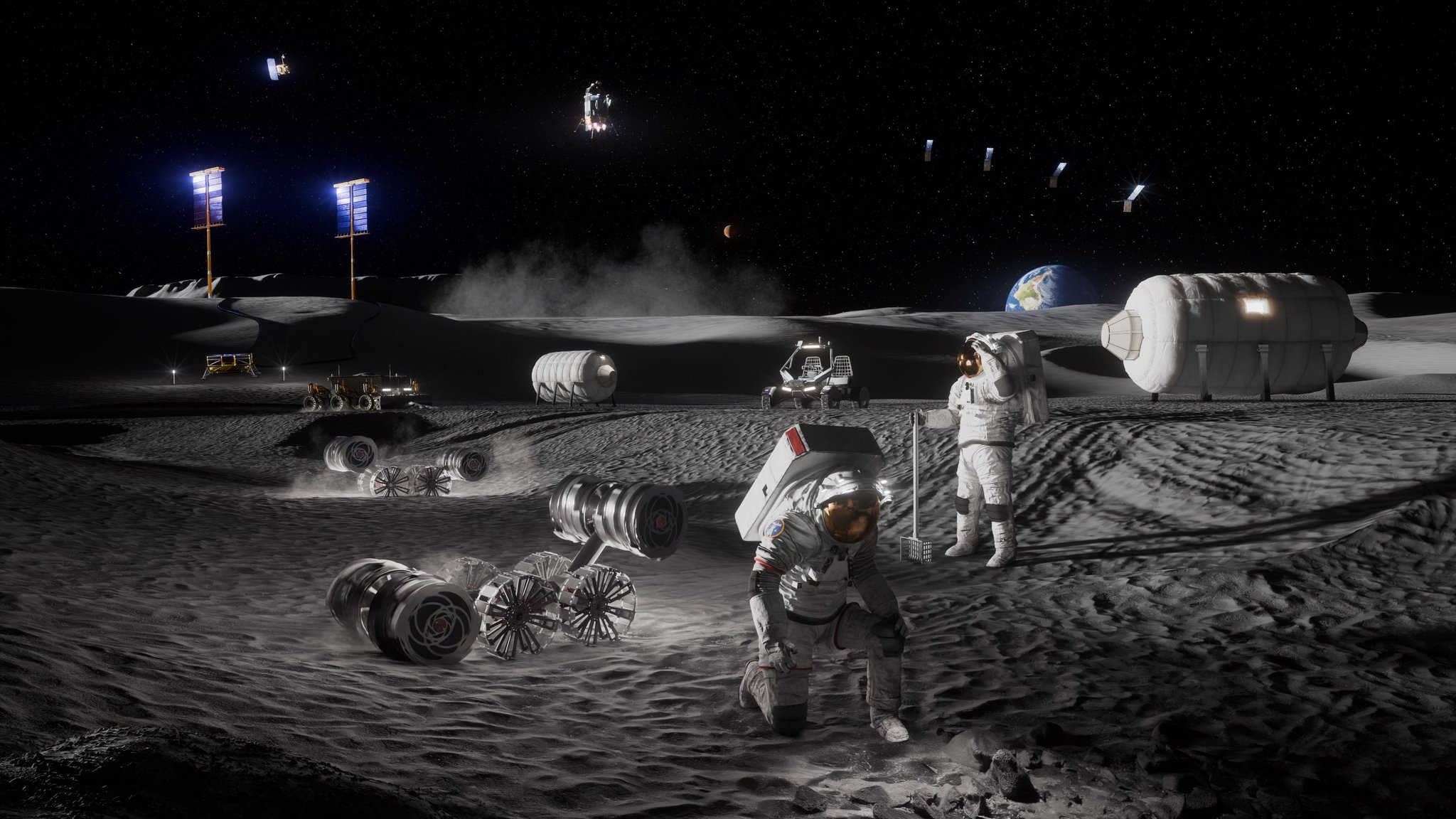
The National Aeronautics and Space Administration (NASA) has unveiled a plan, one of the most ambitious space endeavours in history, to construct a permanent Moon base involving robotic landers, moon buggies and hopping drones before eventually sending humans.
The US space agency has envisaged a permanent lunar base sprawling over hundreds of square miles in the south polar region.
“This initiative will secure American leadership in space, unlock groundbreaking scientific discoveries, and forge the technologies and operational experience needed to send humans to Mars,” NASA said in a statement on Wednesday.
“The moon base will be America’s and humanity’s first outpost on another celestial world,” NASA Administrator Jared Isaacman said in a statement.
“Every mission, crewed and uncrewed, will be a learning opportunity as we return to the lunar surface, build the infrastructure to stay and master the skills required to live and operate in one of the most demanding and dangerous environments imaginable,” he said.
The South Pole region is also scientifically significant because it lies near some of the oldest terrain on the Moon, including the South Pole-Aitken Basin, the largest and oldest known impact basin in the solar system. Samples collected from this region could provide insight into the early history of the Moon, the Earth-Moon system, and the broader evolution of the solar system.
Three uncrewed lunar missions known as Moon Base I, II and III are scheduled for launch later this year.
NASA also announced new partnerships supporting sustained lunar exploration.
Companies, including Jeff Bezos Blue Origin, Intuitive Machines, and Astrobotic, have been awarded the contracts to build the machines.
The agency has selected Astrolab and Lunar Outpost to develop the first phase of Lunar Terrain Vehicles. It has awarded Blue Origin, the aerospace company owned by Amazon founder Jeff Bezos, task orders supporting the delivery of those vehicles to the lunar surface. Further, the US space agency has selected Firefly Aerospace to build the spacecraft that will transport NASA’s MoonFall drones to the Moon.
NASA said the award to Astrolab is worth $219 million, and the award to Lunar Outpost is worth $220 million.
The opening mission, Moon Base I, is targeted for launch later this year using Blue Origin’s Blue Moon Mark 1 cargo lander, known as Endurance. Moon Base II is planned for launch later this year aboard Astrobotic’s Griffin lander. Moon Base III is also targeted for this year.
