

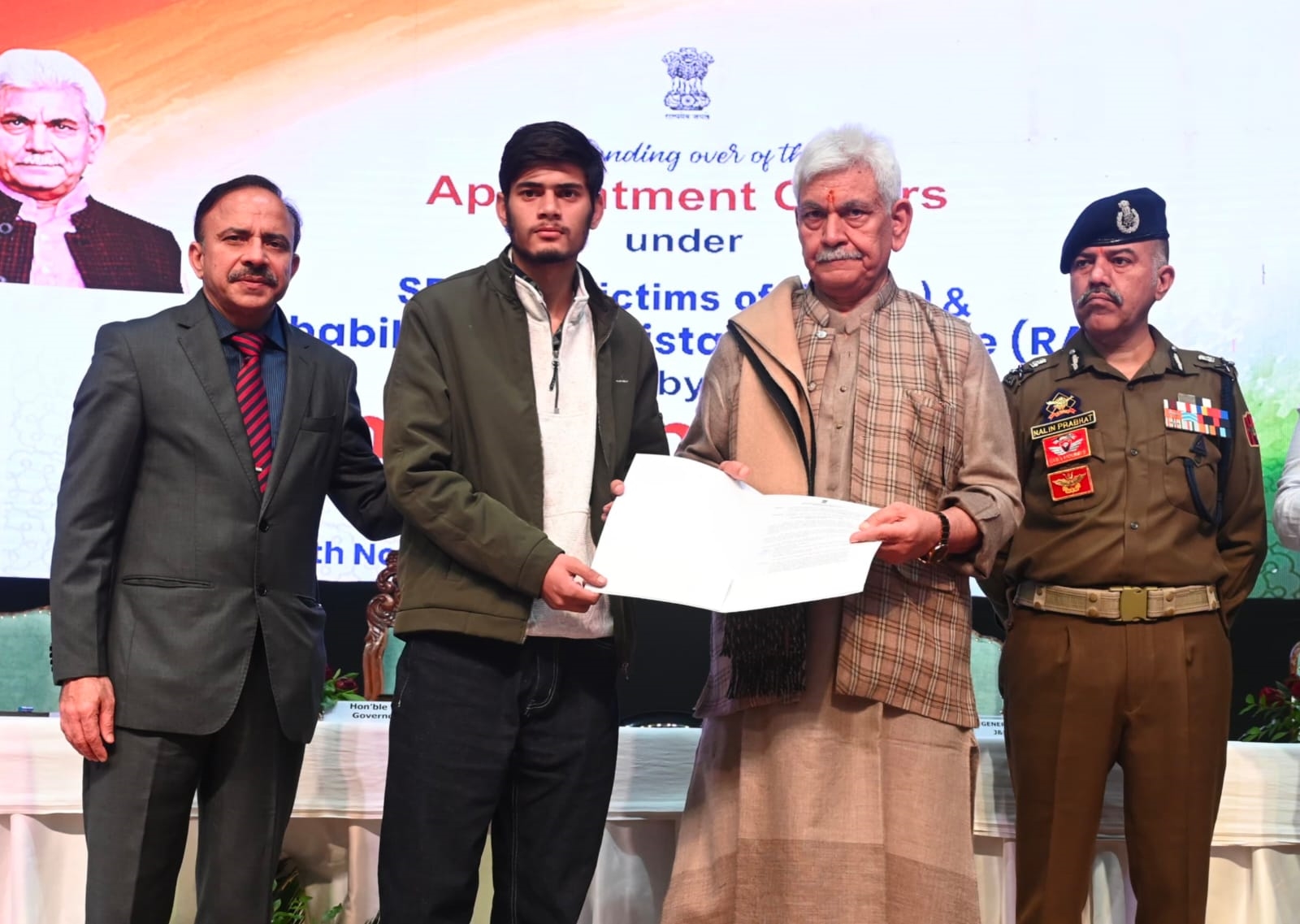
JAMMU: Lieutenant Governor Manoj Sinha on Sunday handed over government appointment letters to 125 beneficiaries, including 59 next of kin of families affected by terrorism and 66 others under the Rehabilitation Assistance Scheme (RAS)-2022 and SRO-43/1994, asserting that justice was finally reaching families who had waited for decades.
Paying tribute to elderly parents, mothers and sisters who lost their sons, brothers and husbands to terrorism, the Lieutenant Governor acknowledged their prolonged struggle for justice and their determination to seek closure despite years of hardship.
Recalling the resolve he had made at Baramulla on July 13, 2025, Sinha said that over the past 15 months, government jobs had been provided to relatives of hundreds of terrorism-affected families across both divisions of Jammu and Kashmir. He described the initiative as a sustained campaign to restore their dignity, rights and lost confidence.
“Terror victim families that stayed silent for decades out of fear are today coming before the entire country to expose terrorists and their ecosystem,” he said.
The Lieutenant Governor specifically referred to the families of Krishna Lal and Gyan Chand of Kishtwar, who were murdered in July 1999, and Mohammad Rafiq of Poonch, who was killed in February 2003.
Highlighting the prolonged suffering of terror-affected families, Sinha said that behind every statistic was a family and behind every incident an unfulfilled dream. He observed that in several cases, families devastated by terrorist violence were subsequently left without institutional support, with investigations not even initiated.
He said the administration had now begun reopening old cases, registering fresh FIRs and initiating investigations into several previously neglected incidents.
“I have promised terror victim families that my responsibility is not limited to standing with them in times of crisis. I will ensure that no citizen feels alone and helpless after the crisis has passed,” he said.
The Lieutenant Governor reiterated that files closed for years were being reviewed and efforts were underway to identify victim families and address their long-pending grievances.
Reaffirming the administration’s zero-tolerance policy towards terrorism, Sinha warned that terrorists and their supporters would face the strictest possible action under the law.
“Even if terrorists and their supporters hide in the Paataal, we will find them and ensure the strictest possible punishment under the law,” he asserted.
He also cautioned elements allegedly attempting to revive separatism and unrest through propaganda, misinformation and false narratives, stating that no one would be permitted to undermine India’s sovereignty, peace in Jammu and Kashmir or the future of its citizens.
Emphasising the supremacy of the Constitution and the rule of law, the Lieutenant Governor said the administration would not tolerate terrorism, separatism or attempts to take the law into one’s own hands.
He maintained that every conspiracy aimed at disturbing peace would be countered through facts and firm legal action, adding that no individual or organisation was above the law.
Highlighting the government’s crackdown on narco-terror networks, Sinha said the Drug-Free Jammu Kashmir campaign had resulted in the arrest of 4,282 drug smugglers and the seizure of 2,800 kilograms of drugs by September. He added that police and security agencies had been given full freedom to act against terrorism and narco-terror networks.
The Lieutenant Governor also highlighted the pace of development in Jammu and Kashmir since 2020. He claimed that while an average of 9,000 to 10,000 projects were completed annually before 2019, more than 50,000 projects and infrastructure works were being completed every year after the abrogation of Article 370. He cited progress in tourism, road connectivity, education, healthcare and industry.
Outlining his four key resolves for Jammu and Kashmir, Sinha called for the complete dismantling of the terror ecosystem, including networks that provide resources, support and social sustenance to terrorism.
His second resolve focused on strengthening justice for victims and ensuring administrative accountability. Urging officials to adopt a compassionate approach, he said the administration must remain accessible to every victim’s family.
“The doors of the administration should never be closed to any victim’s family. No officer should forget that behind a file on their desk may lie an entire family’s life. Always remember that files are made of paper, but behind them are human beings,” he said, urging officers to make sensitivity an essential part of governance.
The third resolve centred on placing greater opportunities and a brighter future in the hands of the youth. Addressing young people, he described their aspirations as the real capital of Jammu and Kashmir and urged them to utilise emerging opportunities under the leadership of Prime Minister Narendra Modi and contribute to nation-building.
His fourth resolve was to establish lasting peace through the active participation of all citizens. Sinha said an aware and united society could resist terrorism and prevent terrorist organisations and their supporters from gaining influence.
He outlined four essential pillars of lasting peace — security, trust, development and justice — and called for continued public participation in strengthening these foundations.
Recalling two guiding principles he had given to the administrative and police machinery, the Lieutenant Governor reiterated: “Do not trouble the innocent, and do not spare the guilty.”
He also repeated his second mantra: “We will not buy peace; we will establish peace.”
Describing the initiative as the outcome of a Whole of Government Approach and collective social participation, Sinha called for intensified efforts to dismantle the terror ecosystem completely.
“It is time to drive the final nail into the coffin of the terror ecosystem,” the Lieutenant Governor said.
