


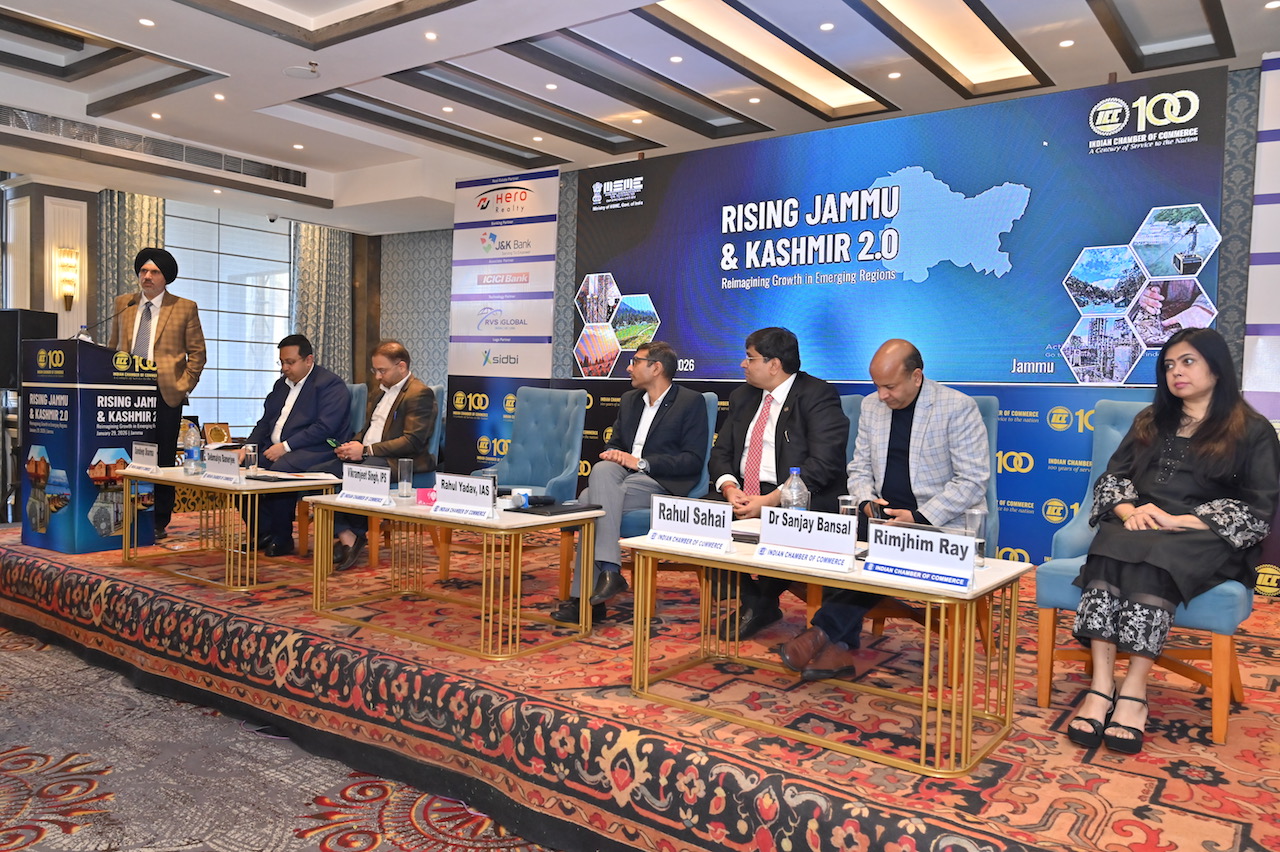
JAMMU: Marking 100 years of service to the nation, the Indian Chamber of Commerce (ICC) successfully organised ICC Rising Jammu & Kashmir 2026, a high-level, multi-session conference aimed at reimagining economic growth and strengthening the development ecosystem of the Union Territory. The event was held under the chairmanship of Rahul Sahai, Chairman, ICC Jammu.
The day-long conference brought together policymakers, senior administrators, bankers, industry leaders, startup founders, professionals, academicians, and students to deliberate on key growth drivers including MSMEs, startups, urban governance, IT & ITES, and the power sector.
The programme was formally inaugurated by Shri Vikramjit Singh, IPS, Commissioner/Secretary, Department of Industries & Commerce, Government of Jammu & Kashmir, as Chief Guest. Rahul Yadav, IAS, Managing Director, J&K Power Development Corporation Limited, and Dr. Devansh Yadav, IAS, Commissioner, Jammu Municipal Corporation, attended as Special Guests, in the presence of Rahul Sahai, Chairman ICC Jammu, and Debmalya Banerjee, Regional Director, ICC Northern Region.
Addressing the gathering, Vikramjit Singh, IPS, congratulated ICC for organising deliberations on relevant and contemporary issues such as municipal bylaws, power reforms, MSME funding, startup ecosystems, and the scope of IT & ITES industries in Jammu & Kashmir. He reiterated that the industrial ecosystem in the UT is steadily improving, obstacles are being addressed, and a robust industrial policy will be launched following stakeholder consultations.
ICC leadership highlighted that Rising Jammu & Kashmir reflects the region’s evolving economic narrative driven by policy reforms, infrastructure development, rising investor confidence, and a young, aspirational population. The focus on MSMEs, startups, IT & ITES, clean energy, and urban reforms underscores the UT’s commitment to inclusive, sustainable, and future-ready growth.
The first technical session, “Building a Resilient J&K Economy,” featured a diverse panel comprising representatives from banking, academia, startups, MSMEs, and government. Panelists included Sandeep Sharma, Zonal Head, ICICI Bank (J&K & Ladakh); Prof. Alka Sharma, Dean, Business Studies & Director, SIIEDC, University of Jammu; Suhel Ahmad Lone, DGM, J&K Bank; Arush Mahajan, Vice President, J&K Startups Association; Vinu Jee Koul, Assistant Director, MSME-DFO Jammu (GoI); and Debmalya Banerjee, Regional Director, ICC Northern Region. Discussions centred on skill development, youth entrepreneurship, startup incubation, access to credit, digital banking, and policy support.
The second session, “Understanding Municipal Bylaws in Jammu: Framework, Compliance & Opportunities,” addressed issues of direct relevance to businesses and citizens. Chaired by Dr. Devansh Yadav, IAS, the session featured Manoj Gupta, Senior Town Planner, JMC, and Ar. Vishal Abrol, Founder & Chief Architect, TRIKONE, and Vice Chairman, Indian Institute of Architects (J&K Chapter). The discussion focused on building permissions, zoning regulations, trade licensing, signage norms, digital governance initiatives, and simplifying compliance to improve ease of doing business.
Session three highlighted the transformative potential of the IT & ITES sector in creating high-value jobs, retaining local talent, and positioning Jammu as a competitive services hub. Speakers Sandeep Sharma, COO, RVS IT Limited, and Ms. Rimjhim Ray, Co-founder, Spotle AI & Heyo, and Partner, Goa Angel Network, discussed the J&K IT/ITES Policy 2020, startup incentives, NCSS support, skill development, and emerging domains such as AI, cloud computing, and cybersecurity.
The concluding session focused on “Transforming the Power Landscape of Jammu & Kashmir,” recognising reliable and affordable power as the backbone of industrial growth. Rahul Yadav, IAS, MD, J&KPDCL, served as Session Chief Guest, along with Dr. Sanjay Bansal, National Board Member, National Traders Welfare Board, Ministry of Commerce & Industry. Deliberations covered hydropower potential, transmission upgrades, private sector participation, and the feasibility of solar power procurement from outside the UT.
Across sessions, speakers emphasised the need for collaboration between government, industry, financial institutions, startups, and academia to translate policy intent into tangible outcomes. The conference concluded with optimism and actionable insights aimed at accelerating Jammu & Kashmir’s journey towards sustainable and inclusive growth.
The event witnessed participation of around 200 delegates, including dignitaries, heads of trade and industry associations, prominent citizens, ICC members, the ICC secretariat, and representatives from print and electronic media.
