


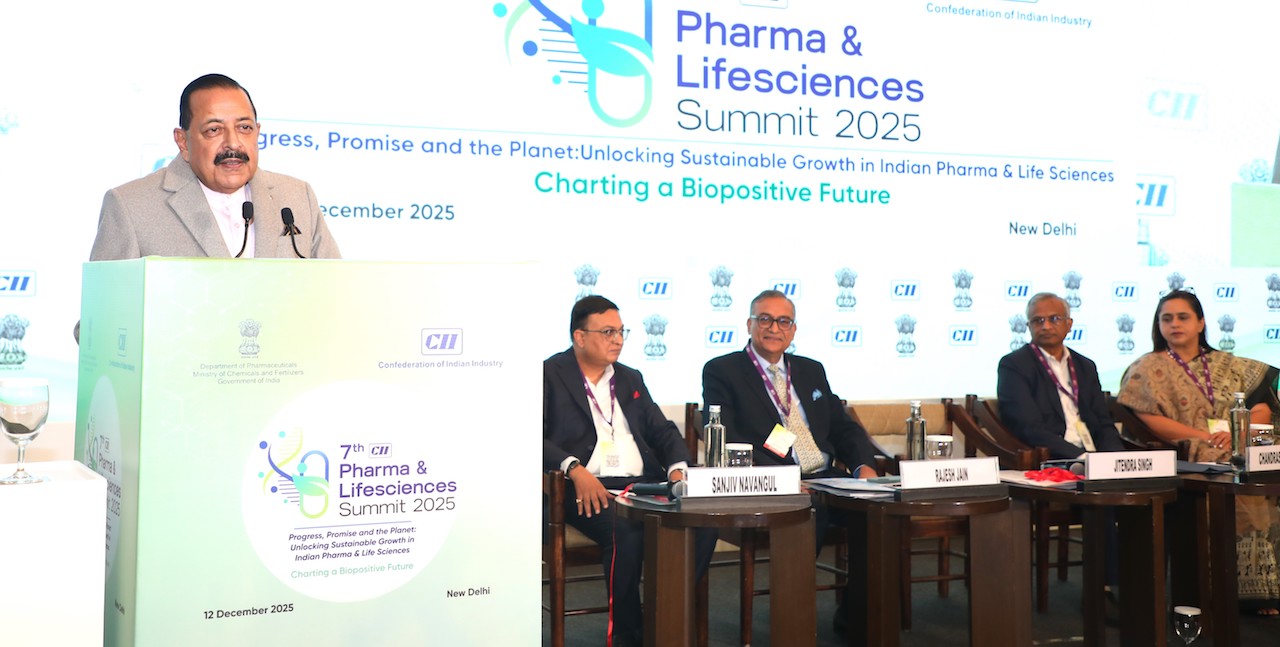
NEW DELHI: Union Minister of State (Independent Charge) for Science & Technology and Minister of State in the PMO, Dr. Jitendra Singh, on Thursday said that the judicious and human-centric use of Artificial Intelligence (AI) can prove to be a major boon for India’s healthcare and pharmaceutical sectors. He was addressing the CII Pharma & Life Sciences Summit 2025.
Dr. Singh emphasized that AI has become an essential tool in diagnostics, drug discovery, and healthcare delivery, but cautioned that technology must complement — not replace — human empathy. “The real challenge is integrating AI into a hybrid model that balances efficiency with human touch,” he said.
Highlighting ongoing advancements, the Minister noted that AI-driven diagnostic tools are dramatically reducing culture test times from days to minutes. He also pointed out that AI-enabled telemedicine initiatives are delivering healthcare services in local dialects to remote regions, significantly improving patient confidence and outcomes.
Dr. Singh underscored India’s expanding capabilities in biotechnology, gene therapy, and vaccine research, driven by strong government–industry collaboration. Several Department of Biotechnology (DBT) projects, he said, are now being jointly executed with leading private firms to create indigenous solutions such as synthetic antibiotics, DNA and HPV vaccines, and advanced bio-manufacturing systems.
Inviting industry participation, the Minister urged companies to leverage the recently launched ₹1 lakh crore R&D Fund, designed to support deep-tech innovations across multiple sectors including health and agriculture. “For the first time, the government is financing private-sector innovation—this is a transformative shift in India’s R&D ecosystem,” he remarked.
He also lauded India’s evolution from an importer of curative healthcare to an exporter of preventive healthcare, noting the country’s growing global presence in vaccines, biosimilars, and affordable medical devices.
Concluding his address, Dr. Singh called upon industry leaders to act as co-drivers in national progress by not only advancing their sectors but also identifying new avenues for joint development. “Science, medicine, and technology are now interconnected components of one ecosystem,” he said, urging collective action to shape the future of global healthcare.
