


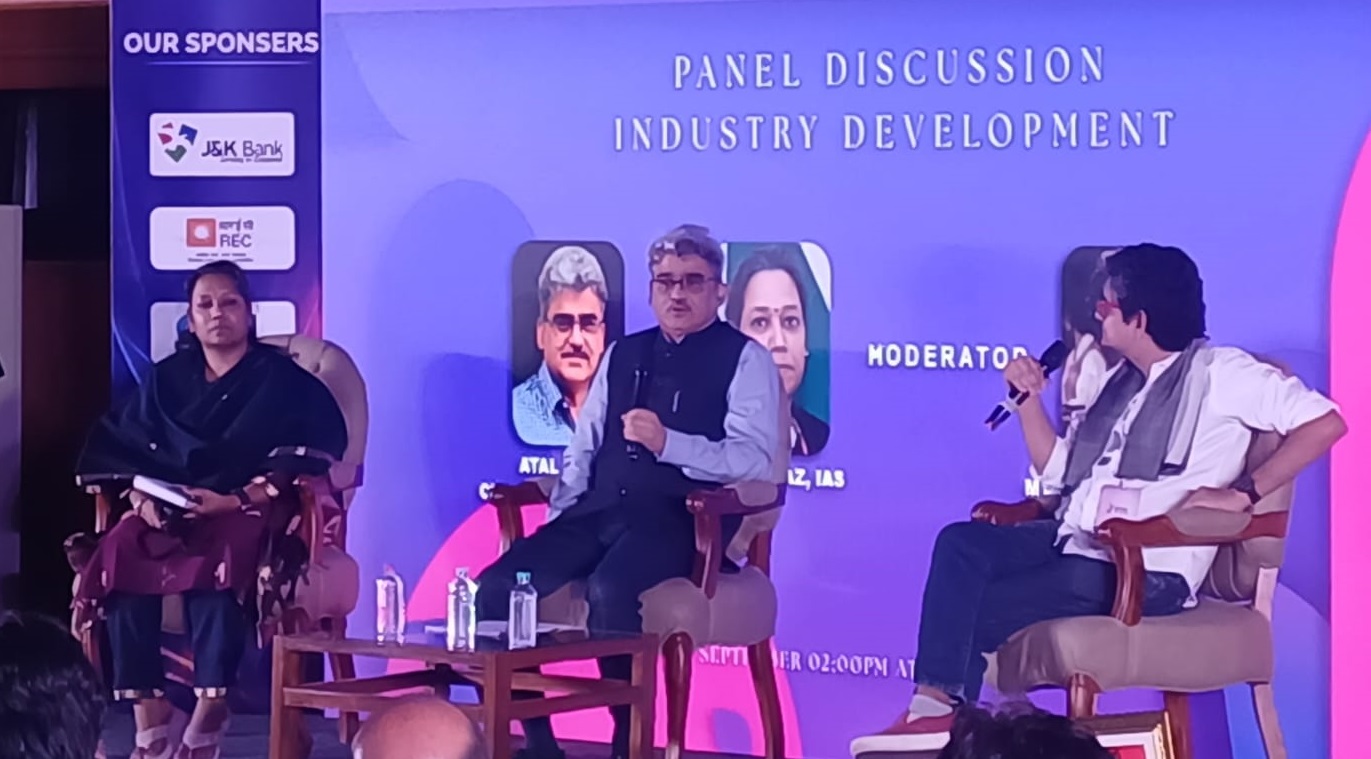
SRINAGAR: The second day of the first International Film Festival of Jammu & Kashmir (IFFJK-2026) witnessed an engaging policy dialogue on the prospects of building a sustainable cinematic ecosystem in the Union Territory, with Chief Secretary Atal Dulloo emphasising the need to create an enabling environment for local talent, filmmaking, film education and investment.
Participating in a panel discussion on “How the J&K Film Policy, Single-Window Clearances, and Incentives Can Build a Sustainable Local Cinematic Ecosystem”, moderated by noted film critic and journalist Mayank Shekhar, the Chief Secretary, along with Commissioner Secretary, Information Department, R. Alice Vaz, dwelt upon the initiatives already undertaken by the Government and the measures being planned to give further impetus to filmmaking and film tourism in J&K.
Chief Secretary Atal Dulloo while speaking said that the people of J&K have a natural affinity towards the creative world and recalled the region’s close association with the film fraternity during the 1970s and 1980s, when its landscapes and locations were extensively connected with the film industry.
He expressed that IFFJK has been conceived as a platform to renew these connections and channel the creative energies of the region’s youth towards filmmaking and its allied professions. “People making efforts to realise their dreams is essential,” the Chief Secretary observed, recalling former President Dr APJ Abdul Kalam’s famous words that “Dreams are those which don’t let you sleep.”
He said that the festival provides an ideal platform to deliberate upon the possibilities and potential that J&K offers to the film industry and, more importantly, to evolve a clear roadmap for carrying the momentum forward after the festival.
He pointed out that cinema is a collective endeavour and that the people seen on the screen or stage constitute only one part of a much larger industry comprising a wide range of professionals whose contribution is essential to bringing a production to life.
Dulloo further underlined the importance of nurturing local human resources and said that the Government was exploring avenues for providing scholarships to students interested in different aspects of filmmaking at reputed national institutions, besides facilitating partnerships with such institutions for imparting specialised courses and training within J&K.
He also highlighted the role of the Skill Development Mission in creating appropriate training opportunities in local institutions, including courses related to filmmaking and its allied fields.
On the ease of filming in J&K, the Chief Secretary emphasised the need to continuously remove procedural bottlenecks faced by filmmakers and production houses. He observed that the Single Window Clearance System needs further strengthening and simplification, while the proposed Ease of Doing Business Bill is expected to bring further deregulation and facilitate a smoother business environment for the industry.
Referring to the culture of encouraging people to write their own stories in Maharashtra, he said that similar efforts could help identify and nurture storytelling talent in J&K, with many of these narratives having the potential to evolve into vibrant film scripts. “We have numerous stories here. What is required is to hone and chisel this talent and present these stories in the right form and style,” he maintained.
Commissioner Secretary, Information, R. Alice Vaz, while elaborating on the J&K Film Policy, outlined the incentives presently available for film shootings in the Union Territory and the additional benefits extended to regional filmmakers and productions having significant local participation.
She explained that the policy has been designed not merely to attract external productions but also to encourage local filmmakers, artists and creative talent, thereby creating greater opportunities for people associated with the film industry within J&K.
She also highlighted the incentives available for films having more than 50 per cent of their shooting in J&K, along with provisions encouraging the engagement of local artists and other personnel.
Vaz said that these policy interventions are intended to create a virtuous cycle in which greater filmmaking activity generates employment and opportunities for local talent while simultaneously showcasing J&K’s landscapes, heritage and cultural richness to wider audiences.
She underlined the strong linkage between filmmaking and tourism, noting that increased cinematic visibility can contribute to the promotion of destinations and generate wider economic activity for local communities.
The panel discussion thus brought together the policy, regulatory, educational, creative and economic dimensions of J&K’s emerging film ecosystem, with the participants stressing that the ultimate objective should be to move beyond facilitating individual film shoots towards creating a sustainable ecosystem capable of nurturing local talent and attracting national and international productions.
The Day-2 proceedings of IFFJK-2026 also featured a diverse range of creative, technical and policy-oriented sessions across SKICC Srinagar. A Masterclass on directing romantic comedies was conducted by filmmaker Sriram Raghavan, while an In-Conversation Session with cinematographer Anil Mehta explored the role of framing, lighting and other visual elements in creating narrative subtext beyond written dialogue.
Furthermore four panel discussions further expanded the festival’s engagement with contemporary cinema and its evolving ecosystem. In Hall 2, a panel moderated by Dhwani Desai explored the convergence of traditional regional art forms with animation, Artificial Intelligence and CGI and the possibilities of creating new authorial voices through emerging technologies. The discussion featured Sanat P. C., Ujjwal Nirgudkar, Hetal Soliya, Jitin Masand, Bharath Laxmipati, Jividha Sharma and Kanika Gautam.
In addition to that the Hall 3 hosted a festival selection round table moderated by Sourav Kanti Datta, with C. S. Venkateshwaran, Siladitya Sen, Nirmal Dhar and Reema Borah deliberating on the changing landscape of independent cinema, curation and access.
The day concluded with an acting-focused panel moderated by Mandar Bam, featuring Sulakhyana Barua, Rahul Bhatt and Ashoke Viswanathan, who discussed the creative demands, preparation and collaborative processes involved in developing memorable characters for the screen.
The varied sessions on the second day reinforced IFFJK-2026’s larger vision of creating a platform where cinema, policy, technology, education, creative talent and tourism converge, while opening new avenues for J&K’s participation in the national and global cinematic landscape.
