


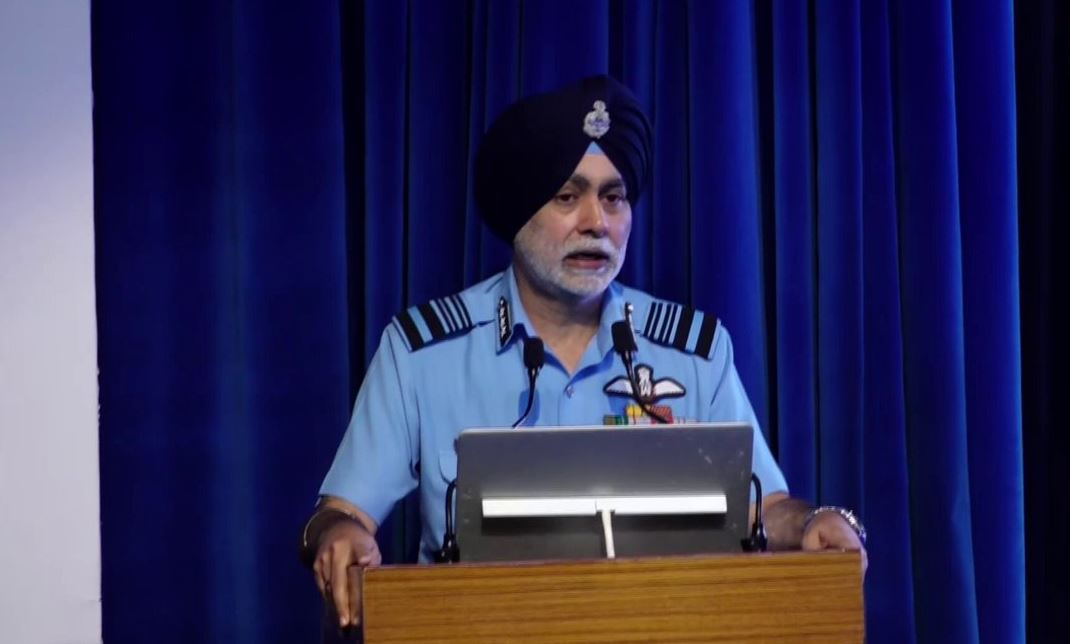
NEW DELHI: Air Marshal Tejpal Singh, Deputy Chief of the Air Staff, on Tuesday said that modern warfare is increasingly defined by information superiority, network-centric operations and split-second decision-making, stressing the need to shorten the OODA (Observe, Orient, Decide and Act) loop to stay ahead of the adversary.
Speaking at the joint seminar on “Surveillance, C4I2 & Electro-Optics” organised with Indian Military Review (IMR) at the Air Force Auditorium, Subroto Park, Air Marshal Singh said modern warfare is increasingly being shaped by the ability to process information.
Highlighting the continuing importance of platforms and weapons while underlining the growing significance of information and decision-making, he said, “In the modern battlespace, I think all of us, in the many seminars that we attend, are focused on platforms and weapons. While the importance of platforms and weapons will never go away, I think today’s battlefield and battle airspace are defined by information superiority, network-centric operations, and most importantly, split-second decision-making. Therefore, success in multi-domain operations can come only if we can reduce and shorten our OODA loop, that is, Observe, Orient, Decide, and Act. The intention is to make our OODA loop shorter than that of the adversary so that we can decide and act before he can.”
Emphasising the need for a common digital ecosystem across the armed forces, he said, “To achieve seamless jointness, it is very, very important that we have standardised protocols. We need to be self-reliant in modern communication systems. All our communications, ground sensors, the platforms, and the aerial ISR (Intelligence, Surveillance, and Reconnaissance) assets all need to operate on the same network, on the same standardised protocols, and speak a common digital language, which is very, very important. Therefore, interoperability must be a design principle and not an afterthought. And last but not least, as military leaders, we need to be ready to integrate modern technologies into our battle plans and into our operational plans.”
Calling for a shift from system-centric thinking to problem-solving, the Deputy Chief of the Air Staff said military planners should first identify the operational challenge and then seek technological solutions from industry and academia.
“We should not be asking, “What is the system?” but “What is the operational problem that I’m trying to address?” So rather than saying that I need this system, we should define the operational problem and let the industry and academia come up with a solution. The future of warfare will certainly continue to revolve around platforms and weapons, but increasingly, it will be won through information, integration, and faster decision-making,” he added.
