


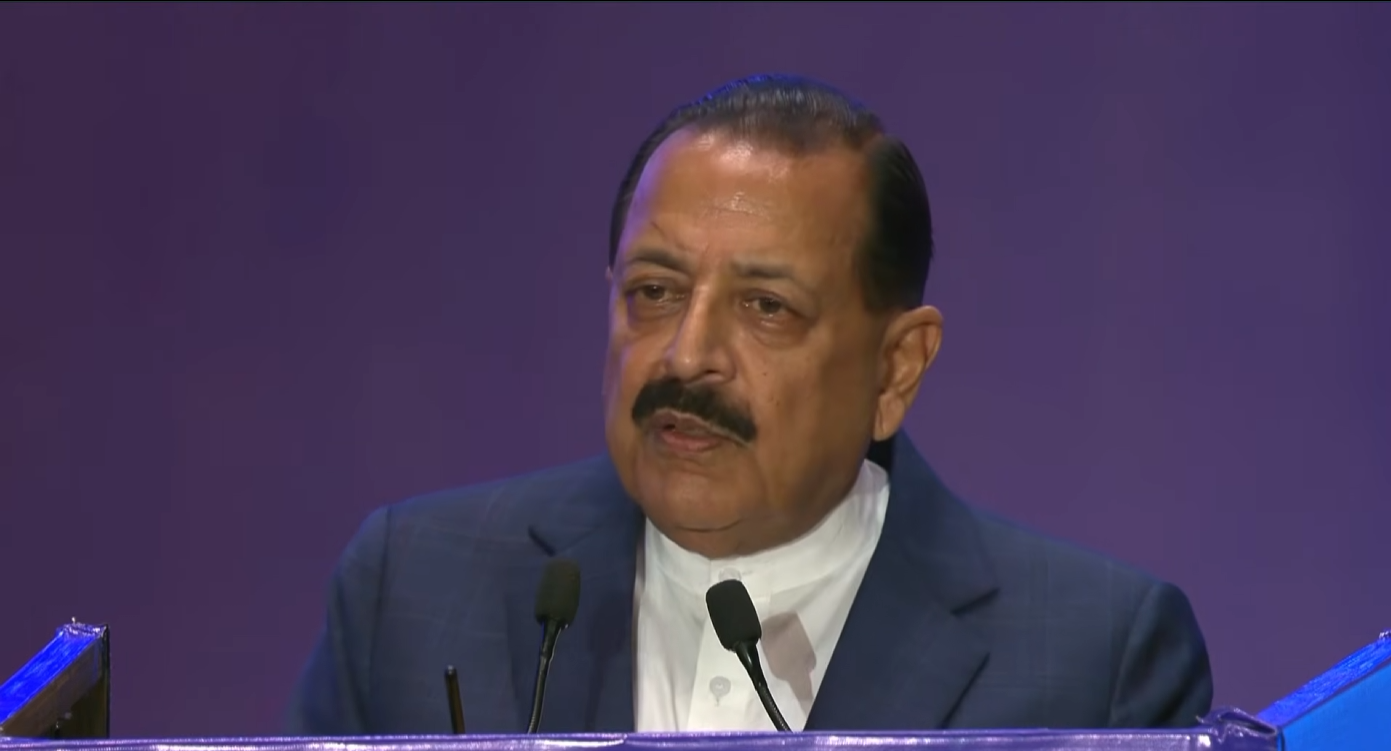
NEW DELHI: India has moved from the “trailing India” of the 20th century to a “future-ready” India of the 21st century, emerging as a global co-creator in science and technology, said, Dr. Jitendra Singh, the Minister of State (Independent Charge) for Science and Technology and Earth Sciences at the inaugural session of the Emerging Science, Technology and Innovation Conclave (ESTIC) 2026 at Bharat Mandapam, here today.
Citing the expansion of India’s startup ecosystem, space economy and bioeconomy, along with growth in patent filings and improvements in innovation rankings, he attributed the country’s progress to sustained policy support, an enabling environment for research and greater private-sector participation.
Describing ESTIC 2026 as a reflection of India’s growing confidence in science, innovation and technological capabilities, Dr. Jitendra Singh said the country had never lacked scientific talent, hard work or ambition. What had been missing, he observed, was the enabling environment and policy support needed to translate these strengths into outcomes. He credited the policy direction provided under the leadership of Prime Minister Narendra Modi since 2014 with helping address this gap and placing science and innovation at the centre of India’s development priorities.
Dr. Jitendra Singh said the Prime Minister had consistently conveyed that progress in the 21st century would depend on innovation and that achieving the goal of Viksit Bharat required India to meet global benchmarks, adopt global parameters and pursue global strategies. He also referred to the Prime Minister’s message that “the age of silos is over”, underscoring the importance of moving beyond institutional and sectoral boundaries to strengthen the country’s research and innovation ecosystem.
The Minister highlighted the expansion of private-sector participation in science and technology, particularly through the opening of the nuclear and space sectors to private players. He noted that science had remained a recurring theme in the Prime Minister’s Independence Day addresses from the Red Fort since 2014, with references to COVID-19 vaccines, the Gaganyaan human spaceflight programme, startups, the Deep Ocean Mission, Digital India and biotechnology. According to Dr. Singh, this sustained emphasis had helped strengthen the national focus on scientific research, technological advancement and innovation-led development.
Referring to the institutional framework for research, Dr. Jitendra Singh highlighted the establishment of the Anusandhan National Research Foundation (ANRF) as an important step in strengthening India’s research ecosystem. He also recalled the announcement of the ₹1 lakh crore Research, Development and Innovation (RDI) Fund at ESTIC 2025, held at the same venue the previous year. The Minister cited these measures as examples of the policy support and investment needed to expand research and development and translate scientific capabilities into innovation.
Citing progress across several indicators, Dr. Jitendra Singh pointed to the expansion of India’s startup ecosystem from approximately 350 startups to around 2.5 lakh. He also referred to the growth of the country’s space economy to approximately US 9 billion and the expansion of the bioeconomy from US10 billion to nearly US$200 billion. These developments, he said, reflected the scale of change in India’s innovation landscape over the preceding years.
The Minister further cited improvements in India’s position in the Global Innovation Index, from rank 80 to rank 38, and an increase in patents from 42,763 to 1,10,375, which he described as a rise of 158 per cent. He also referred to India’s progress in science PhD rankings, from seventh to third. Dr. Jitendra Singh said these developments had contributed to a marked rise in aspirations among the country’s youth, reflecting growing interest in science, technology and innovation.
The Minister’s address also highlighted the role of policy leadership in bringing science and technology into the mainstream of national development. Referring to the Prime Minister’s repeated references to science in his Independence Day addresses, Dr. Jitendra Singh noted the emphasis placed on areas ranging from vaccine development and human spaceflight to deep-ocean exploration, digital technologies, startups and biotechnology. He presented this sustained policy attention as an important factor in creating an environment in which scientific research and innovation could contribute more directly to national priorities.
Emphasising the significance of India’s changing global scientific standing, Dr. Jitendra Singh said the country was no longer limited to following developments elsewhere or participating only as a collaborator. Instead, he described India as an increasingly active contributor to the creation of new knowledge and technologies, with the capacity to help shape the global scientific and innovation landscape.
The Minister’s message to the scientific and innovation community was that India’s expanding capabilities and growing aspirations provided a foundation for a more prominent role in global science and technology. Sustained support for research, an enabling policy environment, participation by private industry and stronger links between scientific capabilities and innovation were central themes of his address.
Concluding his address, Dr. Jitendra Singh said India was no longer merely a follower but had become a global co-creator, reflecting the country’s growing confidence and scientific capabilities. He described the emerging India of the 21st century as “future-ready”, signalling a shift towards a more active role in shaping global scientific and technological progress.
