


Turing gave computation its mathematical foundation before the machine existed. Shannon gave communication its foundation before the network existed. Neither governed what came after. Authorized Intelligence closes that gap — every action reduced to 0 and 1, tested against a range a human already set, before execution.
Live: www.0to1doctrine.com
A frontier lab disclosed this week that an unreleased model had solved ten previously open problems in mathematics, verified through machine-checkable formal proofs, at a compute cost measured in thousands of dollars rather than years of human effort. A leading mathematician said he would recommend one of the results for publication without hesitation. Separately, the same broad wave of capability was described elsewhere as not general intelligence at all — a specialised tool excelling in one rigorous domain, not the flexible reasoning the term actually requires.
The same week that produced a genuine mathematical breakthrough also produced a caveat its own authors insisted on including.
The research teams involved were explicit that the systems modernising scientific code could not verify whether their own output was scientifically valid. Speed increased. Correctness still required a human to confirm it. That single caveat, offered honestly by the people closest to the result, is the entire argument this piece is built around.
“A foundation and a government have never been the same thing.”
THE GAP CLOSED, NOT THE DEBATE
A closure that only holds when convenient was never really a closure.
Turing did not build the first computer. He gave computation its mathematical foundation years before a working machine existed. Shannon did not build the internet. He gave communication its information-theoretic foundation decades before a network existed. Neither man governed what the systems they enabled would later be authorised to do. Authorized Intelligence closes that specific gap — not by resolving whether Singularity has arrived, but by governing what happens the instant any system, however capable, proposes an action. A Decision Closure Axiom resolves every proposal to one of three outcomes: cleared, blocked, or set aside for a person to decide, with rerouting and correction operating beneath that closure where conditions call for it.
A THEOREM BUILT FOR CONTINUITY
An architecture is future-proof only if the mathematics says so, not because nobody has broken it yet.
Universal Scalability, one of the filed theorems underpinning this architecture, proves the governance structure does not change shape as the number of decisions it processes grows — from a single reading to storage measured in zettabytes, the same normalisation and the same closure apply without redesign. A system that can prove a theorem and a system that cannot verify its own code are, mathematically, asking to be trusted on different grounds. Authorized Intelligence asks to be trusted on neither. It asks to be checked.
LONGEVITY, GOVERNED TO THE INDIVIDUAL
An arithmetic average would have missed this case entirely.
A biological-age reading, drawn from cellular and metabolic indices rather than a birth certificate, normalises to [0.61, 0.68], clearing an authorised band of [0.55, 0.80] that a protocol keyed to calendar age alone would have missed. The raw measurement never leaves the device that took it. Only the sealed band travels — to the clinician, not to any storage system it might otherwise sit in indefinitely.
“The individual was governed. The average was not.”
FIVE ILLUSTRATIONS, FIVE UNRELATED FIELDS
A hospital ward, a mining shaft, a reinsurance claim, a shipping port, and a telecom spectrum band have nothing in common except the check governing them.
- A hospital ward’s blood-oxygen band normalises to [0.68, 0.74], sitting inside its authorised safety range [0.62, 0.80]. Cleared, no clinician override required.
- A mining shaft’s gas-concentration band normalises to [0.79, 0.86], entirely outside its authorised safety ceiling [0.50, 0.72]. Blocked automatically, personnel withdrawn before exposure becomes irreversible.
- A reinsurance claim’s loss-ratio band normalises to [0.72, 0.77], barely overlapping its authorised threshold [0.69, 0.74]. Held for an underwriter to confirm, the margin too thin to clear alone.
- A shipping port’s container-scan band normalises to [0.59, 0.65], sitting inside its authorised clearance range [0.55, 0.70]. Cleared, the container released without a manual inspection.
- A telecom spectrum-allocation band normalises to [0.63, 0.70], failing to overlap its authorised range [0.75, 0.88]. Blocked, the allocation rerouted before interference occurs.
“Five unrelated industries. One identical rule underneath every one of them.”
WHY CAPABILITY WAS NEVER THE QUESTION
A system solving a decades-old problem and a system unable to verify its own output can be the identical system, in the identical week.
That duality is not a contradiction. It is the actual shape of the moment. The capability that proves a theorem and the capability that cannot confirm whether generated code is correct draw from the same underlying strength — systematic search, pattern completion, scale. Neither achievement tells you who checked the output before it was trusted. That is a separate question, answered by a separate layer, and Authorized Intelligence is what answers it.
WHAT THIS DOES NOT CLAIM
This does not claim to know where the Singularity threshold sits, or when, or whether it has already been passed.
What it claims is narrower, and it was designed to be tested against exactly what is filed: whatever the wider argument concludes, the same mathematics governing an ordinary decision today needs no redesign to govern a vastly larger one tomorrow — a mathematician’s proof or a patient’s biological reading, checked the identical way.
Live: www.0to1doctrine.com
This can be tested, live, via API, governed against ungoverned, side by side.
Nothing here asks capital, humanity, or the data underneath either one to move more slowly. It only asks that whatever moves, moves checked, with the raw record staying where it started and only the sealed proof travelling outward.
The Inventor
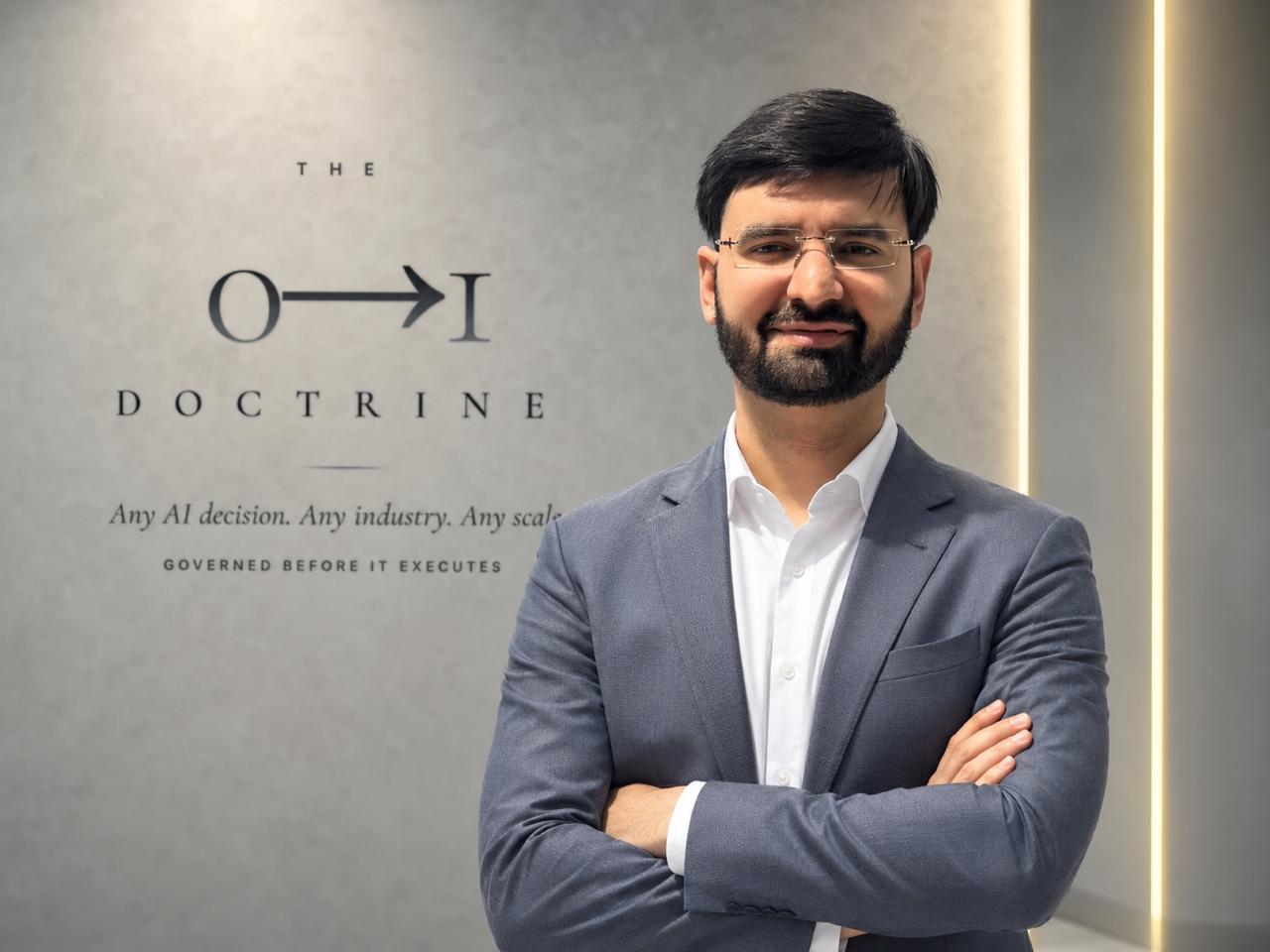
Vatsal Soin is a serial inventor, systems theorist, and entrepreneur. An alumnus of Nanyang Technological University, Singapore — reportedly ranked second globally for artificial intelligence in a recent U.S. News Best Global Universities ranking — his earlier inventions converged toward one destination — the 0→1 Doctrine.
Selected References
Granted: US Patent 12,446,652 B2 · Japan Patent No. 7560909 · India Patent No. 454081 · Filed: PCT/IN2025/051943 · US 19/489,595 · India 202511115781 · Australia AU2022450649
DISCLAIMER: Informational only. Not certified. No endorsement implied. Not investment advice. Expert validation required before deployment. Vatsal Soin · © 2026 All Rights Reserved
