

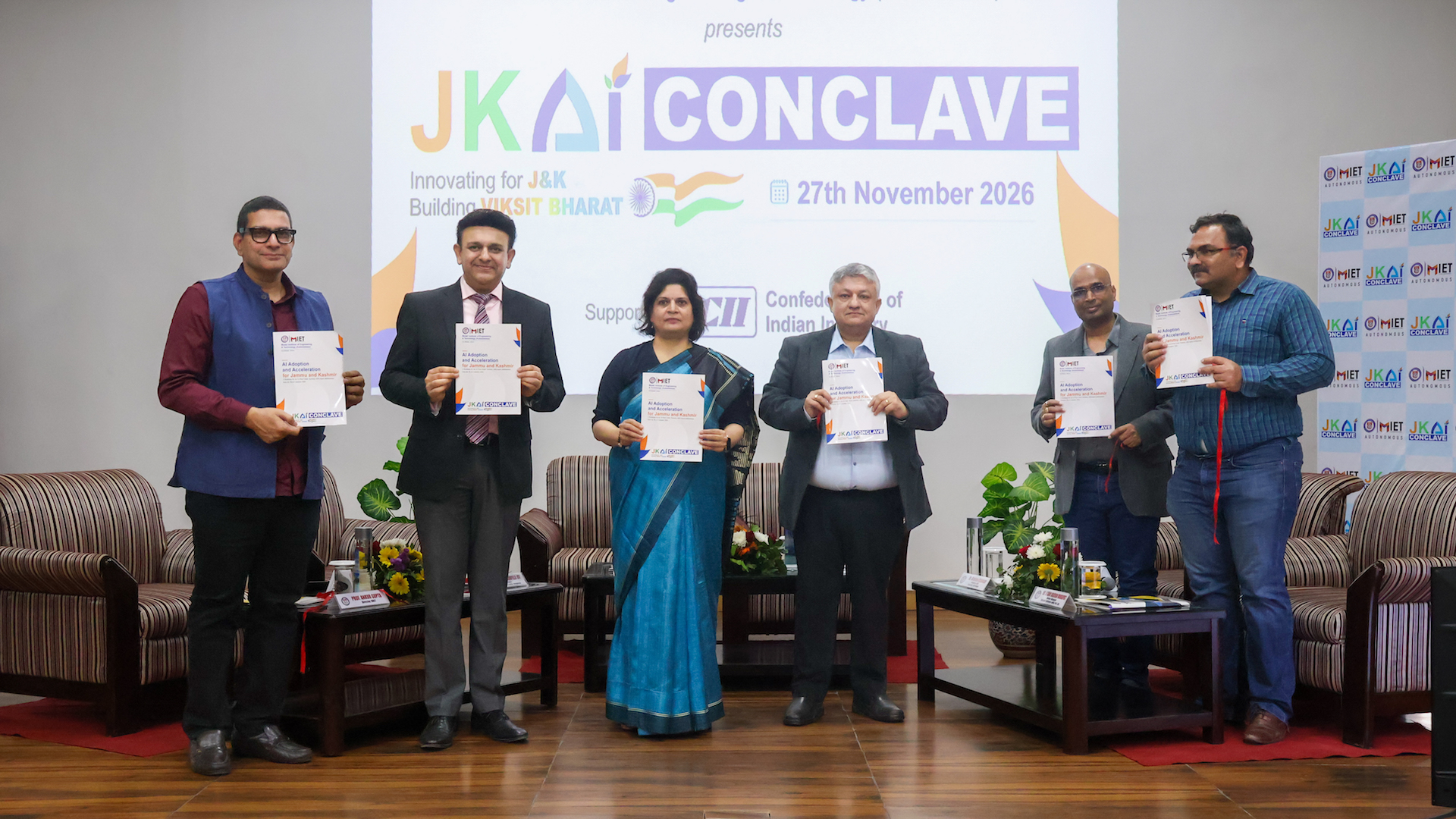
JAMMU: Model Institute of Engineering and Technology (MIET), Kot Bhalwal, hosted the first edition of the JK AI Conclave, bringing together leading artificial intelligence experts, senior government officials, industry representatives, academics, startups, faculty members and students to explore opportunities for accelerating AI adoption in Jammu and Kashmir.
Organised by MIET’s Department of Computer Science and Engineering with the support of the Confederation of Indian Industry (CII), the day-long event was held under the theme “Innovating for J&K, Building Viksit Bharat.” The major highlights included the release of a White Paper on AI Adoption in Jammu and Kashmir, presentation of AI Builder Awards and a panel discussion on accelerating the use of artificial intelligence across the Union Territory.
In his opening address, Prof. Ankur Gupta, Director, MIET, said the objective of the conclave was to develop local capacity and expertise in artificial intelligence, enabling people in Jammu and Kashmir to build, deploy and maintain AI solutions addressing the region’s specific needs. He announced that the conclave would become an annual event, with each edition assessing the progress achieved in the region over the preceding year.
The inaugural session featured keynote addresses by Dr Shailesh Kumar, Chief Data Scientist at Jio and Dean of the Jio Institute; Kashyap Kompella, Founder of RPA2AI Research; Vishnu Makkapati, Senior Manager, AI Engineering at Seismic; and Srinivas Chilukuri, Founder and CEO of TensorGo. Their presentations covered AI development at population scale, adoption by governments and enterprises, moving AI solutions from prototypes to production, and entrepreneurship in the Indian AI ecosystem.
Participants also explored an exhibition featuring more than 30 innovative AI projects and practical solutions, many developed by MIET students and faculty. The projects addressed diverse sectors, including transportation, building safety, apple sorting, vehicle management, personal health and well-being, eldercare, student counselling, legal services, quality assurance and pet lifecycle management.
The second session was attended by Babila Rakwal, IAS, Administrative Secretary, Department of Science and Technology, Government of Jammu and Kashmir, as Distinguished Guest, and Vishesh Paul Mahajan, JKAS, Transport Commissioner, as Guest of Honour.
The dignitaries released the White Paper on AI Adoption in Jammu and Kashmir, prepared by MIET following deliberations with experts during the conclave. The document outlines practical measures for adopting and accelerating artificial intelligence across different sectors in the Union Territory.
The AI Builder Awards recognised individuals and teams developing functional AI-based solutions, with 28 teams felicitated by the dignitaries. Vishesh Paul Mahajan appreciated MIET’s initiative and expressed hope that the conclave would give fresh momentum to AI development in the region.
In her address, Babila Rakwal described artificial intelligence as a transformative force and emphasised the need to equip the youth of Jammu and Kashmir with relevant skills while encouraging the development of solutions that serve society. She also expressed hope that future editions of the conclave would showcase further progress in the region’s AI ecosystem.
The afternoon session featured a panel discussion on “Accelerating AI Adoption in J&K”, moderated by Prof. Ankur Gupta. The panel included Prof. Uma Satyaranjan, Professor of Practice and Dean Outreach, IIT Jammu, along with Kashyap Kompella, Vishnu Makkapati and Srinivas Chilukuri.
The discussion focused on the future of education, the relevance of computer science, changing employment opportunities, priority sectors for AI adoption in Jammu and Kashmir, and the role educational institutions such as MIET can play in developing skilled AI professionals.
Representatives from CII J&K, AIIMS Jammu, IIM Jammu, IIT Jammu, Jammu Municipal Corporation, Reliance Jio, NIC, KPMG and the Army Centre of Excellence in AI were also present.
The conclave concluded with closing remarks and a vote of thanks to the speakers, dignitaries, institutional partners and participants.
