


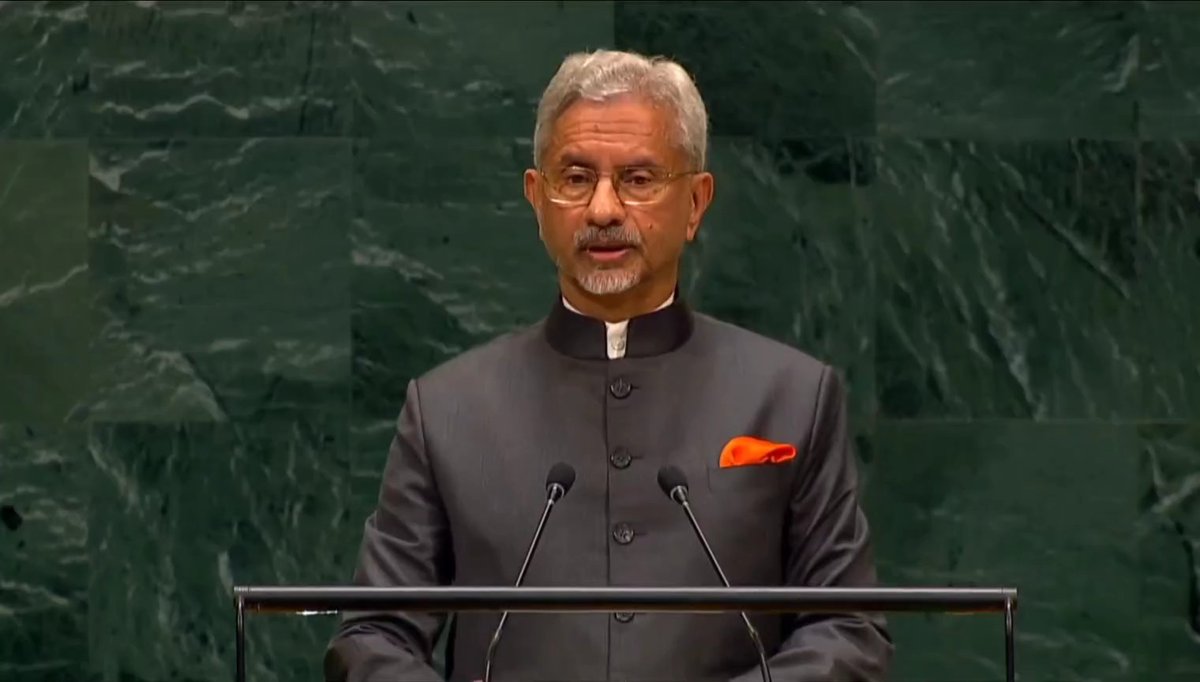
NEW YORK: External Affairs Minister S. Jaishankar used his address to the 81st session of the United Nations General Assembly to underline India’s position that terrorism, including state-sponsored cross-border terrorism, cannot be normalised or shielded from consequences.
Speaking at the UN headquarters, Jaishankar said attempts to misrepresent facts or invoke arguments to justify terrorism would not be accepted by India. “Our right to defend ourselves against terrorism will be exercised,” he said, while stressing that friendship and goodwill could not coexist with terrorism. His remarks came a day after Pakistan Prime Minister Shehbaz Sharif addressed the General Assembly.
Jaishankar also called for stronger international action against terrorism and its financing, arguing that governments supporting or enabling such activities should be held accountable. He described terrorism as a persistent threat to international peace and said the financial networks supporting terrorist activity needed particular attention.
India subsequently exercised its Right of Reply to Sharif’s address, with First Secretary at India’s UN mission Petal Gahlot rejecting Pakistan’s references to Jammu and Kashmir and accusing Islamabad of supporting cross-border terrorism. Gahlot also referred to Osama bin Laden, saying the mastermind of the September 11 attacks had been found living in Pakistan near the country’s premier military academy.
Sharif had raised the Kashmir issue during his UNGA speech and credited US President Donald Trump with what he described as intervention during the 2025 India-Pakistan conflict. He also argued that a resolution of the Kashmir issue was necessary to prevent a recurrence of conflict in South Asia.
In its response, India rejected Pakistan’s characterisation of the Kashmir issue and reiterated that continued terrorism would have consequences. Gahlot said India had demonstrated that terrorists would have “nowhere to run and nowhere to hide” and reaffirmed New Delhi’s right to defend itself against terrorism.
India’s remarks were delivered against the backdrop of the April 22, 2025, Pahalgam terror attack, which killed 26 people, followed by India’s military action under Operation Sindoor on May 7, 2025. New Delhi has maintained that its actions were in response to the attack and has rejected third-party mediation in India-Pakistan matters.
The exchange at the UN also highlighted the continuing divergence between the two countries over Jammu and Kashmir, terrorism and the events of 2025. While Pakistan continues to raise Kashmir at international forums, India maintains that cross-border terrorism must end and that it retains the right to respond in self-defence.
Pakistan has rejected India’s allegations and, in its own response, accused India of supporting militant groups operating against Pakistan.
The latest exchange at the General Assembly underscores the continuing diplomatic confrontation between New Delhi and Islamabad, with terrorism, Kashmir and the question of third-party intervention remaining central points of disagreement.
