


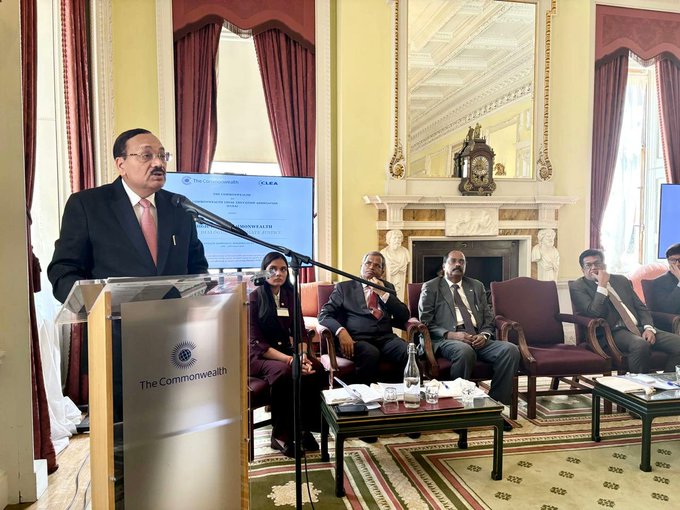
NEW DELHI: Countries that are still industrialising are being asked to rapidly shift to renewable energy and are often criticised for moving too slowly, even as nations now pushing for the transition built their economic strength over two centuries of coal and oil use, Chief Justice of India Justice Surya Kant has said.
Addressing the High-Level Commonwealth Policy Dialogue on Climate Justice at Marlborough House in London, CJI Kant on Friday said the global shift towards clean energy must account for the differing circumstances of countries and ensure that the burden of transition is distributed fairly.
He said the climate crisis presented “two faces” of the same injustice unequal vulnerability to climate change and the unequal costs of the transition to clean energy.
“Countries that are finally industrialising are being asked to move rapidly towards renewable power, and often made to bear the brunt of criticism when they cannot move fast enough. In comparison, the nations urging that transition spent two centuries building their own strength on coal and oil,” the CJI said.
Justice Kant also flagged the environmental and social costs associated with the minerals required for the clean-energy transition, including copper, cobalt and lithium.
He said the pursuit of a cleaner future must not result in “new forms of environmental hardship” for communities where these minerals are extracted.
The urgency of the transition, he stressed, must therefore be reconciled with fairness and the principle of shared responsibility.
The CJI said climate vulnerability itself was unequally distributed, with low-lying island states, flood-prone delta communities and drought-hit regions facing severe consequences. Small farmers and fishing communities, whose livelihoods depend directly on the natural environment, can suffer the loss of land, water and harvests despite having contributed little to the climate crisis.
He said courts had an important role in responding to these inequalities. Referring to India’s environmental jurisprudence, the CJI noted that the Supreme Court has over the years expanded the understanding of the right to life to address environmental harm and climate-related concerns.
The CJI called for greater judicial cooperation among Commonwealth countries, saying jurisdictions should learn from one another instead of developing separate approaches to every climate-related dispute.
The challenge, he said, was not merely to create new legal doctrine but to use existing legal tools more effectively while adapting solutions to the constitutional, social and environmental realities of individual countries.
“Rather, the Courts should be open to borrowing ideas, approaches, and solutions that have proved useful elsewhere in the Commonwealth, while adapting them carefully to their own constitutional, social, and environmental circumstances,” he added.
The CJI said climate change is forcing courts to move beyond traditional legal questions and increasingly grapple with science, technical data and policy choices, and called for greater collaboration between judges, scientists and policymakers.
“The role of a Judge is therefore changing; it is no longer enough to know what the law says; we must also understand the world to which that law is being applied,” said the CJI.
The CJI further said Courts were increasingly being asked to draw the difficult line between developmental necessity and ecological survival, often in the absence of clear legislative guidance.
“It’s no longer enough to know what the law says; we must also understand the world to which that law is being applied,” he said, pointing to disputes that can turn as much on hydrology and emissions data as on legal principles.
Justice Kant called for greater emphasis on climate and environmental issues in legal education, including collaboration with scientists and economists and opportunities for law students to engage with real environmental disputes.
