


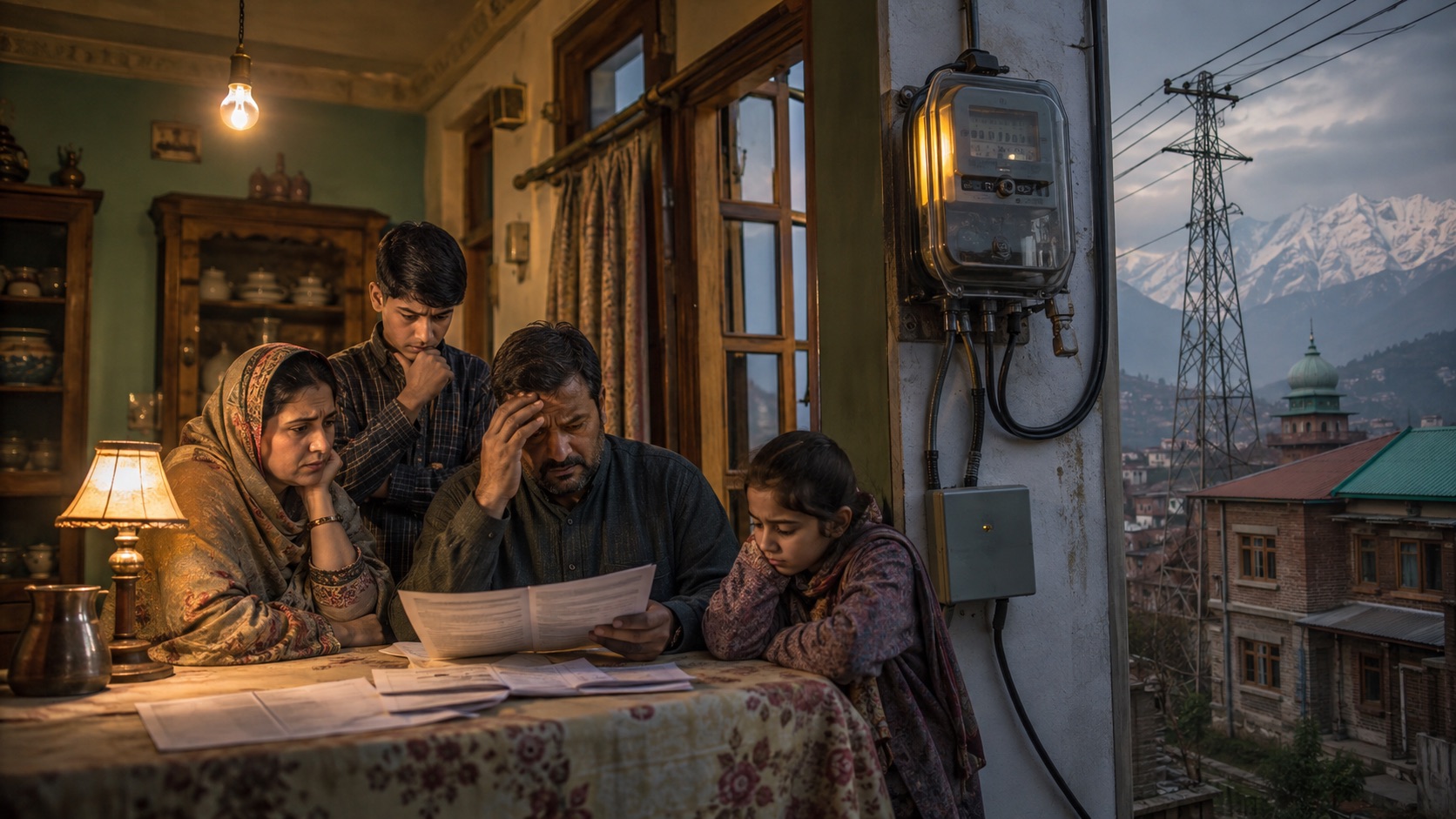
JAMMU: Electricity consumers across Jammu and Kashmir will have to pay more for power from September 1 after the Joint Electricity Regulatory Commission (JERC) approved revised retail tariffs for Jammu Power Distribution Corporation Limited (JPDCL) and Kashmir Power Distribution Corporation Limited (KPDCL) for 2026–27.
The tariff order, issued on August 20, provides for an average 6.83 per cent increase over the existing tariff. The revised rates will apply to electricity consumed from September 1, 2026, and remain in force till March 31, 2027, unless amended, modified or extended by the Commission.
While revising tariffs, JERC has retained concessional rates for domestic consumers, Below Poverty Line (BPL) households and small agricultural consumers. The order also rationalises industrial tariffs, introduces voltage-wise incentives and provides Time-of-Day benefits and surcharges for eligible consumers.
The final amount payable by a consumer will depend on the category, electricity consumption, sanctioned load and, for eligible larger consumers, the time at which electricity is used.
BPL Consumers to Pay ₹1.40 Per Unit
Eligible BPL domestic consumers using up to 30 units a month will pay an energy charge of ₹1.40 per unit, along with a fixed charge of ₹5 per kW per month.
The concession will be available only to consumers possessing a valid BPL certificate issued by the competent authority. Consumption beyond 30 units will be billed according to the applicable domestic tariff slabs.
For other metered domestic consumers, the energy charge has been fixed at ₹2.45 per unit up to 200 units, ₹4.20 per unit for 201 to 400 units and ₹4.60 per unit above 400 units.
The fixed charge for metered domestic consumers will be ₹10 per kW per month.
This means households crossing the 200-unit and 400-unit thresholds will enter higher tariff slabs, making the final bill dependent on both consumption and the applicable slab.
Concessional Tariff for Small Farmers
Agricultural consumers with connections up to 20 HP will be charged ₹1.05 per unit, with a fixed charge of ₹23 per HP per month.
For agricultural connections above 20 HP, the energy charge has been fixed at ₹6.30 per unit, while the fixed charge will be ₹47 per HP per month.
The lower rate for small agricultural consumers is aimed at protecting categories considered more vulnerable to tariff increases.
Commercial Tariff Revised
For single-phase Non-Domestic/Commercial consumers, the energy charge will be ₹3.75 per unit up to 200 units and ₹5.70 per unit above 200 units, with a fixed charge of ₹75 per kW per month.
Three-phase commercial consumers will pay ₹6.15 per kVAh, along with a fixed charge of ₹140 per kVA per month.
Commercial consumers having sanctioned load below 100 kW but supplied and metered at HT voltage will be eligible for a 5 per cent rebate on energy charges.
Industrial Consumers Get Voltage-Based Incentives
For LT industrial supply, the energy tariff has been fixed at ₹4.60 per kVAh, along with a fixed charge of ₹63 per kVA per month.
HT industrial consumers supplied at 11 kV will pay ₹4.50 per kVAh, besides a demand charge of ₹184 per kVA per month.
Industrial consumers drawing power at 33 kV will get an energy charge 10 paise per unit lower than the applicable 11 kV rate, while consumers supplied at 66 kV and above will receive a 20-paise-per-unit reduction compared with the 11 kV rate.
For Power Intensive Industries, the energy charge has been fixed at ₹5.30 per kVAh at 11 kV and ₹5.25 per kVAh at 33 kV, with a demand charge of ₹236 per kVA per month.
Supply at 66 kV and above will receive a further reduction of 10 paise per unit over the 33 kV rate.
Peak-Hour Surcharge, Solar-Hour Rebate
The revised tariff introduces a Time-of-Day (ToD) tariff for eligible consumers, excluding agricultural consumers, having sanctioned load or contract demand above 10 kW, subject to compatible metering and billing infrastructure.
Industrial and commercial consumers will face a 20 per cent surcharge during peak hours, while other eligible consumers will pay a 10 per cent peak-hour surcharge.
At the same time, eligible consumers will receive a 20 per cent rebate during solar hours.
The mechanism is intended to encourage consumers to shift electricity consumption away from peak-demand periods.
EV Charging at ₹7 Per kVAh
Electric vehicle charging and battery-swapping stations taking LT supply will be charged ₹7 per kVAh, with no demand charge.
However, privately owned electric vehicles charged at homes or other premises will continue to be billed under the tariff category applicable to those premises rather than the EV charging-station tariff.
Government departments using LT metered supply will pay ₹8.30 per kVAh.
General Purpose Bulk Supply at 11 kV has been fixed at ₹5.90 per kVAh, with a demand charge of ₹250 per kVA per month.
Railway traction supply at 11 kV will attract an energy charge of ₹5.70 per kVAh, along with a demand charge of ₹315 per kVA per month.
The Green Power Tariff will remain unchanged at ₹0.50 per kWh over and above the applicable category tariff.
Temporary Connections to Cost More
Temporary electricity connections will be billed at one-and-a-half times the tariff applicable to the relevant consumer category.
If a temporary connection continues beyond 12 months, twice the normal fixed or demand charges as well as energy charges will become applicable.
₹10,275.72-Crore Revenue Requirement Approved
JERC has approved a combined Annual Revenue Requirement (ARR) of ₹10,275.72 crore for JPDCL and KPDCL for 2026–27.
At the existing tariff, revenue was estimated at ₹7,352.87 crore, leaving a gap of ₹2,922.85 crore.
Following the tariff revision, expected revenue will rise to ₹7,854.94 crore, while the remaining ₹2,420.78 crore will be met through government subsidy and grant support.
JERC has observed that recovering the entire revenue gap through tariff alone could have required an increase of around 40 per cent, indicating that government support has helped limit the burden on consumers.
The Commission has approved an average power purchase cost of ₹4.88 per unit for 2026–27, projected at ₹4.73 per unit in 2027–28 and ₹4.78 per unit in 2028–29.
Distribution loss targets have been retained at 15 per cent for JPDCL and 19 per cent for KPDCL for the 2026–27 to 2028–29 control period, though the targets for the subsequent years may be reviewed based on actual performance.
The order also rationalises consumer categories and sub-categories in line with Revamped Distribution Sector Scheme norms, continues the Fuel and Power Purchase Cost Adjustment mechanism with quarterly reporting, and keeps miscellaneous charges unchanged.
JERC has also approved the Business Plan and Multi-Year Tariff framework for JPDCL and KPDCL for the period 2026–27 to 2028–29.
