


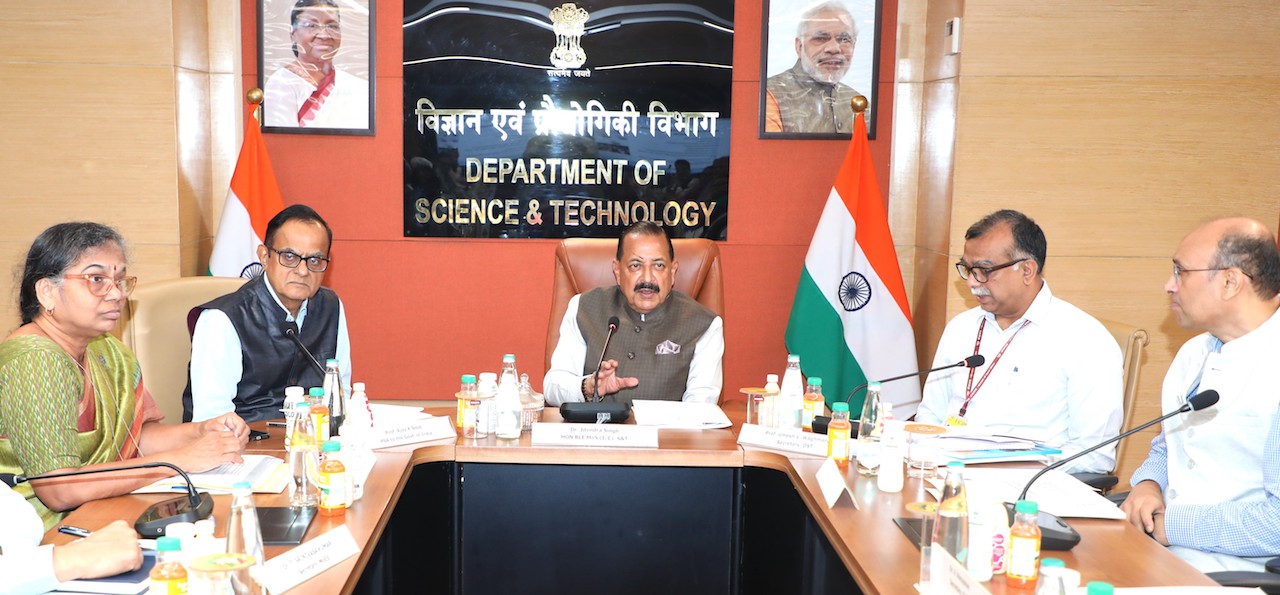
NEW DELHI: The monthly joint meeting of Science Secretaries chaired by Dr. Jitendra Singh, Union Minister of State (Independent Charge) for Science & Technology and Earth Sciences and MoS PMO, Personnel, Public Grievances, Pensions, Atomic Energy and Space, was marked by three important announcements.
Dr Jitendra Singh said that the RDI Fund ‘Conflict of Interest’ policy was protected by stringent safeguards to ensure protection of Taxpayers’ Money as well as private capital. However, he added that suggestions from stakeholders are most welcome and wherever feasible more safeguard could be considered.
During the meeting , Dr Jitendra Singh announced that the next round of RDI Fund disbursal was planned shortly.
The meeting was also informed that over 20 more Second Level Fund Managers are being appointed shortly, possibly within a month or so.
Dr Jitendra Singh reviewed the progress of the Research, Development and Innovation (RDI) Fund during a review meeting with Science Secretaries and directed that the disbursal process for the selected firms be expedited and timelines reduced to the minimum possible. Officials informed the Minister that the proposals of the selected firms have already undergone the required evaluation process and that the next stage of disbursal is expected to be completed within about two weeks or so.
During the review, the Minister was apprised that stringent protocols are being followed for both fund disbursement and conflict-of-interest safeguards to ensure transparency, fairness and accountability, given that the RDI Fund involves public money. He was also informed that the framework has robust mechanisms to protect the integrity of investment decisions, with further safeguards being considered wherever required.
The Minister noted that the RDI Fund carries a shared responsibility, as 50 per cent of the investment is expected to come from private equity sources, placing an equal responsibility on investment committees to safeguard both taxpayers’ money and private capital. He emphasised that while due diligence and verification processes must remain uncompromised, timely release of funds is equally important to enable firms to move forward. He directed officials to adopt faster timelines and make the disbursal process more responsive in the future.
Dr. Jitendra Singh was chairing the Monthly Review Meeting of Science Ministries and Departments at Aryabhatta Hall, Technology Bhawan, New Delhi. The meeting was attended by Prof. Umesh V. Waghmare, Secretary, Department of Science & Technology; Dr. Rajesh S. Gokhale, Secretary, Department of Biotechnology; Dr. N. Kalaiselvi, Secretary, Department of Scientific and Industrial Research and Director General, CSIR; Dr. Srinivasa Kumar Tummala, Secretary, Ministry of Earth Sciences; Dr. V. Narayanan, Secretary, Department of Space and Chairman, ISRO; Shri Rajesh Kumar Pathak, Secretary, Technology Development Board; and the CEO, Anusandhan National Research Foundation (ANRF), besides other senior officials.
The Minister’s direction on RDI processing comes at a time when the Government is seeking to create a more competitive and responsive environment for private-sector participation in research and development. During the review, it was informed that the first round of application assessment had already been completed and positive recommendations were ready in respect of eligible applications. The emphasis was on moving the proposals through the remaining stages without avoidable delay, while retaining the scrutiny required before public funds are released.
The RDI initiative assumes particular significance as a first-of-its-kind Government effort to accelerate private investment in R&D by providing public funding support. The meeting noted that the first cycle is also expected to help the mechanism move towards a smoother and more efficient mode in subsequent cycles. At the same time, the Government is conscious that private-sector participation is a new experience within such a public funding framework and therefore requires a balance between speed, responsibility and stakeholder confidence.
Dr. Jitendra Singh also reviewed proposals to widen the scope of strategic areas covered under the RDI framework, based on consultations with Ministries and expert deliberations. The expansion is intended to cover areas of emerging strategic importance while remaining within the framework of the RDI guidelines. The discussions also recognised the rapidly changing nature of technologies, particularly Artificial Intelligence, requiring the innovation-support ecosystem to remain sufficiently flexible to accommodate new and emerging fields.
The meeting further reviewed measures to strengthen inter-departmental collaboration and information sharing across the science and technology ecosystem. The Secretaries and departments have been encouraged to maintain regular interaction, identify areas of mutual interest and develop greater synergy among scientific institutions and programmes. Periodic institutional interactions involving CSIR and other scientific organisations are also being pursued to strengthen collaboration and avoid duplication.
The review also took stock of the progress of Sah-SANKALP, the resource book showcasing technologies developed through Government-supported scientific research. Of the 60 technologies featured in the initiative, 56 have already been deployed at the grassroots level, while 41 have reached Technology Readiness Levels of 8 or 9, indicating strong potential for wider adoption. CSIR has also reported interest from enterprises and entrepreneurs in adopting 38 technologies showcased during the initiative, with technology seekers being connected to the relevant laboratories for further action.
A significant part of the meeting focused on making the communication of scientific achievements more direct, contemporary and accessible. The Minister stressed the need for greater coordination among the communication and social-media teams of different science departments so that important achievements, technology transfers, industry collaborations and societal interventions receive sustained visibility. The discussions also favoured greater use of short-form digital content and platforms that can directly reach citizens, industry and potential technology users.
The proposed digital library of science and technology success stories was also discussed as a means of creating a common, easily shareable repository of validated content from different departments and laboratories. The proposed approach envisages short videos of around two to three minutes, enabling laboratories and institutions across the country to contribute directly while making scientific achievements more accessible to wider audiences.
Preparations for the Emerging Science, Technology and Innovation Conclave (ESTIC) 2026, scheduled from October 27 to 29 at Bharat Mandapam, New Delhi, were also reviewed. Three Nobel Laureates and three other distinguished international award recipients have confirmed participation, while additional confirmations are expected. The exhibition is being expanded to up to 150 stalls, including participation from Ministries and Departments, an ESTIC Innovation Booth, major sponsors and selected deep-tech startups. More than 120 invitations have been issued, with 73 acceptances received so far.
The meeting also reviewed preparations for the Swachh Sagar Surakshit Sagar (SSSS) Campaign 2026, scheduled from September 12 to 19, with activities planned across 111 identified beaches. Participation from fisherfolk, universities, colleges, NCC, NSS, Scouts and Guides, voluntary organisations and private stakeholders is being facilitated. A dedicated website, dashboard and mobile application have already been created, while the campaign is being supported through digital outreach, competitions and the Ocean Olympiad.
The meeting further reviewed initiatives to strengthen public engagement with science, including the proposed monthly ‘Vigyan Ki Baat’ lecture series beginning August 29 and science- and innovation-based competitions and quizzes in collaboration with MyGov. These initiatives are aimed at creating a stronger interface between scientific institutions, citizens, young researchers and the wider innovation ecosystem.
The review meeting reflected the Government’s broader approach of combining speed in RDI delivery with rigorous safeguards in the use of public funds. With private investment emerging as an increasingly important component of India’s R&D ecosystem, the Government is working to ensure that promising startups and private innovators receive timely support while public resources remain protected through robust verification, transparency and conflict-of-interest safeguards.
