


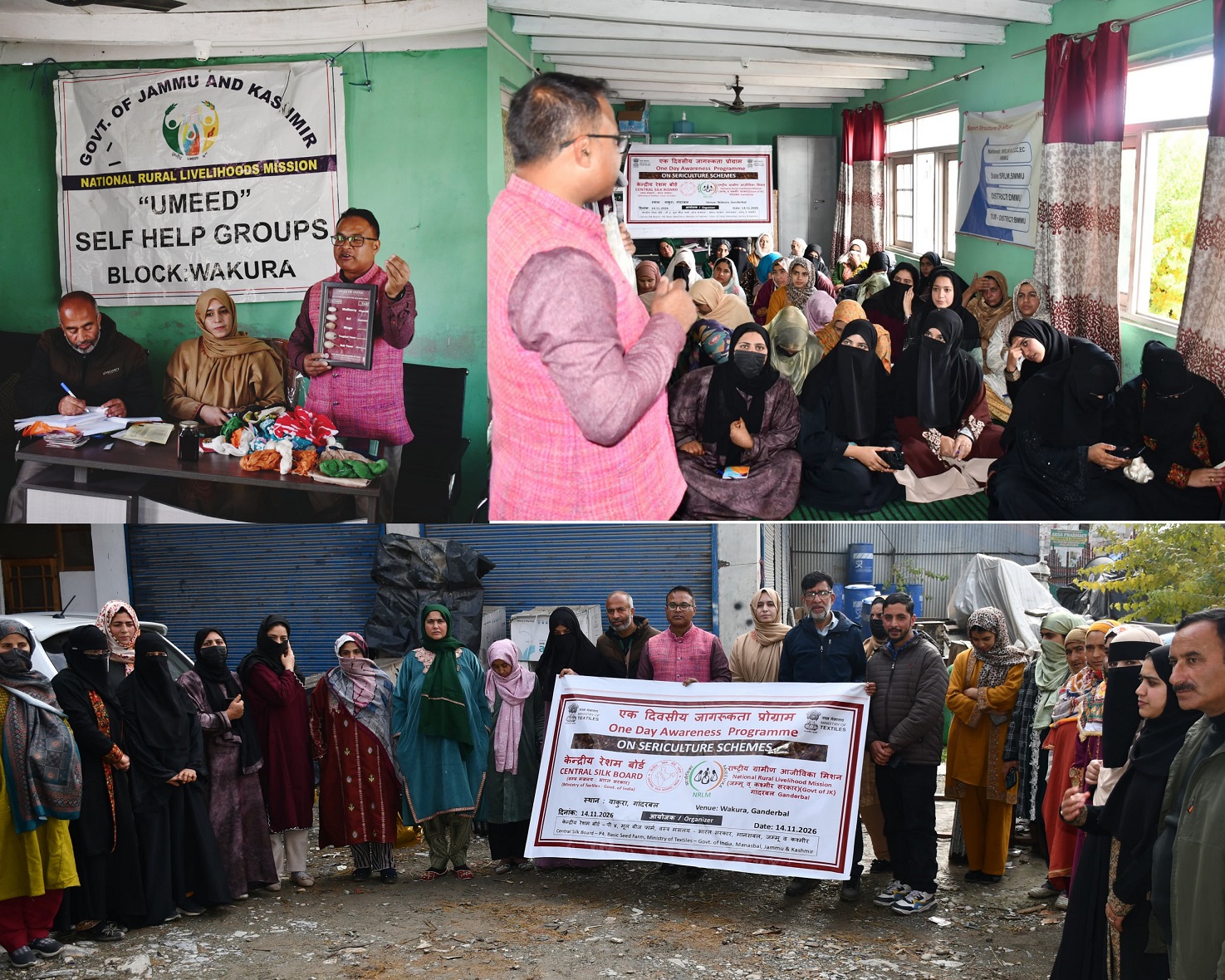
GANDERBAL: Jammu & Kashmir Rural Livelihood Mission (JKRLM), Block Wakura, in collaboration with the P4 Basic Seed Farm, Central Silk Board (CSB), Manasbal, today organised an awareness programme on the field scope and economic importance of sericulture for 50 Self-Help Group (SHG) members associated with JKRLM Block Wakura.
The day long awareness programme aimed to introduce SHG members to sericulture as a practical, skill-based livelihood option and familiarise them with the technical and financial support available for adopting the enterprise.
Delivering the keynote address, Dr. Rajesh Kumar, Scientist-D and Unit In-Charge of P4 Basic Seed Farm, Manasbal, said Ganderbal’s agro-climatic conditions are highly conducive to bivoltine silk production, which is renowned for its superior quality. He described sericulture as a low-investment, high-return, home-based enterprise capable of empowering women and generating supplementary household income, as much of the work can be managed at home alongside routine domestic responsibilities.
Dr. Kumar also briefed the participants on scientific rearing practices, covering the key stages of silkworm rearing, from the maintenance of mulberry plants, which serve as the silkworms’ primary feed, to the harvesting of cocoons. He further detailed the financial and technical assistance available to beneficiaries under the Silk Samagra-2 scheme and urged the women to avail themselves of these benefits.
Participants were also informed about the importance of ensuring the purity of silk through the Silk Mark label. A hologram-based quality assurance mark promoted under the aegis of the Central Silk Board, the Silk Mark certifies products made of pure natural silk. It helps consumers identify genuine silk and avoid synthetic imitations, while building buyer trust and supporting better market value for authentic silk products.
Speaking on the occasion, Block Programme Manager (BPM) Wakura, Madina Bukhari, stated that the initiative seeks to diversify rural livelihoods by connecting SHG members with sustainable, skill-based sectors like sericulture. She noted that this goal would be achieved through continued awareness, technical orientation and upcoming 3 days training program at Manasbal farm, allowing participants to observe rearing practices first-hand.
During the interactive session, participants clarified their doubts with the experts regarding initial investment, rearing requirements and the marketing of cocoons.
The organisers expressed hope that the programme would motivate more SHG members across the block to adopt sericulture as a reliable source of regular income.
