


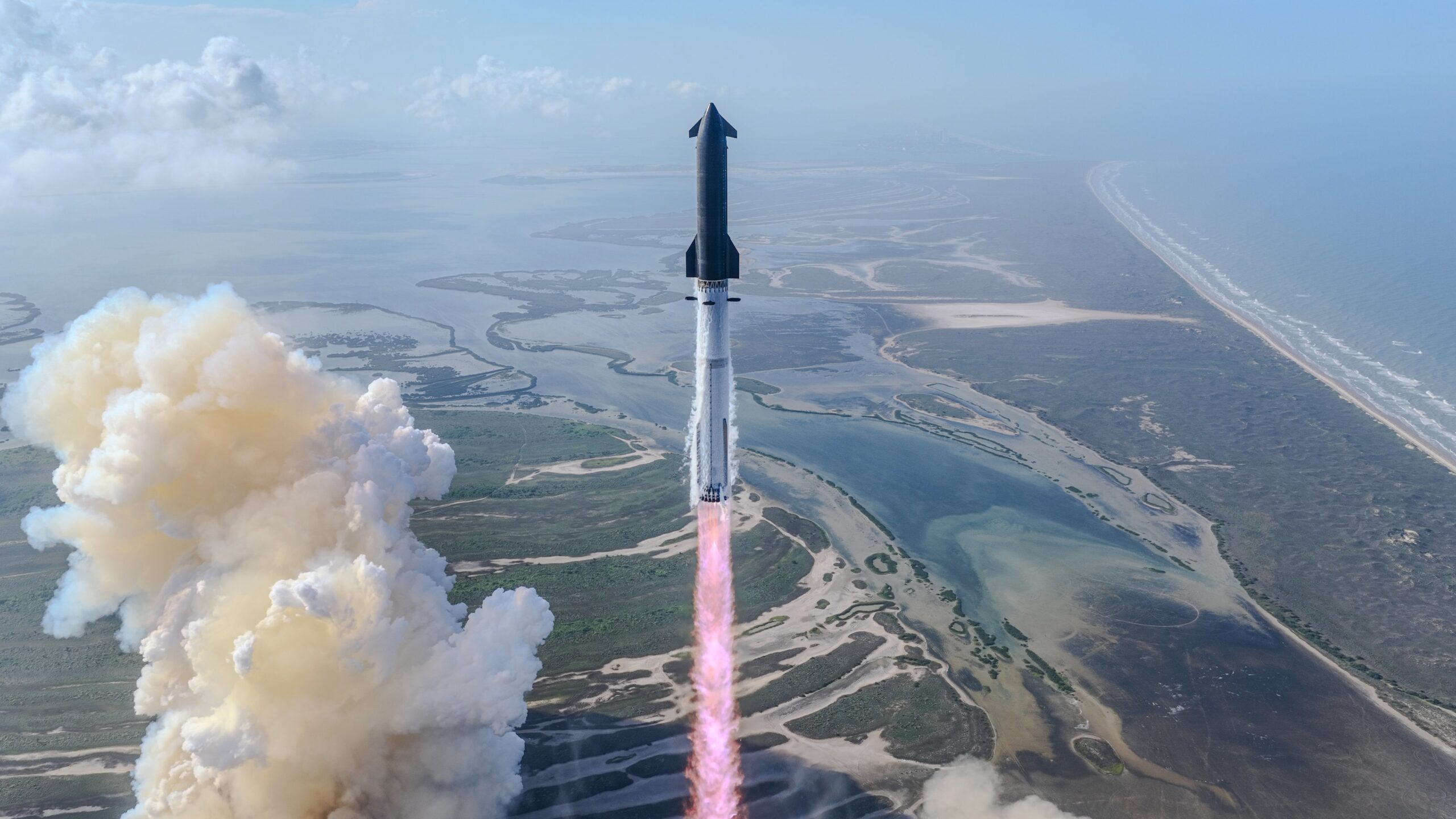
SpaceX successfully launched the twelfth test flight of its next-generation Starship on Friday evening (local time), marking the first-ever flight of the upgraded Starship and Super Heavy Version 3 vehicles and the debut of the company’s new Raptor 3 engines.
According to the SpaceX press release, the mission lifted off from Starbase, Texas, at 5:30 pm CT and also marked the first Starship launch from the company’s new Pad 2 facility.
The flight began with all 33 Rapotor 3 engines on the Super Heavy booster igniting successfully as the vehicle ascended over the Gulf of America. SpaceX said that one engine shut down during ascent, but the booster completed its first-stage climb and successfully executed a hot-staging manoeuvre, allowing Starship’s upper stage to continue toward space using its six Raptor engines.
Following stage separation, the Super Heavy booster performed a directional flip manoeuvre and attempted a boostback burn. However, according to the company, it was “unable to light all planned engines” and completed only a partial boostback burn before later experiencing a hard splashdown in the Gulf of America during its landing attempt.
During ascent, Starship also lost one of its vacuum-optimised Raptor 3 engines but maintained its planned trajectory and demonstrated “engine-out capability.”
SpaceX said the mission successfully deployed 20 Starlink simulators and two modified Starlink satellites designed to image Starship in space, the first time such a deployment has occurred during a Starship test flight.
The spacecraft later re-entered Earth’s atmosphere and gathered critical data on heatshield performance and structural integrity. In the final phase of flight, engineers intentionally stressed the vehicle’s rear flaps and tested a dynamic banking manoeuvre intended to simulate future return trajectories to Starbase.
Starship eventually guided itself to a planned splashdown zone in the Indian Ocean, where it completed a landing flip manoeuvre, landing burn, and splashdown using two Raptor engines.
