


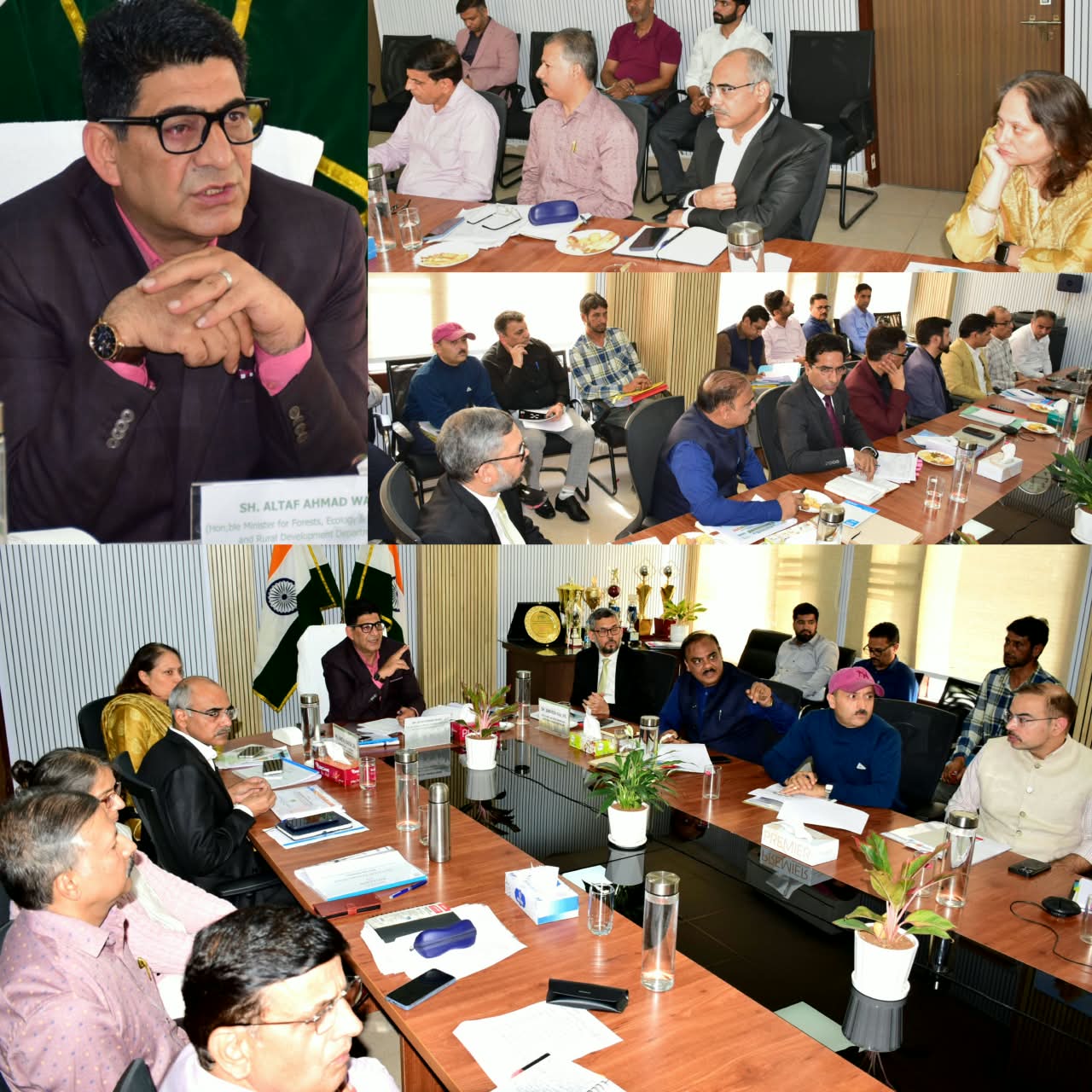
JAMMU: Minister for Forests, Ecology & Environment, Rural Development and Panchayati Raj,Altaf Ahmad Wani, today said that Jammu and Kashmir is blessed with a unique natural heritage and its protection is not merely a departmental duty but a collective responsibility of the government and the people.
The Minister was speaking during a detailed review meeting of the Wildlife Protection Department and J&K Forest Research Institute (JKFRI) at the PCCF / HoFF office, Jammu.
The meeting was attended by Sheetal Nanda, Commissioner Secretary, Forest, Ecology & Environment; Sarvesh Rai, Principal Chief Conservator of Forests & Head of Forest Force, J&K, Vasu Yadav, Chairman, PCC, Dr. Suneesh Buxy, Chief Wildlife Warden, J&K and Director, JKFRI, Regional Wildlife Wardens, DFOs and other senior officers.
Reviewing functioning of the department, the Minister said that J&K is home to some of the rarest species in the world. “Hangul is found nowhere else in the world. It is our pride, our identity. We cannot afford to lose it,” he said, directing the department to take up Hangul conservation on mission mode with scientific monitoring and habitat improvement.
The Minister was informed that J&K has a Protected Area Network of 50 Protected Areas covering 4,861.282 sq km across 20 districts including 4 National Parks, 14 Wildlife Sanctuaries, 16 Conservation Reserves and 16 Wetland Reserves. Besides, Eco-Sensitive Zones for 10 Protected Areas including Jasrota, Rajparian, Ramnagar, Hirpora, Surinsar-Mansar, Gulmarg, Kazinag, Kishtwar High Altitude National Park, Dachigam-Overa-Aru and Tral have been notified.
The Minister was apprised that J&K is home to 4,440 plant, 111 mammal, 608 bird, 68+ reptile, 14 amphibian, 308+ butterfly and 100+ fish species. Birds alone account for 44 percent of India’s bird diversity. The UT has 10 rare and endangered species including 4 Critically Endangered including Hangul, Kashmir Musk Deer, Markhor and Asiatic Ibex.
Expressing deep concern over human-wildlife conflict, the Minister said, “One human life lost is a tragedy for the family. Protecting human life must come first while also protecting wildlife. Both are possible if we respond on time.”
Directing the department to strengthen the response system, the Minister said Rapid Response Teams must reach the spot without delay, compensation must be paid on time and early warning systems and awareness camps must be held in every vulnerable village with the help of Panchayats.
He directed the department to prepare a compendium on J&K specific wildlife, flora and fauna in consultation with the experts. This will help in properly documenting the rich biodiversity of Jammu and Kashmir for the researchers, students and the public.
While reviewing the functioning of JK Forest Research Institute( JKFRI), the Minister said that science is the backbone of forest conservation and research must not remain in files and laboratories rather should reach the forests, the farmer and the common man. He directed the JKFRI to strengthen coordination with the Forest Department, farmers and industry and ensure that research outcomes translate into income for the local people and better protection of forests.
The Minister was apprised that JKFRI has developed two Seed Banks at Jammu and Srinagar for proper storage of seeds of forest tree species collected from Seed Production Areas.. It was further informed that JKFRI has developed protocols for cultivation of important medicinal plants including Kuth, Tilpushpi, Mushkwala, Pushkarmul, Angur Shefa and Shinglimingli. It has also inventoried and mapped medicinal plants in both Jammu and Kashmir regions and raised their germplasm in JKFRI nurseries.
Emphasising participatory development, the Minister said the concerned MLA must be taken on board wherever works are executed in a district. The public representatives understand the ground realities more deeply and their involvement will ensure transparency and better execution, added the Minister.
Appreciating the geo-tagging work, the Minister was informed that around 30,000 Chinar trees across J&K have been geo-tagged and a digital database has been created. Besides, QR-enabled metal plates have been installed on 10,000 prominent Chinar trees in Kashmir and 3,500 QR plates on Peepal and Bargad trees in Jammu. In the second phase, geo-tagging of left-over Chinar, Bargad and Peepal trees will be completed.
